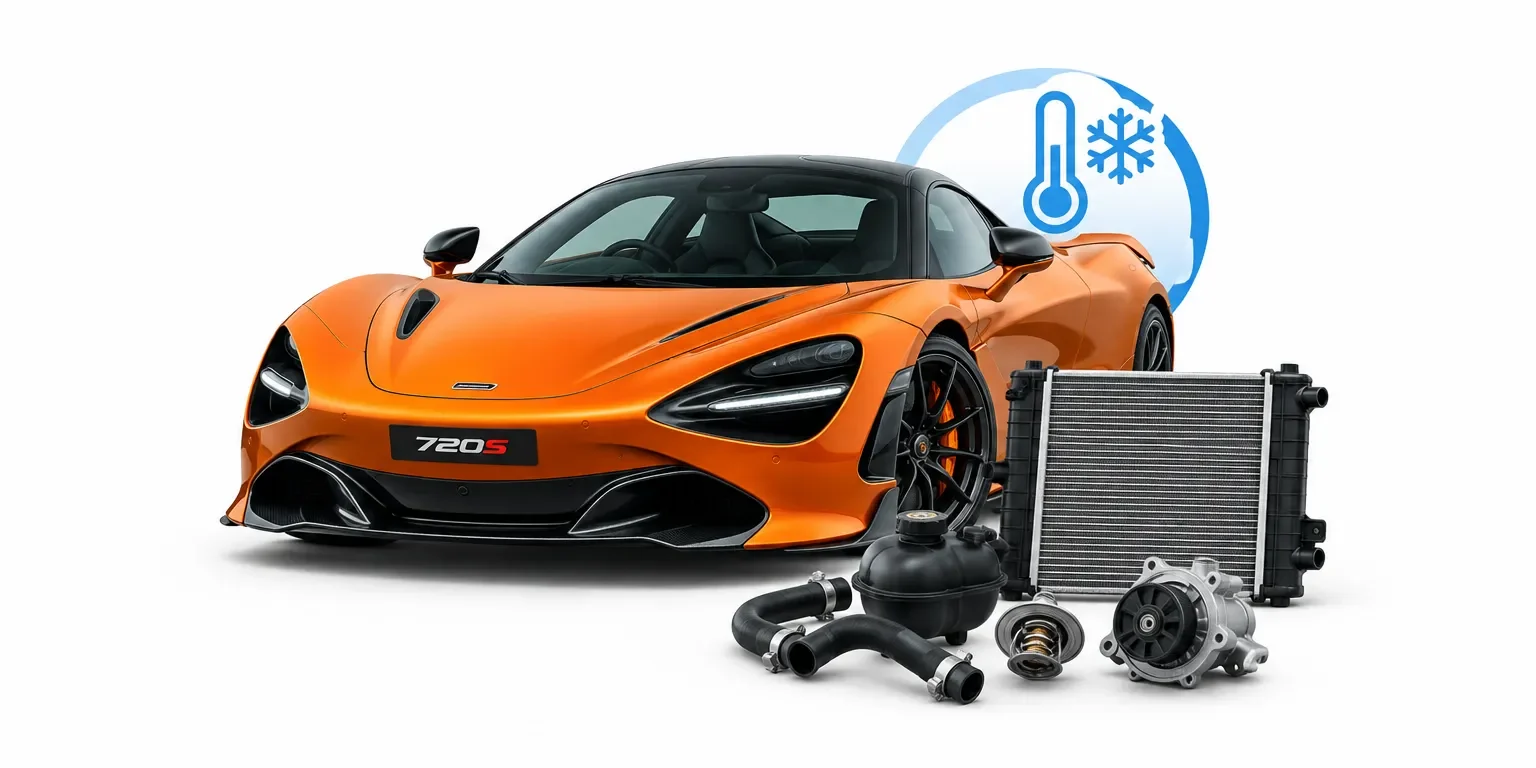
A McLaren 720S is built for high performance, but its cooling system has to work perfectly to keep that performance safe. In Dubai, high ambient temperatures, traffic, and long periods of idling can put even more demand on the cooling system.
If your 720S shows a rising water temperature, coolant warning, coolant loss, or unusual heat from the engine area, do not treat it as a minor issue. McLaren 720S cooling system repair requires proper diagnosis because a small cooling fault can develop into expensive engine damage.
In this guide, we will explain the main cooling problems, warning signs, professional diagnostic process, and why specialist repair matters for a McLaren 720S in Dubai.
Why Is the McLaren 720S Cooling System So Important?
The McLaren 720S uses a high performance twin turbocharged V8 engine, which produces substantial heat during normal and spirited driving. The cooling system must control engine temperature and remove heat efficiently under changing driving conditions.
The McLaren owner’s handbook specifically warns drivers to take action when the water temperature becomes excessive. If the temperature gauge reaches the red zone, the vehicle should be stopped as soon as safety permits and professional assistance should be contacted.
The cooling system is not simply a radiator and some coolant. It involves multiple components working together, including radiators, coolant hoses, pumps, fans, sensors, the header tank, and temperature control components.
A fault in one part can affect the performance of the entire system.
What Are the Common McLaren 720S Cooling System Problems?
A 720S cooling problem can appear in several ways. Some faults are easy to notice, while others develop slowly.
Common symptoms include:
- Rising water temperature
- Coolant warning on the dashboard
- Low coolant level
- Visible coolant leaks
- Coolant smell after driving
- Cooling fans running excessively
- Engine temperature increasing in traffic
- Temperature becoming unstable during hard driving
- Steam or visible coolant around the engine area
- Reduced performance caused by excessive engine temperature
One important point is that coolant loss should never be ignored. McLaren’s handbook advises owners not to drive the vehicle if it is losing coolant and to contact a qualified McLaren service provider.
Why Is Dubai Heat a Concern for the McLaren 720S?
Dubai creates a demanding environment for any performance vehicle. High outside temperatures reduce the cooling system’s ability to reject heat, while traffic can reduce natural airflow through the radiators.
For example, a 720S may maintain normal temperature while travelling on Sheikh Zayed Road but show a temperature increase after spending 20 or 30 minutes in heavy traffic. That difference is an important diagnostic clue.
A technician should investigate whether the problem is related to coolant flow, radiator efficiency, fan operation, a leak, or another component rather than simply assuming the vehicle needs more coolant.
What Does Professional McLaren 720S Cooling System Repair Include?
Professional cooling system repair starts with diagnosis, not parts replacement.
A technician may inspect:
- Coolant level and condition.
- Cooling system hoses and connections.
- Radiators and visible damage.
- Cooling fans and fan operation.
- Water temperature readings.
- Coolant pressure and possible leaks.
- Water pump operation.
- Header tank and related connections.
- Cooling system fault codes.
- Evidence of an internal engine coolant problem.
McLaren service information also shows that cooling system work requires dedicated procedures and equipment. The documented 720S coolant procedure includes pressure testing and checking areas such as the water pump, oil cooler, transmission oil cooler, and associated pipes.
This is why a basic coolant top up is not always a repair.
How Do You Know If Your McLaren 720S Is Overheating?
A McLaren 720S may be overheating if the water temperature rises above its normal range, a coolant warning appears, the temperature gauge enters the high range, or coolant is being lost. If the gauge reaches the red zone or the vehicle displays an overheating warning, stop driving as soon as it is safe and arrange professional inspection.
Do not continue driving simply because the vehicle still feels normal. Modern performance engines can continue operating while temperatures are already outside the safe range.
Real Workshop Style Case Example: Temperature Rises in Traffic
Consider a common diagnostic situation.
A McLaren 720S owner notices that the temperature remains normal while driving at highway speed but begins to rise while sitting in Dubai traffic. There is no obvious coolant puddle underneath the car.
Instead of replacing the radiator immediately, a technician should reproduce the condition and check cooling fan operation, coolant temperature data, radiator airflow, coolant level, and system pressure.
If the fans are not providing the required airflow at low vehicle speed, the problem can appear mainly in traffic. If the fans work correctly, the technician then moves to other possible causes.
The important lesson is that the symptom tells the technician where to investigate. It does not automatically identify the failed part.
Real Workshop Style Case Example: Repeated Coolant Loss
Another situation is a 720S that needs coolant topping up repeatedly.
The owner may assume that the coolant level is simply dropping because of Dubai’s heat. That is not a proper diagnosis.
A professional inspection should look for external leaks and pressure loss around the cooling system. McLaren service information specifically describes pressurising the system and checking areas including the water pump, engine oil cooler, transmission oil cooler, and related pipes.
If an external leak cannot be found, further testing may be needed to determine whether the coolant is escaping internally.
This is where proper diagnosis can prevent repeated coolant top ups from becoming a much larger engine repair.
Real Workshop Style Case Example: Coolant Level Looks Fine but Temperature Rises
A third situation can be more difficult.
The coolant level appears correct when the engine is cold, but the temperature still rises during hard acceleration or extended driving. In this situation, a technician should not assume that the coolant level proves the cooling system is healthy.
Coolant circulation, radiator efficiency, fan operation, temperature readings, trapped air, restrictions, and pump performance may all need to be considered.
The McLaren 720S service documentation includes dedicated high temperature cooling procedures and specialised coolant filling and displacement equipment, showing why correct servicing is more involved than simply opening the reservoir and adding fluid.
Why Should You Avoid a Basic Coolant Top Up?
Adding coolant can temporarily correct a low reservoir level, but it does not necessarily repair the reason the coolant became low.
For example, if a hose connection is leaking, topping up the coolant only hides the symptom for a short time.
There is also a risk of using an incorrect coolant or incorrect concentration. McLaren documentation specifies the required coolant type and concentration, and warns that an incorrect mixture can reduce cooling efficiency.
For a high performance vehicle such as the 720S, the correct fluid, filling method, pressure testing, and bleeding procedure all matter.
How Does a Professional Technician Diagnose a 720S Cooling Problem?
A proper inspection normally follows a logical sequence.
Step 1: Listen to the Driver
When does the temperature rise?
Does it happen in traffic, during highway driving, after hard acceleration, or shortly after starting the engine?
This information can significantly narrow the diagnostic path.
Step 2: Perform a Visual Inspection
The technician checks the coolant level, hoses, connections, radiator areas, header tank, and visible signs of coolant leakage.
Step 3: Scan the Vehicle
Electronic diagnostics can help identify stored faults and provide temperature or sensor information that cannot be confirmed through a visual inspection alone.
Step 4: Test the Cooling System
Pressure testing can help identify leaks that are not immediately visible.
Step 5: Check Cooling Performance
Fan operation, coolant circulation, temperature behaviour, and radiator performance should be evaluated.
Step 6: Confirm the Repair
After the repair, the vehicle should be checked again under suitable operating conditions to make sure the original symptom has been resolved.
This diagnostic approach is also consistent with the general process recommended by Car Repair Auto Service for engine problems in Dubai, where diagnosis and physical inspection are performed before recommending repairs.
Why Professional McLaren 720S Repair Matters
A McLaren 720S is not a vehicle where guessing is a good repair strategy.
A mechanic who simply sees a high temperature reading and replaces a component without testing can leave the actual problem unresolved.
Professional repair provides several important advantages:
- Correct fault identification
- Proper cooling system testing
- Appropriate diagnostic equipment
- Correct coolant and service procedures
- Inspection for hidden leaks
- Reduced risk of unnecessary parts replacement
- Better protection against secondary engine damage
The McLaren documentation itself includes dedicated cooling system procedures and specialised tools, including vacuum filling and coolant displacement testing equipment.
How Car Repair Auto Services Can Help in Dubai
Car Repair Auto Services provides diagnostic and repair services for vehicles in Dubai, including engine diagnostics, cooling system inspection, and other mechanical repairs.
For a performance vehicle such as a McLaren 720S, the important part is not simply replacing a component. The workshop should first understand what is causing the temperature problem.
You can explore the company’s broader engine diagnostics and repair service information to understand how diagnostic inspection works.
For other cooling and mechanical problems, you can also review the Car Repair Auto Service .
If your McLaren is showing overheating symptoms, coolant loss, or a temperature warning, an inspection is a better starting point than repeatedly topping up the coolant.
McLaren 720S Cooling System Repair: What Should You Do First?
If your 720S shows a cooling warning or the temperature is rising, take the symptom seriously.
Do not open a hot cooling system. The McLaren service procedure specifically warns that the cooling system is pressurised when hot and that opening it can cause serious burns.
The safer approach is to stop the vehicle when appropriate, allow it to cool, and arrange professional diagnosis.
If coolant is visibly leaking or the temperature reaches an excessive level, avoid continuing to drive the vehicle.
Frequently Asked Questions
How much does McLaren 720S cooling system repair cost in Dubai?
The cost depends on the actual fault. A coolant leak, hose, sensor, fan problem, radiator issue, water pump problem, or more serious engine fault can require very different repairs. A proper inspection is needed before giving an accurate repair estimate.
Can I drive my McLaren 720S if the coolant level is low?
It is not advisable to continue driving if the vehicle is losing coolant. McLaren’s owner’s handbook specifically advises owners not to drive the vehicle if it is losing coolant and to contact a McLaren service provider.
Why does my McLaren 720S get hot in traffic but stay normal on the highway?
This pattern can point toward an airflow or cooling performance issue because the vehicle receives less natural airflow when stationary. Cooling fan operation, radiator condition, coolant circulation, and other components should be tested before identifying the exact cause.
What coolant does a McLaren 720S use?
McLaren documentation specifies Mobil Extra Antifreeze and provides specific guidance for coolant concentration. The exact service procedure should follow the requirements for the vehicle’s model year and market.
Is a coolant top up enough to fix overheating?
Not necessarily. A low coolant level is a symptom, not always the root cause. If coolant is disappearing, the system should be checked for leaks and other faults before the vehicle is returned to normal driving.
Final Thoughts
The McLaren 720S cooling system plays a critical role in protecting one of the most important parts of the car, its high performance engine. Dubai’s heat and traffic make cooling system condition even more important.
If you notice rising temperature, coolant loss, warning messages, or unusual cooling fan behaviour, do not wait for the problem to become an engine repair.
Professional McLaren 720S cooling system repair should begin with accurate diagnosis, pressure testing, component inspection, and correct service procedures.
If your 720S is showing cooling problems in Dubai, Car Repair Auto Services can inspect the vehicle and help identify the actual cause before unnecessary parts are replaced.