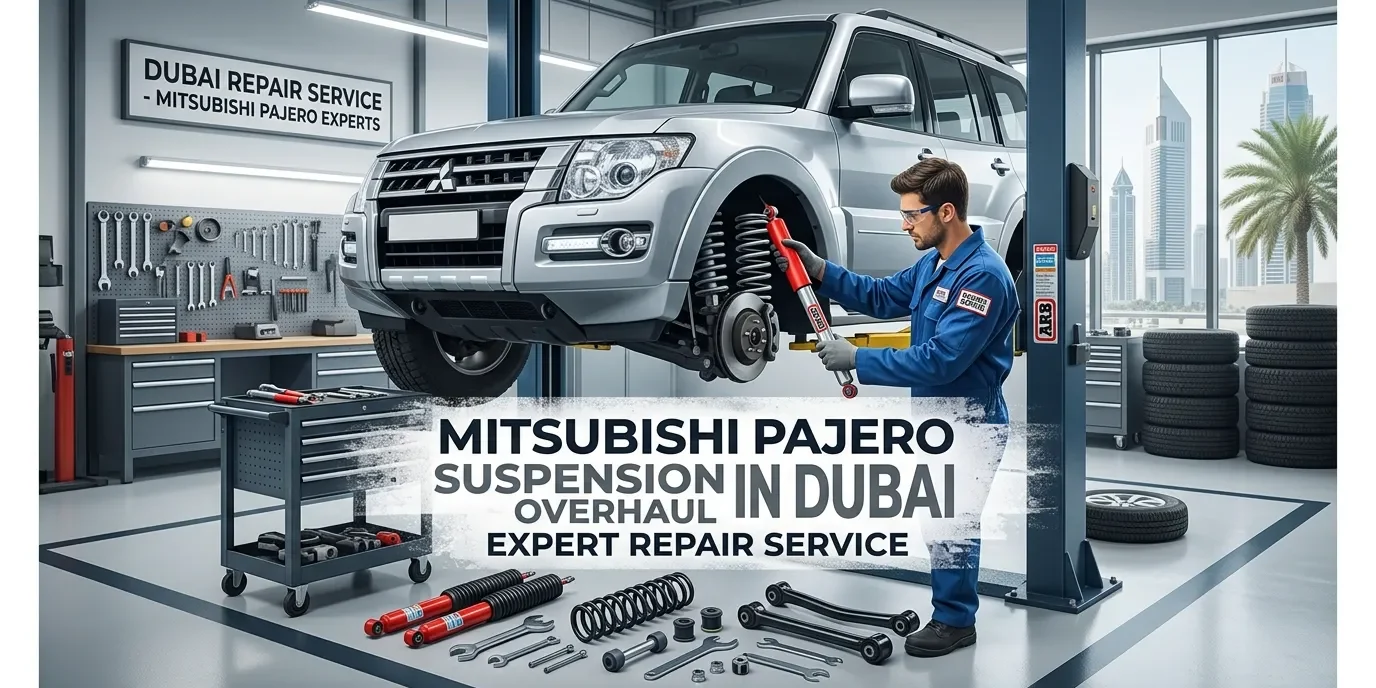
A Mitsubishi Pajero should feel solid, controlled, and predictable whether you are driving through Dubai traffic, cruising on Sheikh Zayed Road, or heading toward desert tracks. When the SUV starts bouncing, knocking over speed bumps, pulling to one side, or feeling loose through corners, the suspension deserves attention.
A Mitsubishi Pajero Suspension Overhaul is not simply a matter of replacing four shock absorbers. The right approach is to inspect the complete system, identify what has actually worn out, and repair only what is necessary to restore stability, comfort, steering control, and tyre contact.
This guide explains the warning signs, common Pajero suspension failures, diagnostic process, repair procedure, cost factors, and what Dubai owners should know before approving a complete overhaul.
What Is a Mitsubishi Pajero Suspension Overhaul?
A Mitsubishi Pajero suspension overhaul is a detailed inspection and repair of worn or damaged components in the front and rear suspension system.
Depending on the vehicle’s condition, the work may include shock absorbers, springs, control arms, bushings, ball joints, stabilizer links, tie rod ends, mounts, and related hardware.
A proper overhaul should not mean automatically replacing everything.
An experienced technician first checks which components have excessive movement, damaged rubber, leakage, wear, or structural problems. This prevents good parts from being replaced unnecessarily.
At Car Repair Auto Services, the correct approach starts with suspension diagnosis before deciding whether your Pajero needs a complete overhaul or only targeted repairs.
Internal link: Car Suspension Repair in Dubai
How Do I Know If My Mitsubishi Pajero Suspension Needs Repair?
The clearest signs are excessive bouncing, knocking noises, unstable steering, uneven tyre wear, body roll, vibration, or a noticeable drop in ride comfort.
One symptom alone does not tell you which suspension component has failed. Several different parts can create similar noises or handling problems, which is why physical inspection is important.
Common warning signs include:
- Clunking or knocking when crossing speed bumps
- Excessive bouncing after road dips
- Pajero leaning more than normal during turns
- Steering that feels loose or vague
- Vehicle pulling left or right
- Uneven or rapid tyre wear
- Front-end vibration
- Nose diving during braking
- One corner sitting lower than the others
- Oil leaking from a shock absorber
- Squeaking or creaking while steering
- Reduced stability at highway speeds
If several of these symptoms appear together, a complete suspension inspection is usually more useful than replacing one part based on guesswork.
Why Pajero Suspension Components Wear in Dubai
The Mitsubishi Pajero is built as a capable SUV, but its suspension still experiences considerable mechanical stress.
Dubai conditions can be demanding because vehicles regularly deal with high ambient temperatures, speed humps, construction areas, long highway journeys, heavy loads, and occasional desert driving.
Heat and Rubber Components
Suspension bushings contain rubber that isolates vibration and controls movement between metal components.
Over time, heat and age can cause rubber to harden, crack, deform, or separate. Once this happens, you may hear knocking or notice less precise steering.
Frequent Speed Bumps
Repeated compression and extension place load on shocks, links, bushings, and joints.
A healthy Pajero absorbs these movements smoothly. A worn suspension can feel harsh on the way up and continue bouncing afterward.
Desert and Off-Road Driving
Off-road driving creates larger suspension movements than normal road use. Sand itself is not necessarily the main problem. Repeated impacts, articulation, heat, and higher loads can accelerate wear in shocks, bushes, ball joints, links, and mounting points.
If your Pajero regularly goes off-road, suspension checks should be part of preventive maintenance rather than something you do only after a noise develops.
Which Parts Are Checked During a Pajero Suspension Overhaul?
A complete Mitsubishi Pajero Suspension Overhaul should include both front and rear suspension inspections.
Technicians normally examine the following components:
- Front and rear shock absorbers
- Coil springs
- Upper and lower control arms
- Control arm bushings
- Ball joints
- Stabilizer bar bushings
- Stabilizer links
- Tie rod ends
- Steering components
- Shock mounts and rubber pads
- Wheel bearings where relevant
- Suspension mounting bolts
- Tyres and tyre wear patterns
- Wheel alignment angles
The important point is that these parts work together.
For example, fitting new shocks will not completely fix poor handling if worn control arm bushings still allow unwanted wheel movement.
Does a Pajero Always Need a Full Suspension Overhaul?
No. A full overhaul is only justified when several suspension components are worn, damaged, or approaching the end of their useful condition.
A Pajero with one worn stabilizer link may only need that component repaired. A higher-mileage Pajero with leaking shocks, cracked bushes, loose joints, and poor alignment may benefit from a broader overhaul.
This distinction can save owners considerable money.
In the workshop, we prefer to separate suspension faults into three categories.
Localised Wear
Only one or two components show meaningful wear. The rest of the system remains serviceable.
Targeted replacement is normally sufficient.
Multiple Worn Components
Several connected components are worn. Replacing only the most obvious part may improve the symptom without properly restoring suspension performance.
This situation often justifies a partial or complete overhaul.
Safety-Critical Wear
Excessive play in ball joints, steering joints, mounting hardware, or other important components requires immediate attention because vehicle control may be affected.
The decision should be based on inspection, not mileage alone.
Mitsubishi Pajero Suspension Diagnostic Process
Good suspension work begins before a spanner touches the vehicle.
At Car Repair Auto Services, a professional assessment should focus on identifying the source of the problem rather than simply matching a replacement part to a customer’s description.
1. Customer Complaint Review
The technician first needs to understand when the problem occurs.
Does the noise happen while turning? Only over bumps? During braking? At low speed? At highway speed?
These details narrow the inspection area.
2. Road Test
A controlled road test can reveal bouncing, steering play, pulling, vibration, body roll, noise, and braking instability.
3. Lift Inspection
Once raised on a lift, the suspension can be checked for physical wear.
Technicians inspect for leaking shocks, cracked bushes, torn boots, loose joints, damaged mounts, spring problems, and excessive component movement.
4. Steering and Joint Inspection
Ball joints, tie rod ends, control arms, stabilizer links, and related parts are checked for unwanted play.
5. Tyre Inspection
Tyre wear often provides useful clues.
Uneven inner or outer shoulder wear may indicate an alignment or suspension geometry problem. Cupping can also be associated with poor wheel control.
6. Alignment Check
Wheel alignment measurements help confirm whether suspension geometry is within specification.
An alignment should also be performed after replacing components that affect wheel position.
Internal link: Engine Diagnostics and Repair in Dubai Complete Guide
What Happens During a Mitsubishi Pajero Suspension Overhaul?
The exact procedure depends on what the inspection finds, but a professional overhaul commonly follows these steps:
- Inspect the complete front and rear suspension.
- Identify worn, loose, leaking, or damaged components.
- Prepare an itemised repair recommendation.
- Remove components that fail inspection.
- Install suitable replacement parts.
- Torque suspension fasteners correctly.
- Check steering and suspension movement.
- Perform wheel alignment where required.
- Conduct a final road test.
- Confirm that noise, handling, stability, and ride quality have improved.
The last two steps matter.
Replacing parts without alignment and road testing can leave the job technically incomplete.
Pajero Shock Absorber Replacement
Shock absorbers control the movement of the springs. They help prevent the vehicle from continuing to bounce after hitting a bump.
Worn shocks can cause excessive body movement, reduced tyre control, poor ride quality, and less confidence during braking or cornering.
Visible oil leakage can indicate shock failure, but not every worn shock leaks dramatically.
A technician should evaluate shock condition together with the rest of the suspension rather than automatically assuming a rough ride means all four shocks need replacing.
Pajero Control Arms, Bushings and Ball Joints
Control arms help keep each wheel correctly positioned as the suspension moves.
Bushings allow controlled movement while isolating vibration. Ball joints provide flexible movement between suspension and steering components.
When these parts wear, the Pajero may develop:
- Knocking noises
- Steering instability
- Uneven tyre wear
- Alignment problems
- Vibration
- Reduced cornering confidence
A common repair mistake is focusing only on shocks while ignoring worn bushings or joints.
For a high-mileage SUV, the entire suspension should be assessed as one connected system.
Why Wheel Alignment Matters After Suspension Repair
Wheel alignment controls the angles at which the tyres contact the road.
Replacing control arms, tie rods, ball joints, bushes, or other geometry-related components can change those angles.
An alignment after suspension work helps:
- Keep the Pajero tracking straight
- Improve steering response
- Reduce uneven tyre wear
- Maintain proper road contact
- Protect new suspension components from unnecessary stress
If significant suspension work has been completed, skipping alignment to save money is usually false economy.
How Much Does Mitsubishi Pajero Suspension Overhaul Cost in Dubai?
There is no responsible fixed price for every Pajero suspension overhaul because two vehicles of the same model can need completely different repairs.
The final cost depends on:
- Number of components requiring replacement
- Front, rear, or complete suspension work
- Shock absorber brand and specification
- Genuine, OEM-quality, or aftermarket parts
- Condition of control arms and bushings
- Ball joint and steering wear
- Vehicle generation and model year
- Labour required
- Wheel alignment
- Additional damage discovered during inspection
The best approach is to request an itemised estimate showing exactly which parts have failed and why they need replacement.
That is more useful than approving a vague quote for a “complete suspension” without seeing the inspection findings.
A Practical Pajero Suspension Example
Consider a Pajero owner who hears a knocking noise every time the vehicle crosses a speed hump.
It is easy to assume the shock absorbers are finished.
During inspection, however, a technician may find the shocks still control movement correctly while a stabilizer link and worn bush have developed play.
Replacing all four shocks in this situation would increase the bill without addressing the diagnosis properly.
Now consider another Pajero with high mileage, leaking rear shocks, cracked control arm bushings, loose stabilizer links, uneven tyre wear, and poor highway stability.
Repairing one link alone would not restore the vehicle properly. A more complete overhaul could make better mechanical and financial sense.
This is why diagnosis comes before parts replacement.
Can You Drive a Pajero With Worn Suspension?
Minor suspension wear may not stop the vehicle from moving, but that does not mean it should be ignored.
Worn suspension can affect tyre contact, steering accuracy, braking stability, ride comfort, and alignment.
If your Pajero has severe steering play, excessive bouncing, a broken spring, a major lean, strong knocking, or feels unstable at speed, avoid unnecessary driving and arrange an inspection.
Safety-related suspension faults can worsen without much warning.
How to Protect Your Pajero Suspension in Dubai
You cannot prevent all suspension wear, but good driving and regular inspections can extend component life.
Avoid hitting speed bumps or potholes aggressively. Maintain correct tyre pressures and investigate uneven tyre wear instead of simply fitting another set of tyres.
After demanding desert trips, pay attention to new noises, steering changes, or unusual vehicle height.
If the Pajero feels different, have it inspected while the problem is still small.
Routine suspension checks are particularly valuable on older or high-mileage Pajeros.
Why Choose Car Repair Auto Services for Pajero Suspension Repair?
A good suspension garage should diagnose before replacing.
At Car Repair Auto Services in Dubai, our focus is on checking the complete suspension system, finding the actual worn components, and recommending repairs based on condition rather than assumptions.
Our workshop can assist with:
- Mitsubishi Pajero suspension inspection
- Shock absorber replacement
- Suspension bush replacement
- Control arm repair and replacement
- Ball joint inspection
- Stabilizer link replacement
- Steering inspection
- Wheel alignment related repairs
- Complete suspension overhaul
- General Mitsubishi repair and maintenance
If another workshop has already recommended a long list of suspension parts, you can also request a detailed inspection before committing to the work.
Internal link: Garage Near Me in Dubai
Frequently Asked Questions
How do I know if my Pajero shock absorbers are bad?
Common symptoms include excessive bouncing, reduced stability, increased body movement, poor control over bumps, and visible oil leakage. However, bushings and links can create similar complaints, so the suspension should be inspected before replacing shocks.
Should all four Pajero shocks be replaced together?
Not automatically. Replacement depends on the condition and design of the system. Shocks on the same axle are generally assessed together to maintain balanced damping, but a technician should inspect the complete suspension before recommending replacement.
Can worn Pajero suspension cause uneven tyre wear?
Yes. Worn joints, bushings, control arms, steering components, or incorrect alignment can change tyre contact with the road and contribute to uneven wear.
Is suspension repair necessary after desert driving?
Not after every trip, but frequent or demanding off-road driving increases suspension stress. If you notice new knocking, looseness, vibration, leakage, or a change in ride height after off-road use, arrange an inspection.
How long does a Mitsubishi Pajero suspension overhaul take?
Repair time depends on the number of components being replaced, parts availability, vehicle condition, and whether alignment or additional steering work is necessary. A workshop should confirm the expected repair scope after inspection.
Final Thoughts
A Mitsubishi Pajero Suspension Overhaul should restore more than ride comfort. It should bring back controlled steering, stable braking, predictable cornering, correct wheel movement, and confidence behind the wheel.
The key is accurate diagnosis. A knocking noise does not automatically mean four new shock absorbers, and high mileage does not automatically mean every suspension component has failed.
If your Pajero is bouncing, pulling, knocking, wearing tyres unevenly, or simply no longer feels as stable as it used to, arrange a complete suspension inspection before the problem develops further.
Car Repair Auto Services provides Mitsubishi suspension inspection and repair in Dubai, from individual bushes and shock absorbers to complete suspension overhauls. Have the system checked first, understand exactly what needs attention, and repair the vehicle based on evidence rather than guesswork.