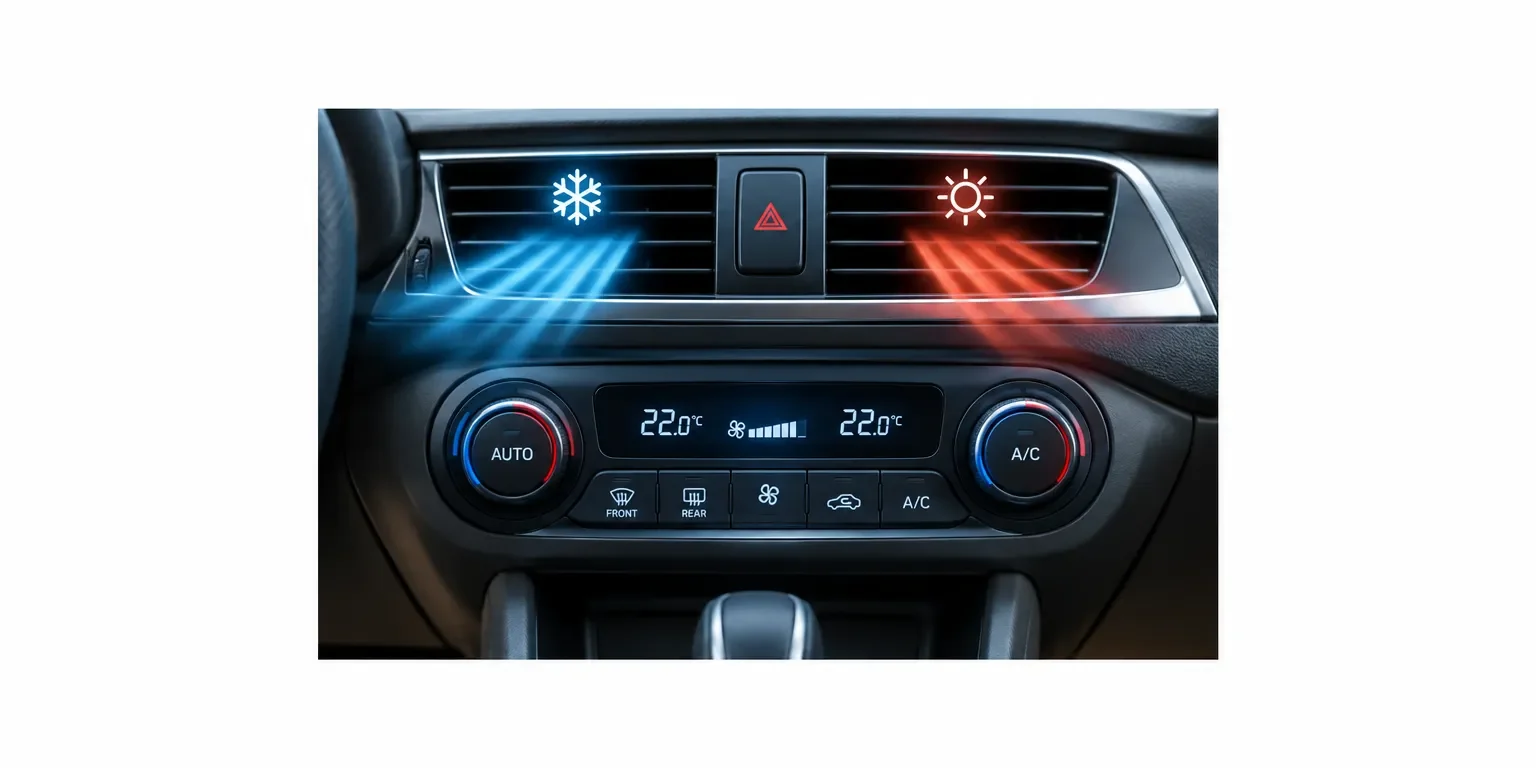
Have you set your car climate control to the lowest temperature, but the cabin still feels warm? Or perhaps the air is cold on one side and warm on the other, the fan works only on certain speeds, or the airflow suddenly becomes weak after driving for some time. These problems are common, especially when a vehicle is working hard in Dubai’s hot weather.
The good news is that a climate control problem does not always mean the compressor has failed. The fault can come from the refrigerant system, blower motor, temperature sensor, blend door actuator, electrical circuit, cabin filter, or climate control module. This guide explains the common causes, how mechanics diagnose them, and when you should get professional Car Climate Control repair.
What Is Car Climate Control?
Car climate control is the system that manages the temperature, airflow, fan speed, and air distribution inside the cabin. In modern vehicles, the system uses sensors, electronic controls, actuators, the blower motor, evaporator, compressor, and other HVAC components to maintain the temperature selected by the driver.
Unlike a basic air conditioning system, automatic climate control continuously monitors cabin conditions and adjusts the system automatically. This means a fault in a sensor or actuator can sometimes cause strange symptoms even when the AC compressor itself is working normally.
Modern diagnostic procedures also check individual functions such as blower speeds, temperature control, mode doors, recirculation, and temperature actuators instead of simply assuming that the compressor is faulty. (NHTSA)
Why Is My Car Climate Control Not Working Properly?
The most common causes include:
- Low or incorrect refrigerant charge
- Faulty AC compressor or compressor control
- Failed blower motor or blower resistor
- Faulty blend door actuator
- Bad evaporator temperature sensor
- Blocked cabin air filter
- Electrical or wiring problems
- Faulty climate control panel or HVAC module
- Evaporator or condenser problems
- Incorrect sensor readings or calibration
The important point is that the same symptom can have several different causes. Proper testing is therefore more useful than replacing parts based only on the symptom.
1. Low Refrigerant Can Cause Poor Cooling
One of the first things drivers notice is that the AC is running, but the cabin does not get cold enough.
Low refrigerant can reduce cooling performance and may prevent the compressor from operating under certain conditions. However, simply adding AC gas is not always the correct repair. If refrigerant is low, a technician should investigate why it became low in the first place.
A leak from an AC hose, condenser, evaporator, compressor seal, or connection can gradually reduce refrigerant levels.
A common Dubai example
A car may feel reasonably cool during a short morning drive but struggle badly during the afternoon. The owner may assume the system only needs a gas refill. During proper inspection, however, a technician may discover a small leak that allows refrigerant to escape.
A refill might temporarily improve cooling, but repairing the leak addresses the actual problem.
For Dubai vehicles, proper AC inspection is particularly important because drivers rely heavily on air conditioning throughout much of the year.
2. The AC Compressor May Not Be Getting the Correct Command
The compressor is responsible for circulating refrigerant through the AC system. But modern vehicles do not always operate the compressor in a simple ON or OFF manner.
Depending on the vehicle, the climate control system can communicate with the engine computer and control the compressor electronically. Diagnostic information from automotive service procedures shows that technicians may need to check the AC request, compressor command, pressure readings, sensors, and electrical signals. (NHTSA)
This means replacing a compressor without testing the control system can result in an expensive repair that does not solve the original problem.
3. Faulty Blend Door Actuator
If one side of the cabin is cold while the other side is warm, the blend door system should be inspected.
A blend door controls how air is directed through the heating and cooling sections of the HVAC housing. The actuator moves the door according to commands from the climate control system.
A documented Ford service bulletin describes vehicles where the temperature blend door could bind and cause constant warm air from the climate control system. (Ford Service Content)
Another documented Mazda service bulletin describes intermittent temperature differences between the driver and passenger sides that were associated with temperature blend door actuators. (Charm)
This is a good example of why “AC is not cold” does not automatically mean “AC gas is low.”
4. Bad Evaporator Temperature Sensor
The evaporator temperature sensor monitors the temperature of the evaporator and helps the climate control system prevent excessive cooling and freezing.
If the sensor gives an incorrect reading, the system may reduce or interrupt cooling. In some vehicles, a faulty sensor can cause the evaporator to freeze, leading to reduced airflow and poor cooling.
For example, a General Motors service bulletin for the 2016 Cadillac CT6 describes poor AC performance, warm air, reduced airflow, and mist from the vents caused by an evaporator temperature sensor that was not properly seated. (NHTSA)
Kia also issued a service action for certain Sportage vehicles involving the evaporator temperature sensor and intermittent poor AC performance. (NHTSA)
What does evaporator freezing feel like?
You may notice:
- Cooling is good when you first start driving
- Airflow gradually becomes weaker
- The vents eventually produce less air
- Turning the AC off for a while may temporarily restore airflow
- Water or mist may appear around the vents in some cases
If this happens repeatedly, the system needs proper diagnosis rather than repeated refrigerant charging.
5. Blower Motor or Resistor Problems
If your climate control works but the fan does not blow properly, inspect the blower system.
A failing blower motor may produce weak airflow, unusual noises, intermittent operation, or no airflow at all. On systems with a blower resistor or electronic blower control module, certain fan speeds may stop working.
For example, if speeds 1 and 2 do not work but higher speeds still operate, the blower control circuit may need inspection.
A mechanic should test the blower motor, power supply, ground, resistor or control module, and related wiring before replacing components.
6. A Blocked Cabin Air Filter Can Reduce Airflow
A dirty cabin air filter is a simple issue that is often overlooked.
When the filter becomes heavily restricted, less air reaches the cabin. The AC may still be producing cold air, but the driver feels that the system is not cooling properly because there is not enough airflow.
If your car is used frequently in dusty conditions or heavy traffic, the cabin filter deserves regular inspection.
A useful diagnostic approach is to compare cooling temperature with airflow. If the air is cold but airflow is weak, the problem may not be refrigerant related at all.
7. Electrical Problems Can Affect Climate Control
Modern climate control systems depend heavily on electrical components.
A problem with a fuse, wiring connection, sensor, control module, actuator, or communication circuit can cause symptoms that look like an AC problem.
For example, an HVAC diagnostic procedure may require checking the control head, fuses, blower operation, mode control, recirculation function, and temperature control separately. (NHTSA)
This is why electrical diagnostics are particularly important on newer German, American, luxury, and electronically controlled vehicles.
8. Climate Control Panel or HVAC Module Failure
If the buttons or touchscreen do not respond correctly, the climate control panel itself may be involved.
You might notice:
- Temperature changes by itself
- Buttons stop responding
- Display works but the system does not respond
- Fan speed changes unexpectedly
- Air direction does not follow the selected setting
- One or more climate functions stop working
In these cases, a diagnostic scan can help determine whether the HVAC module has stored fault codes.
A technician should also check the power supply and communication circuits before condemning the module.
Real Case: When the Problem Was Not the Compressor
A useful documented example comes from Ford. Certain vehicles were reported to have a lack of heating or cooling when the climate control temperature was changed. Ford identified cases involving a stuck or binding temperature door or an inoperative temperature door actuator. The diagnostic procedure included monitoring temperature door operation before replacing components.
This type of case is important for car owners because it shows why diagnosis matters. A driver can experience poor cooling while the compressor and refrigerant system are not necessarily the root cause.
Real Case: AC Cooling Gets Worse During a Long Drive
Another documented example involves certain Kia Optima and Sorento vehicles. The service bulletin describes evaporator freeze-up during extended driving, with the evaporator temperature sensor identified as part of the repair procedure. (OEMDTC)
This is similar to a complaint mechanics sometimes hear from customers: “The AC is cold when I start driving, but after some time the airflow becomes weak.”
That symptom should prompt an inspection of the evaporator, temperature sensor, refrigerant system, and airflow rather than an automatic gas refill.
How Do Mechanics Diagnose Car Climate Control Problems?
A professional diagnosis normally starts with the customer’s exact complaint.
For example, a mechanic needs to know whether:
- The air is warm or completely hot
- The airflow is weak or normal
- The problem affects one side or the whole cabin
- The AC works initially and then stops
- The blower works on all speeds
- The problem occurs only when the vehicle is stationary
- The problem changes when driving
- The issue started after an AC repair or electrical repair
After that, the technician can test the system.
A typical diagnostic process
Step 1: Visual inspection
The technician checks the cabin filter, AC components, wiring, connectors, hoses, compressor, condenser, and visible signs of damage or leakage.
Step 2: Scan the HVAC system
Modern vehicles may store HVAC or body control fault codes. A professional scan tool can help identify sensor, actuator, communication, and control problems.
Step 3: Check airflow
The blower motor and different fan speeds are tested. The technician also checks whether air is reaching the correct vents.
Step 4: Check temperature control
The mechanic compares temperature changes from the driver’s and passenger’s sides where applicable and checks blend door operation.
Step 5: Test AC performance
Refrigerant pressures, vent temperature, compressor operation, and other system values are checked against vehicle specifications.
Step 6: Test the suspected component
Only after the diagnostic evidence points toward a component should that component be repaired or replaced.
This approach can prevent unnecessary parts replacement and helps identify the actual cause of the problem.
Why Dubai Heat Can Make Climate Control Problems More Noticeable
Dubai’s high temperatures place significant demand on a vehicle’s AC system.
A vehicle that feels acceptable in mild weather can expose a weak AC component much more clearly during a hot afternoon. The cabin also starts at a much higher temperature after being parked outside.
This does not mean every weak AC system has a Dubai specific fault. It means an already marginal system can become much more noticeable when the cooling system is under heavy load.
That is why regular inspection of the AC system, cabin filter, refrigerant condition, electrical components, and cooling performance can be useful.
Should You Add AC Gas Yourself?
It is better not to treat refrigerant as a routine top up.
If the refrigerant level is low, there may be a leak. Adding refrigerant without finding the cause can temporarily improve cooling while allowing the underlying problem to continue.
The correct procedure is to check the system, confirm refrigerant condition and pressure, identify leaks where necessary, and recharge the system according to the manufacturer’s specifications.
When Should You Get Car Climate Control Repair?
You should arrange an inspection if you notice:
- AC blowing warm air
- Different temperatures from each side
- Weak airflow
- Fan working only on certain speeds
- AC becoming warm after driving
- Strange clicking from behind the dashboard
- Water or unusual moisture around the vents
- AC compressor repeatedly switching on and off
- Climate control buttons not responding
- Unusual smell from the vents
A clicking noise behind the dashboard combined with incorrect temperature control can be a useful clue toward an actuator or HVAC door problem.
Car Climate Control Repair in Dubai
At Car Repair Auto Service, climate control problems are approached as diagnostic problems rather than simply “AC gas” problems. The workshop provides car AC repair, compressor inspection, AC gas service, cooling system inspection, and electrical diagnostics for different vehicle brands in Dubai.
If the AC issue is connected to another vehicle system, the workshop also provides related services such as car electrical repair and engine cooling system repair. The goal is to identify the actual fault before recommending the repair.
For more information about the workshop and available services, visit Car Repair Auto Service in Dubai.
Final Thoughts
When your Car Climate Control stops working properly, the compressor is not always the problem. Low refrigerant, blend door actuators, evaporator sensors, blower components, cabin filters, electrical faults, and HVAC control modules can all create similar symptoms.
The best approach is to diagnose the complete system and follow the evidence. Documented manufacturer service information shows that even problems such as warm air, weak airflow, and inconsistent temperatures can originate from sensors or climate control doors rather than the compressor itself.
If your car’s climate control is struggling in Dubai, especially if the problem keeps returning after an AC gas refill, have the system properly inspected. Finding the actual cause can save you from replacing good parts and help restore reliable cabin cooling.
FAQs
Why is my car climate control blowing warm air?
Warm air can be caused by low refrigerant, compressor problems, blend door faults, sensor issues, electrical problems, or HVAC control faults. A proper diagnosis is needed to identify the exact cause.
Why is my car AC cold on one side but warm on the other?
This can happen when a temperature blend door actuator or related HVAC component is not operating correctly. Dual zone climate control systems can develop separate temperature control problems on each side. (Charm)
Why does my AC become weak after driving for a while?
Possible causes include evaporator freezing, incorrect temperature sensor readings, restricted airflow, or refrigerant and pressure problems. Some manufacturer service bulletins document evaporator freeze-up during extended driving. (OEMDTC)
Can a dirty cabin filter affect climate control?
Yes. A heavily restricted cabin filter can reduce airflow even when the AC is producing cold air. Checking the filter is one of the simpler steps in an AC diagnosis.
Should I refill AC gas if my car is not cooling?
Not automatically. Low refrigerant can indicate a leak. The system should be inspected and tested before refrigerant is added.