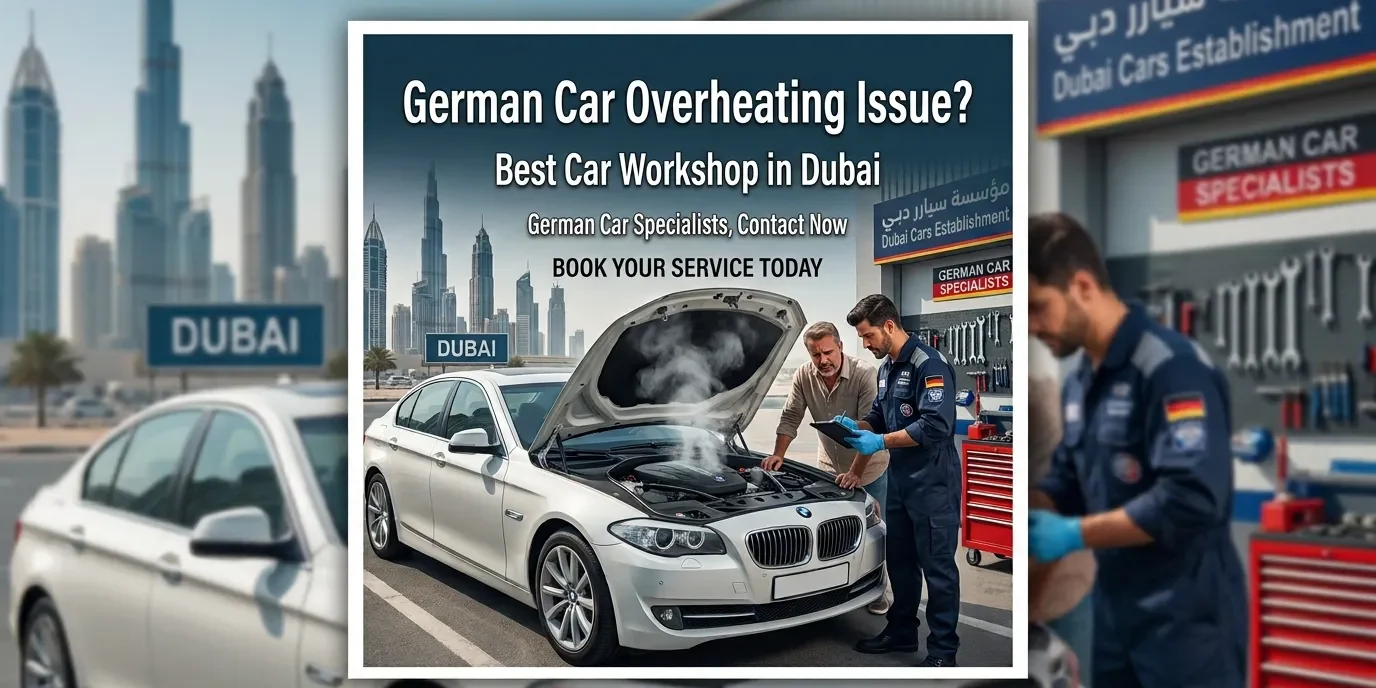
A German car running hot in Dubai is not something to ignore. One moment your BMW, Mercedes-Benz, Audi, Porsche, or Volkswagen may be driving normally, and the next you see a coolant warning, rising temperature, reduced engine power, or steam from under the bonnet.
Finding the best car workshop in Dubai German car overheating owners can trust starts with proper diagnosis, not simply replacing the radiator or adding coolant. German cooling systems are complex, and one small fault can affect several components.
In this guide, we explain why German cars overheat in Dubai, what the warning signs mean, how professional mechanics diagnose the problem, and what you should do before expensive engine damage occurs.
Why Do German Cars Overheat in Dubai?
German vehicles are engineered to control engine temperature very precisely. Modern engines operate with electronically controlled water pumps, thermostats, cooling fans, sensors, control modules, pressure systems, and multiple coolant circuits.
Dubai creates particularly demanding operating conditions.
During summer, the cooling system must remove engine heat while also dealing with very high outside temperatures. Stop-and-go traffic, extended idling, AC use, dusty roads, and long highway journeys place additional load on the system.
A cooling component that is already becoming weak may work normally during cooler months but begin failing once summer arrives.
Common causes of German car overheating include:
- Low coolant caused by a leak
- Faulty electric water pump
- Stuck thermostat
- Weak or failed radiator fan
- Blocked or damaged radiator
- Expansion tank leakage
- Coolant hose failure
- Faulty coolant temperature sensor
- Air trapped inside the cooling system
- Incorrect coolant mixture
- Head gasket or internal engine problems
The important point is that overheating is a symptom. The workshop must identify what is causing it.
What Should You Do If Your German Car Starts Overheating?
If a red temperature warning appears or the vehicle tells you to stop because the coolant is too hot, find a safe place to stop and switch the engine off.
Do not continue driving just because the car still moves normally.
Continuing to run an overheated engine can turn a cooling-system repair into a major engine repair.
You should:
- Pull over safely.
- Switch off the engine.
- Allow the engine to cool completely.
- Do not immediately open the coolant reservoir.
- Look for obvious coolant underneath the vehicle only when it is safe.
- Arrange professional inspection or recovery if the warning was serious.
Never open a pressurised cooling system while it is hot. Hot coolant can escape under pressure and cause severe burns.
If the warning returns after the engine cools, the problem requires diagnosis rather than repeated coolant top-ups.
What Causes BMW Overheating in Dubai?
BMW cooling systems deserve particular attention because many modern BMW models use electronically controlled cooling components.
A BMW that overheats may have a problem with the electric water pump, thermostat, radiator fan, coolant reservoir, hose connection, temperature sensor, or coolant circulation.
One common diagnostic mistake is assuming the radiator is responsible simply because the engine temperature is high.
For example, imagine a BMW that behaves normally at first but begins displaying a temperature warning after sitting in traffic. The technician should not immediately order a radiator.
The first checks should include coolant level, leaks, fan command, actual coolant temperature, water pump operation, thermostat behaviour, fault codes, and coolant circulation.
If an electric pump is receiving the correct command but not producing the expected circulation, the pump becomes a much stronger suspect.
That is the difference between diagnosis and guesswork.
For BMW owners experiencing temperature warnings together with other performance issues, our Engine Diagnostics and Repair in Dubai guide explains why electronic testing should be part of the inspection process.
Why Does a Mercedes-Benz Overheat?
Mercedes-Benz vehicles can overheat because of low coolant, radiator airflow problems, cooling fan faults, coolant pump failure, thermostat problems, sensors, leakage, or internal cooling-system issues.
Some Mercedes models will display warnings such as:
Check Coolant Level
or
Coolant Too Hot, Stop Vehicle
These messages should be taken seriously.
A technician diagnosing a Mercedes overheating complaint should inspect both the mechanical cooling circuit and the electronic controls.
The cooling fan, for example, may physically look fine but fail to reach the requested speed. Likewise, a temperature sensor can provide incorrect data to the control system.
That is why scan-tool data matters.
A professional Mercedes inspection should compare the actual temperature, requested fan operation, coolant circulation, cooling-system pressure, and stored fault codes before parts are replaced.
Why Does an Audi Overheat?
Audi vehicles share many cooling-system technologies with other Volkswagen Group vehicles.
Depending on the engine, cooling problems may involve the water pump, thermostat housing, radiator, electric fans, coolant connections, expansion tank, sensors, or coolant leaks.
Turbocharged Audi engines also create substantial heat.
If coolant circulation becomes restricted, that heat cannot be removed efficiently.
An Audi may show symptoms such as:
- Coolant warning appearing intermittently
- Temperature increasing during traffic
- Coolant level repeatedly dropping
- Sweet coolant smell after driving
- Cooling fan running unusually loudly
- Heater temperature changing unexpectedly
- Reduced engine performance
A coolant warning should not automatically be treated as a simple coolant refill.
If the level has fallen, the mechanic needs to determine where the coolant went.
Porsche Overheating Requires Careful Diagnosis
Porsche engines are built to operate within controlled temperature ranges, and overheating should be investigated quickly.
Depending on the model, technicians may inspect the radiators, front cooling ducts, coolant pumps, thermostats, coolant pipes, expansion tank, fans, pressure integrity, and electronic controls.
Airflow is particularly important.
Radiators positioned toward the front of the vehicle can collect dust and debris over time. Restricted airflow reduces the cooling system’s ability to release heat, especially when outside temperatures are already extreme.
Porsche guidance also advises stopping the engine when coolant temperature becomes excessive and addressing the underlying fault rather than continuing to drive.
Does Volkswagen Overheating Have the Same Causes?
Many causes are similar, but the exact diagnosis depends on the engine.
Volkswagen overheating problems may involve:
- Water pump leakage or failure
- Thermostat problems
- Thermostat housing leaks
- Radiator restrictions
- Cooling fan faults
- Expansion tank problems
- Coolant sensors
- Hose or connector leaks
Some faults only appear when the engine reaches a particular temperature or when cooling demand increases.
That makes reproducing the customer’s complaint an important part of diagnosis.
Why Does My German Car Overheat Only in Traffic?
A car that overheats mainly in traffic often has an airflow or cooling-fan problem because there is less natural air passing through the radiator when the vehicle is stationary. A blocked radiator, weak fan, fan-control problem, water-pump issue, or low coolant can also produce similar symptoms.
This driving pattern gives the mechanic an important diagnostic clue.
At highway speed, outside air naturally moves through the cooling package. At a traffic signal, the electric fan becomes much more important.
If the temperature rises at idle but drops once the car begins moving, fan performance and radiator airflow should be checked carefully.
However, that symptom alone does not prove the fan has failed. Proper testing is still required.
Why Does My Car Overheat With the AC On?
The AC system places additional thermal load on the front cooling package.
The AC condenser releases heat in front of or near the engine radiator. When temperatures are high, both systems depend heavily on effective airflow.
If a cooling fan is weak, the radiator is partially restricted, or the engine cooling system is already struggling, switching on the AC can make the temperature problem easier to notice.
If you experience poor AC performance together with overheating or unusually high fan activity, both systems may need inspection.
Car Repair Auto Services also provides Car AC Repair in Dubai, which can be internally linked here for readers experiencing AC and temperature problems together.
Can Low Coolant Cause Engine Overheating?
Yes.
Low coolant reduces the cooling system’s ability to transfer heat away from the engine. If the coolant level becomes too low, circulation can be interrupted and air pockets may form, causing rapid temperature increases and possible engine damage.
But topping up coolant is not a complete repair.
Coolant does not normally disappear without a reason.
Possible leak points include the expansion tank, radiator, water pump, thermostat housing, hoses, connectors, seals, heater circuit, and internal engine components.
A workshop should pressure-test the system when leakage is suspected.
How Professional Mechanics Diagnose German Car Overheating
At Car Repair Auto Services, the correct approach is to diagnose the cause before recommending major components.
A proper German car overheating diagnosis can include:
- Confirming the customer’s symptoms.
- Checking coolant level and condition.
- Inspecting for external leaks.
- Scanning manufacturer-specific fault codes.
- Reading live coolant-temperature data.
- Testing cooling fan activation and speed.
- Checking water-pump operation.
- Evaluating thermostat behaviour.
- Inspecting radiator airflow and restrictions.
- Pressure-testing the cooling system.
- Checking coolant circulation.
- Looking for signs of internal engine leakage when required.
- Bleeding and vacuum-filling the cooling system correctly after repair.
- Road-testing the vehicle under realistic operating conditions.
This process avoids one of the most expensive workshop mistakes, replacing parts until the overheating disappears.
For vehicles showing warning lights or unclear temperature faults, link readers to Engine Diagnostics and Repair in Dubai.
Water Pump Failure vs Thermostat Failure
These two faults can create similar symptoms, but they are not the same.
Water Pump Failure
The water pump circulates coolant through the engine and radiator.
A failing pump may cause poor circulation, rapidly rising temperatures, heater irregularities, coolant leakage, or overheating under load.
On vehicles with electric pumps, diagnostic testing can sometimes reveal pump-speed, communication, or performance faults.
Thermostat Failure
The thermostat controls coolant flow based on temperature.
If it remains closed or does not open correctly, hot coolant cannot circulate through the radiator as intended.
The engine may then overheat even though the coolant level is correct.
Replacing a thermostat without testing the rest of the system is still risky because pump and thermostat symptoms can overlap.
Can a Bad Radiator Cause German Car Overheating?
Yes, but radiators should be tested rather than blamed automatically.
A radiator can lose efficiency because of:
- External dirt and debris
- Internal blockage
- Damaged fins
- Leaks
- Restricted coolant flow
- Poor airflow from fan problems
Dubai’s dust and heat make radiator condition particularly important.
The front cooling package should be inspected for restrictions without damaging delicate radiator or condenser fins.
Why Proper Coolant Matters in German Cars
Coolant is more than coloured water.
The correct coolant provides temperature control, corrosion protection, freeze protection, lubrication, and material compatibility within the cooling system.
German manufacturers may specify particular coolant chemistry for particular vehicles.
Mixing incompatible coolant types or repeatedly adding ordinary water can reduce corrosion protection and alter the coolant mixture.
The correct specification should therefore be confirmed for the specific model and engine.
In an emergency, follow the manufacturer’s instructions for your vehicle rather than guessing which coolant colour is correct.
Colour alone is not a reliable specification.
Can Overheating Damage a German Car Engine?
Yes.
Severe overheating can cause expensive damage, including:
- Cylinder-head distortion
- Head-gasket failure
- Internal coolant leakage
- Damaged seals
- Oil degradation
- Turbocharger stress
- Plastic cooling-component damage
- Engine seizure in extreme cases
Modern German engines often combine aluminium components, turbocharging, high operating pressures, and tight engineering tolerances.
That is why repeatedly driving an overheating vehicle is a poor gamble.
A relatively manageable cooling-system fault can become a much larger engine job.
Signs You Need German Car Overheating Repair
Arrange an inspection if you notice:
- Red coolant or temperature warning
- Temperature gauge rising above normal
- Steam from the engine compartment
- Coolant smell
- Coolant repeatedly disappearing
- Coolant beneath the vehicle
- Cooling fan running unusually often
- Poor heater performance
- Reduced engine power
- Warning appearing during traffic
- Overheating when the AC is switched on
- Engine temperature dropping and rising unpredictably
Early diagnosis usually gives the technician more options and reduces the chance of secondary damage.
What Makes a Good German Car Workshop in Dubai?
The best German car workshop is not simply the closest garage or the workshop with the cheapest quotation.
Look for technicians who understand BMW, Mercedes-Benz, Audi, Porsche, and Volkswagen systems and who diagnose before replacing components.
A capable workshop should have:
- Professional diagnostic equipment
- Experience with German vehicles
- Cooling-system pressure-testing equipment
- Proper coolant filling and bleeding tools
- Electrical diagnostic capability
- Access to suitable replacement parts
- Clear inspection reports
- Transparent repair recommendations
- Post-repair testing
Car Repair Auto Services works on German and luxury vehicles from its Dubai workshop and provides diagnostics, engine repair, electrical work, AC repair, routine servicing, suspension repair, and other mechanical services.
Readers looking for broader workshop support can be internally linked to the Garage Near Me in Dubai service page or the Car Repair Auto Services homepage.
A Mechanic’s Advice: Do Not Start by Replacing Parts
This is one of the most important points in this guide.
If a German car overheats, do not begin by automatically replacing the radiator, thermostat, or water pump.
Start with the evidence.
A good mechanic asks:
When does it overheat?
Only in traffic?
At highway speed?
With the AC running?
After 20 minutes?
Does the coolant level fall?
Is the fan operating?
Are there fault codes?
Is coolant circulating?
Does the system hold pressure?
Those answers help narrow the fault dramatically.
German vehicles reward accurate diagnosis. Guessing gets expensive quickly.
How to Reduce the Risk of Overheating in Dubai
Preventive maintenance cannot stop every component failure, but it can catch many cooling problems before they become emergencies.
German car owners in Dubai should:
- Check the coolant level periodically when the engine is cold.
- Investigate repeated coolant loss immediately.
- Use the correct coolant specification.
- Have leaks repaired rather than continuously topping up.
- Inspect hoses, expansion tanks, and connections during servicing.
- Keep radiator and condenser airflow areas clean.
- Investigate cooling-fan abnormalities.
- Do not ignore temperature or coolant warnings.
- Have the vehicle scanned when electronic cooling faults are suspected.
- Follow the manufacturer’s service recommendations.
A cooling-system inspection is particularly sensible before peak summer if the vehicle has already shown signs of coolant loss or temperature instability.
Choosing Car Repair Auto Services for German Car Overheating in Dubai
When your German car overheats, the real value of a workshop comes from identifying why it overheated.
At Car Repair Auto Services, German and luxury vehicle repair can include computer diagnostics, cooling-system inspection, engine troubleshooting, radiator checks, electrical diagnosis, AC inspection, and general mechanical repair.
Instead of treating every overheating problem as a radiator replacement, the objective should be to test the complete system and identify the component responsible.
That approach can save money, prevent unnecessary parts replacement, and help protect the engine from further damage.
If your BMW, Mercedes-Benz, Audi, Porsche, or Volkswagen is displaying a coolant warning, losing coolant, running hot in traffic, or overheating with the AC on, arrange an inspection before continuing to drive it regularly.
Final Thoughts
German car overheating in Dubai should never be treated as a minor inconvenience.
The problem may be as straightforward as a coolant leak or fan fault, but it can also involve an electric water pump, thermostat, radiator restriction, sensor, electronic control fault, or internal engine problem.
The safest approach is professional diagnosis followed by the correct repair.
If you are searching for the best car workshop in Dubai German car overheating diagnosis requires, focus on technical experience, accurate testing, transparent recommendations, and familiarity with German vehicles.
Car Repair Auto Services can inspect the cooling system, diagnose the underlying fault, and recommend the repair your car actually needs. Get the vehicle checked early, before a temperature warning becomes major engine damage.
Frequently Asked Questions
Why is my German car overheating in Dubai?
German cars can overheat because of low coolant, leaks, water-pump failure, thermostat problems, radiator restrictions, cooling-fan faults, sensors, or poor coolant circulation. Dubai’s extreme summer temperatures and heavy traffic can make an already weak cooling component fail more quickly.
Can I drive my BMW or Mercedes if it is overheating?
You should not continue normal driving when the vehicle shows a serious overheating warning. Stop safely, switch off the engine, allow it to cool, and follow the manufacturer’s instructions. Continued overheating can cause major engine damage.
Why does my German car overheat only when stationary?
Overheating mainly while stationary can indicate insufficient radiator airflow. A weak cooling fan, fan-control problem, blocked radiator, low coolant, or circulation issue may be responsible. Proper diagnosis is needed before replacing any component.
How do mechanics test a German car for overheating?
A professional inspection may include fault-code scanning, live temperature readings, cooling-system pressure testing, leak inspection, radiator airflow checks, fan activation tests, water-pump testing, thermostat evaluation, and coolant-circulation checks.
Is adding coolant enough to fix overheating?
Not necessarily. If coolant is low, the workshop should determine why it became low. Repeated coolant loss usually means there is a leak or another cooling-system fault that needs repair.