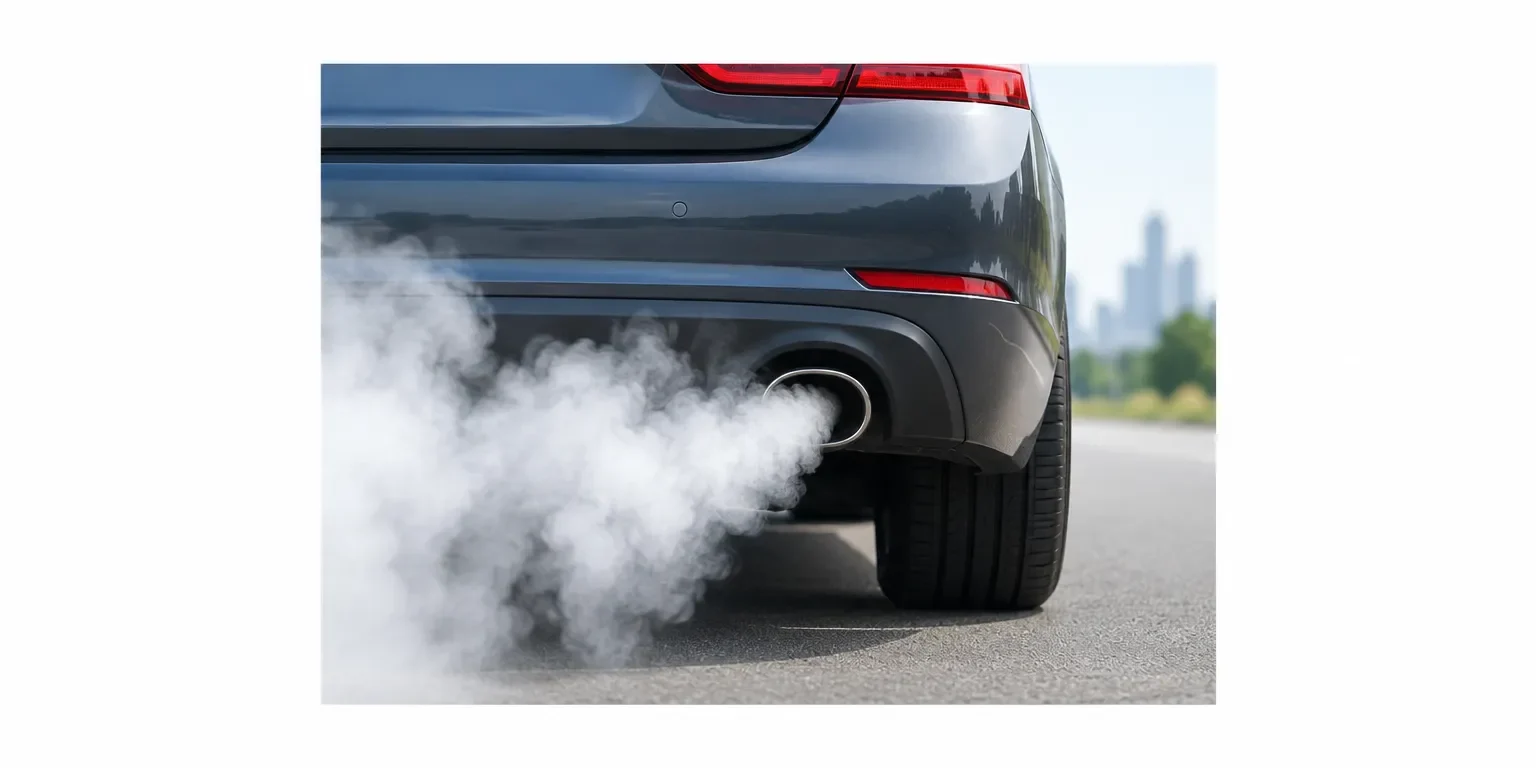
Seeing white smoke coming from my exhaust can be worrying, especially when it keeps coming after the engine has warmed up. A small amount of white vapor on a cold morning can be normal, but thick or constant white smoke may point to a coolant or engine problem. In this guide, we explain what causes white smoke from exhaust, how mechanics diagnose it, when you should stop driving, and what repairs may be needed. If you are in Dubai, we will also explain when professional engine inspection is the safer option.
Is White Smoke From the Exhaust Always a Problem?
No. White exhaust smoke is not always a sign of serious engine damage.
When a car is started from cold, water vapor can collect inside the exhaust system. As the exhaust heats up, this moisture turns into vapor and disappears. This is especially common during a cold start and usually stops within a few minutes.
The concern starts when the smoke is thick, persistent, or accompanied by coolant loss, overheating, a sweet smell, rough running, or low engine performance.
A useful rule is simple: if the white smoke continues after the engine reaches normal operating temperature, it deserves attention.
What Causes White Smoke From Exhaust?
The most common cause of persistent white smoke is coolant entering the combustion chamber and burning with the air and fuel mixture.
Several problems can allow this to happen, including:
- Blown head gasket
- Cracked cylinder head
- Warped cylinder head
- Cracked engine block
- Failed intake manifold gasket on certain engines
- Internal coolant leak
- Severe engine overheating
When coolant reaches the combustion chamber, it is exposed to very high temperatures. It turns into steam and exits through the exhaust pipe, creating noticeable white smoke.
This is why white smoke should not automatically be treated as an exhaust problem. The exhaust is often showing you a symptom of an engine or cooling system problem.
Why Does Coolant Cause White Smoke?
Coolant is designed to circulate through passages around the engine cylinders and combustion areas. It should remain inside the cooling system and never enter the combustion chamber.
If a head gasket, cylinder head, engine block, or related gasket develops a leak, coolant can enter a cylinder. During combustion, the coolant is heated and vaporized. That vapor then leaves through the exhaust system and appears as white smoke.
If you also notice white smoke from exhaust and coolant loss, the combination is particularly important. Check the coolant reservoir and temperature gauge, but never open a hot cooling system because pressurized coolant can cause serious burns.
How to Tell Normal Condensation From a Real Problem
One of the most common mistakes is assuming every white cloud from an exhaust means the engine has failed.
Normal condensation usually:
- Appears during a cold start
- Looks thin rather than extremely thick
- Disappears as the exhaust warms
- Does not have a strong sweet smell
- Does not cause continuous coolant loss
Problematic white smoke usually:
- Continues after the engine warms up
- Gets thicker when accelerating
- Has a sweet smell from the exhaust
- Appears repeatedly during normal driving
- Comes with falling coolant levels
- May be accompanied by overheating or rough idle
If the smoke is constant, do not rely on appearance alone. Proper diagnosis is needed.
White Smoke From Exhaust on Cold Start
White smoke from exhaust on cold start can be completely normal if it is actually condensation.
During a cold start, moisture inside the exhaust system turns into water vapor when the engine begins producing hot exhaust gases. In many cases, the vapor becomes less noticeable as the exhaust reaches operating temperature.
However, if the smoke remains thick after several minutes, keeps returning during warm operation, or is accompanied by coolant loss, the vehicle should be inspected.
The key difference is duration and behavior, not simply the color of the smoke.
Thick White Smoke From Exhaust When Accelerating
Thick white smoke from exhaust when accelerating can be more concerning than light vapor during startup.
Acceleration increases engine load and cylinder pressure. If coolant is leaking into one or more combustion chambers, the increased pressure and airflow can make the smoke more noticeable.
A mechanic may also look for other signs, including:
- Low coolant level
- Engine misfire
- Rough idle
- Low compression
- Overheating
- Sweet exhaust smell
- Bubbles or abnormal pressure in the coolant system
- Coolant contamination in engine oil
These symptoms do not prove a blown head gasket by themselves, but they provide useful clues during diagnosis.
What Does White Smoke From Exhaust That Smells Sweet Mean?
A sweet smell from exhaust combined with persistent white smoke often indicates that coolant is being burned inside the engine.
Coolant contains chemicals that can produce a distinctive sweet odor when heated. If the smell continues with thick white exhaust smoke, a technician should inspect the cooling system and engine for an internal coolant leak.
Do not keep driving simply because the temperature gauge still appears normal. A coolant leak can become worse quickly, and engine overheating can turn a repairable problem into major engine damage.
White Smoke From Exhaust but No Overheating
Can you have white smoke from exhaust but no overheating?
Yes. An engine can have an internal coolant leak before the cooling system becomes unable to control engine temperature. A small head gasket leak, for example, may allow coolant into a cylinder without immediately causing the temperature gauge to rise.
This is why the absence of overheating does not completely rule out an engine problem.
If you have white smoke and low coolant, even without overheating, it is worth having the vehicle inspected.
How Do Mechanics Diagnose White Smoke From Exhaust?
A proper diagnosis should identify where the coolant is going instead of immediately replacing expensive engine parts.
At a professional workshop, the inspection may include:
1. Cooling System Inspection
The mechanic checks the coolant reservoir, radiator, hoses, water pump area, thermostat housing, and other cooling system components for visible leaks.
2. Cooling System Pressure Test
A coolant system pressure test applies controlled pressure to the cooling system. If pressure drops without an obvious external leak, the technician may investigate the engine for an internal coolant leak.
3. Compression Test
A compression test measures cylinder pressure. Abnormally low compression in one or more cylinders can provide evidence of a sealing problem involving the head gasket, valves, piston, or cylinder.
4. Combustion Gas Testing
A technician can test the cooling system for combustion gases. If exhaust gases are entering the cooling system, it can point toward a head gasket or cylinder head problem.
5. Engine Oil Inspection
Coolant mixing with oil can create a milky or contaminated appearance. However, not every head gasket failure causes coolant and oil to mix, so clean-looking oil does not automatically rule out a gasket problem.
6. Further Engine Inspection
If testing points toward internal engine damage, additional inspection may be required. Depending on the vehicle, this can include cylinder leak testing, borescope inspection, or partial engine disassembly.
The goal should always be to confirm the failure before recommending a major repair.
Can I Drive With White Smoke From Exhaust?
If the white smoke is thick or constant, it is better not to continue driving until the cause is identified.
Driving with an internal coolant leak can lead to low coolant, engine overheating, cylinder misfires, catalytic converter damage, or more serious engine damage. Severe overheating can also damage the cylinder head, engine block, bearings, and other internal components.
If the temperature gauge rises, the coolant level drops quickly, the engine runs roughly, or a warning light appears, stop driving as soon as it is safe to do so.
For a vehicle that cannot be safely driven to a workshop, roadside assistance or a mobile car mechanic can be a better option.
Common Problems Behind White Exhaust Smoke
| Possible Cause | Typical Clues | Potential Severity |
|---|---|---|
| Normal condensation | Thin vapor on cold start | Low |
| Head gasket failure | White smoke, coolant loss, overheating | High |
| Cracked cylinder head | White smoke, coolant loss, misfire | High |
| Warped cylinder head | Coolant loss, overheating, compression issues | High |
| Cracked engine block | Coolant loss, persistent smoke, engine problems | Very high |
| Intake manifold gasket leak | Coolant loss and engine running issues on some engines | Moderate to high |
| External coolant leak | Low coolant but usually no white exhaust smoke | Moderate |
The important point is that not every coolant leak creates white smoke. An external leak around a hose, radiator, water pump, or thermostat housing may lower coolant without sending coolant into the combustion chamber.
White Smoke and Low Coolant: What Should You Do?
If you notice white smoke and low coolant, first allow the vehicle to cool completely before checking the coolant reservoir.
Do not remove a radiator cap while the engine is hot.
If the coolant level is repeatedly falling, do not simply keep performing coolant top-ups and continue driving. A top-up can temporarily restore the level, but it does not repair the reason the coolant is disappearing.
A professional cooling system inspection can help determine whether the coolant is leaking externally or entering the engine internally.
How to Fix White Smoke From Exhaust
The correct repair depends entirely on the cause.
If the problem is condensation, no repair is necessary.
If there is an external coolant leak, the repair may involve replacing a damaged hose, radiator component, water pump, thermostat housing, or gasket.
If testing confirms head gasket failure, the repair can be considerably more involved. The cylinder head may need to be removed, inspected for warping or cracks, and resurfaced or replaced where necessary. The head gasket is then replaced and the engine is reassembled according to the manufacturer’s specifications.
A cracked cylinder head or engine block may require component replacement or specialist engine repair. In severe cases, an engine rebuild may be considered.
The important thing is not to approve a major repair based only on white smoke. Testing should establish the cause first.
How Much Does White Smoke From Exhaust Repair Cost?
The white smoke from exhaust repair cost depends on what is causing the smoke.
A simple external coolant leak may be relatively inexpensive to repair, while a failed head gasket, cracked cylinder head, or damaged engine block can require substantially more labor and parts.
The final price can depend on:
- Vehicle make and model
- Engine type
- Location of the leak
- Parts required
- Labor time
- Cylinder head condition
- Extent of overheating
- Whether additional engine damage has occurred
A proper diagnosis is therefore more useful than quoting one fixed price for every vehicle.
Why Dubai Heat Makes Cooling System Problems Important
Dubai’s high temperatures place significant demands on a vehicle’s cooling system. Long periods in traffic, high ambient temperatures, and regular air conditioning use can put additional load on an already weak cooling system.
That does not mean every overheating or white smoke problem is caused by Dubai’s climate. However, drivers should take coolant loss, rising engine temperature, warning lights, and unusual exhaust smoke seriously.
A small cooling system problem can become a much larger engine repair if it is ignored.
White Smoke From Exhaust in Dubai: Where Can You Get It Checked?
If your vehicle is producing constant white smoke, losing coolant, or showing signs of engine overheating, getting an accurate diagnosis should be the first priority.
Car Repair Auto Service provides car repair and engine diagnostic services in Dubai, with its workshop based in Al Quoz. Its listed services include engine repair and diagnostics, engine coolant leak repair, and engine cooling system repair.
You can explore the workshop’s services through the Car Repair Auto Service website. The business also provides diagnostic and repair services for different vehicle makes and models.
For drivers searching for a car mechanic in Al Quoz, car engine repair Dubai, coolant leak repair Dubai, or a garage near me in Al Quoz, an inspection can help identify whether the smoke is simply condensation or a symptom of a deeper engine problem.
A Practical Example From the Workshop
Imagine a driver notices thick white smoke every morning. The car still drives normally, and the temperature gauge has not moved above normal.
The driver assumes there is nothing serious because the vehicle is not overheating.
During inspection, the coolant level is found to be slowly dropping. A cooling system pressure test does not reveal an obvious external leak, so the technician performs further testing. If combustion gases are detected in the cooling system and cylinder testing supports the finding, an internal coolant leak becomes much more likely.
This example shows why symptoms should be considered together. White smoke alone does not tell the entire story.
When Should You Take White Smoke Seriously?
You should arrange an inspection if you notice any of the following:
- Constant white smoke after the engine warms up
- Thick white smoke during acceleration
- Sweet smell from the exhaust
- Repeated coolant loss
- Low coolant warning
- Engine overheating
- Rough idle or misfire
- Reduced engine performance
- Milky engine oil
- Cooling system pressure problems
If several symptoms appear together, delaying diagnosis can increase the risk of expensive engine damage.
Final Thoughts
White smoke coming from my exhaust can have a harmless explanation, especially when it appears briefly during a cold start. But thick or constant white smoke is different and can indicate that coolant is entering the combustion chamber.
The combination of white smoke, coolant loss, sweet exhaust smell, overheating, or rough engine operation deserves professional attention. A cooling system pressure test, compression test, combustion gas test, and careful engine inspection can help identify the actual cause.
If you are in Dubai and your vehicle is producing persistent white exhaust smoke, do not keep guessing or repeatedly topping up the coolant. Have the vehicle properly diagnosed before a small problem develops into major engine damage.
For professional inspection and repair in Dubai, you can contact Car Repair Auto Service through its official website and arrange an inspection with the workshop team.
Frequently Asked Questions
Why is white smoke coming from my exhaust?
Persistent white smoke usually means coolant is entering the combustion chamber and being burned. Common causes include a blown head gasket, cracked cylinder head, warped cylinder head, or cracked engine block. Thin white vapor that disappears shortly after a cold start is often normal condensation.
Is white smoke from exhaust but no overheating still serious?
It can be. An internal coolant leak may begin before the engine overheats. If white smoke continues after the engine warms up, especially with coolant loss or a sweet smell, the vehicle should be inspected even if the temperature gauge remains normal.
Can I drive with white smoke from exhaust?
It is generally safer not to drive a vehicle producing thick or constant white smoke until the cause is diagnosed. Continuing to drive with an internal coolant leak can lead to overheating and serious engine damage.
Why does white smoke from exhaust smell sweet?
A sweet smell can occur when engine coolant enters the combustion chamber and burns with the fuel mixture. If the smell is combined with persistent white smoke and falling coolant levels, an internal coolant leak should be investigated.
How is white smoke from exhaust diagnosed?
A mechanic may inspect the cooling system, perform a coolant system pressure test, check engine compression, test for combustion gases in the coolant, inspect the engine oil, and perform additional engine tests when required. The exact diagnostic process depends on the vehicle and symptoms.