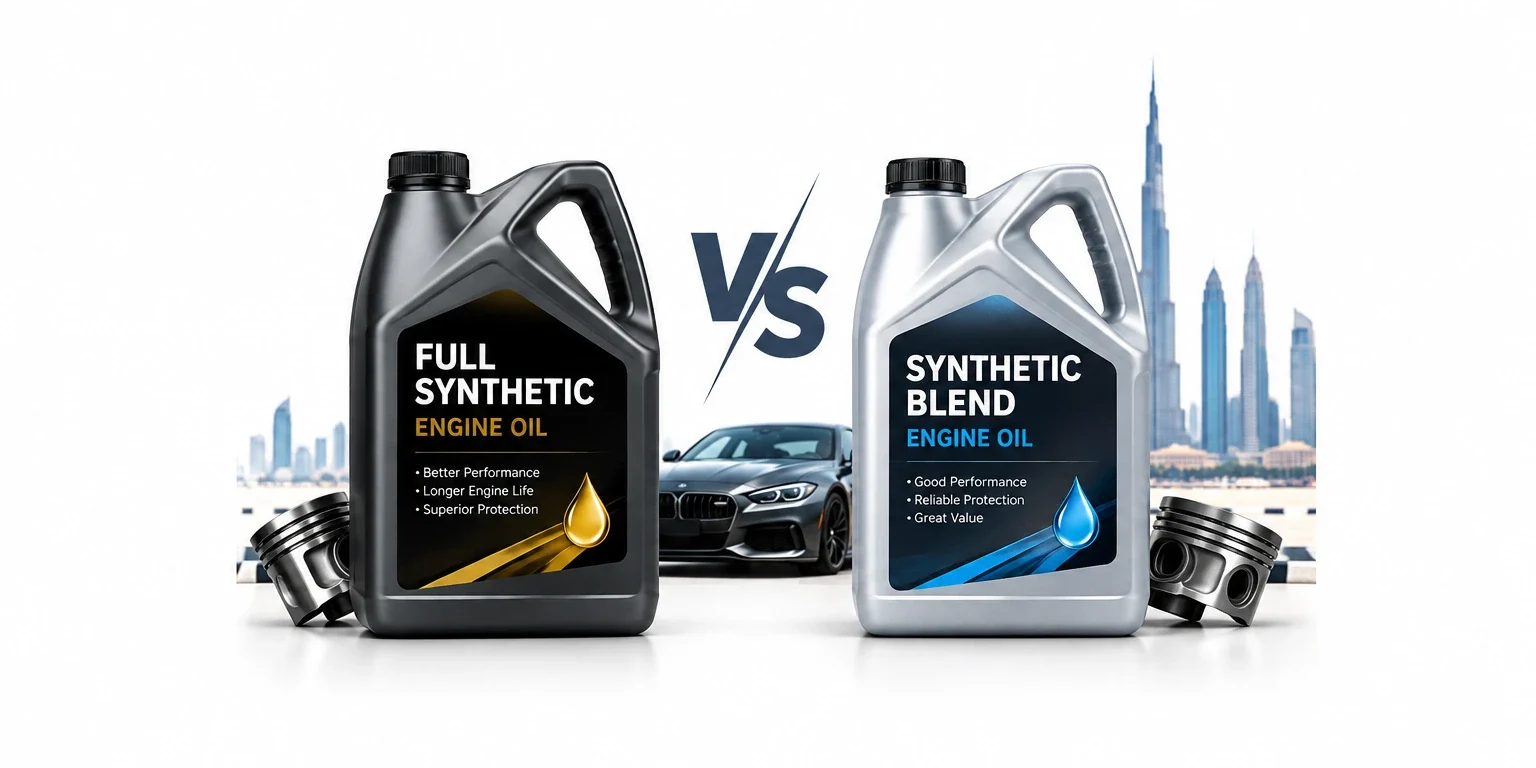
Choosing the right engine oil becomes even more important when you drive in Dubai. High temperatures, heavy traffic, frequent idling, and short trips can put extra stress on your engine and its lubricant. But does that mean you always need full synthetic oil?
The answer depends on your vehicle, engine design, manufacturer requirements, and driving conditions. In this guide, we compare Full Synthetic vs Synthetic Blend Oil, explain how each performs in Dubai, and help you decide which option makes sense for your car.
What Is Full Synthetic Oil?
Full synthetic oil is a highly engineered engine lubricant made using refined synthetic base oils and carefully selected additives. Unlike conventional motor oil, its formulation is designed to provide consistent performance across a wide range of temperatures.
A quality full synthetic motor oil can provide strong oxidation resistance, better friction control, and improved protection against engine wear. It is also designed to maintain its viscosity and protective properties under demanding operating conditions.
For Dubai drivers, this can be particularly useful because an engine may operate under high temperatures while the vehicle is sitting in traffic, climbing a road, or running the air conditioning continuously.
What Is Synthetic Blend Oil?
Synthetic blend oil, also called semi synthetic oil, combines synthetic base oil with conventional mineral oil. It is designed to provide some of the performance advantages of synthetic oil while keeping the cost lower than a fully synthetic formulation.
Synthetic blend motor oil can offer better protection and temperature performance than conventional motor oil. It can be a practical option for certain older vehicles, everyday drivers, and engines whose manufacturers specifically allow or recommend it.
However, synthetic blend does not automatically mean it is suitable for every vehicle. The correct oil specification and viscosity should always come first.
Full Synthetic vs Synthetic Blend Oil: What Is the Difference?
The main difference is the formulation of the base oil and the level of performance the lubricant is designed to provide.
| Feature | Full Synthetic Oil | Synthetic Blend Oil |
|---|---|---|
| Base oil | Synthetic | Synthetic and conventional |
| Heat resistance | Excellent | Good |
| Oxidation resistance | Excellent | Good |
| Engine wear protection | Excellent | Good |
| High temperature performance | Strong | Moderate to strong |
| Oil life | Generally longer | Generally shorter |
| Engine cleanliness | Excellent | Good |
| Friction reduction | Excellent | Good |
| Cost | Higher | More affordable |
| Best for | Modern and demanding engines | Suitable everyday applications |
These are general characteristics. The actual performance depends on the oil formulation, viscosity, additive package, vehicle requirements, and service conditions.
Which Oil Handles Dubai Heat Better?
Full synthetic oil generally provides stronger high temperature protection and oxidation resistance than synthetic blend oil. Its formulation is designed to remain stable under demanding conditions, which can make it a good choice for vehicles regularly exposed to Dubai’s heat and traffic.
However, heat alone does not mean every vehicle should automatically use full synthetic oil. Your owner’s manual remains the first source for the required viscosity and specification.
Dubai’s environment can create severe driving conditions even when the car is being used for normal daily transportation. Long periods of idling, stop and go traffic, short journeys, highway driving, and continuous AC use can all increase the workload on an engine.
Why Engine Oil Matters in Dubai
Engine oil does much more than lubricate moving parts. It also helps control heat, reduce friction, carry contaminants away from sensitive components, and protect internal surfaces against wear.
As oil ages, heat and oxidation gradually affect its performance. Additives can become depleted, contaminants can accumulate, and the oil may no longer provide the same level of protection it offered when fresh.
This is why regular oil changes matter even if you use premium synthetic engine oil. Synthetic oil can have a longer useful life, but it is not a lifetime lubricant.
Full Synthetic Oil for Hot Weather Driving
One of the biggest advantages of full synthetic oil is its ability to maintain more consistent performance across changing temperatures.
During a Dubai summer, the outside temperature can be extremely high, while the temperature inside a running engine can be much higher. Traffic makes the situation more demanding because the engine may remain hot while the vehicle moves slowly or sits stationary.
Full synthetic oil is generally better suited to these demanding conditions because of its thermal stability and oxidation resistance.
It can also help maintain engine cleanliness by resisting the formation of deposits and sludge when the oil is correctly specified and changed at the recommended interval.
Does Full Synthetic Oil Improve Fuel Efficiency?
It can, but the improvement should not be exaggerated.
Synthetic formulations can provide lower internal friction than some conventional or lower quality oils. Reduced friction may help an engine operate more efficiently, but fuel economy also depends on tyre pressure, driving habits, traffic, vehicle condition, engine design, AC usage, and many other factors.
Therefore, switching to full synthetic oil should not be treated as a guaranteed way to achieve a major increase in fuel economy.
Is Synthetic Blend Oil Bad for Your Car?
No. Synthetic blend oil is not automatically a poor choice.
If your vehicle manufacturer allows synthetic blend oil and the product meets the required specification and viscosity, it can provide reliable engine lubrication and wear protection.
Synthetic blend oil can make sense for drivers who want an improvement over conventional motor oil without paying the higher price of full synthetic oil.
The important mistake is choosing oil based only on the words “synthetic” or “premium” printed on the bottle. The specification required by the engine matters more.
Which Is Better for Daily Driving in Dubai?
For many modern vehicles, full synthetic oil is the stronger choice for daily driving in Dubai, especially when the manufacturer specifies it.
A typical Dubai commute can involve heavy traffic, repeated acceleration and braking, long periods of idling, short trips, and high ambient temperatures. These conditions can place more stress on engine oil than steady highway driving.
However, an older vehicle that is specifically designed for synthetic blend oil may not benefit from changing to a different formulation unless the manufacturer permits it.
The best oil is therefore not simply the most expensive oil. It is the oil that matches the engine’s requirements and your actual driving conditions.
Full Synthetic vs Synthetic Blend Oil for Older Cars
Older cars require a little more consideration.
Some high mileage engines may consume oil or have existing seals and deposits that influence which lubricant is appropriate. In these cases, a mechanic should check the engine’s condition rather than recommending an oil based only on the vehicle’s age.
If an older car’s owner’s manual allows both full synthetic and synthetic blend oil, the decision can come down to driving conditions, oil consumption, service intervals, and budget.
For a vehicle that spends a lot of time in Dubai traffic, full synthetic may provide an additional protection margin. But it should still be the correct viscosity and specification for that particular engine.
How to Choose the Right Engine Oil for Your Car
Before buying an engine oil, check these four things:
- Manufacturer specification: Check your owner’s manual or manufacturer service information for the required oil standard.
- Oil viscosity: Look for the recommended viscosity, such as 0W 20, 5W 30, or 5W 40. Do not choose viscosity based only on Dubai’s weather.
- Driving conditions: Consider whether you mainly drive in traffic, make short trips, travel long distances, or frequently operate the vehicle under heavy loads.
- Oil change interval: Follow the manufacturer’s service schedule and adjust only when a qualified technician or manufacturer guidance supports doing so.
Using the wrong viscosity or specification can be more problematic than choosing between full synthetic and synthetic blend.
Common Mistakes Dubai Drivers Make With Engine Oil
Many oil related engine problems start with simple maintenance mistakes.
One common mistake is assuming that more expensive oil is automatically better. Another is changing the oil grade without checking the manufacturer’s requirements.
Some drivers also extend oil change intervals too far because synthetic oil generally lasts longer. While full synthetic oil can offer longer service life than some conventional formulations, it still becomes contaminated and degraded over time.
Another mistake is ignoring an oil leak. Adding fresh oil repeatedly does not fix the underlying leak. A leak should be diagnosed and repaired before it causes low oil levels or further engine problems.
What Happens During a Professional Oil Change?
A proper oil change should involve more than simply draining the old oil and filling the engine again.
At Car Garage Auto Service, oil change and preventive maintenance are part of the services provided for vehicles in Dubai. The workshop’s service offering includes engine oil changes and routine maintenance intended to help protect the engine and support vehicle longevity.
A professional oil service should generally include:
- Checking the correct oil specification and viscosity
- Draining the old engine oil
- Replacing the oil filter when required
- Filling the engine with the correct quantity of oil
- Checking the final oil level
- Inspecting for visible oil leaks
- Checking for obvious engine or maintenance concerns
- Checking the vehicle after the new oil has been installed
This inspection can sometimes reveal a small leak, damaged component, or other issue before it develops into a larger repair.
If your vehicle also has an oil leak, Car Garage Auto Service provides oil leak detection and repair as part of its wider garage services.
A Practical Example From Dubai Driving
Imagine two drivers with similar cars.
Driver A mainly travels between Dubai and Abu Dhabi on open highways. The engine reaches normal operating temperature and spends much of the journey cruising at a steady speed.
Driver B drives through central Dubai every day. Their commute involves traffic queues, frequent stops, short trips, repeated acceleration, and long periods with the AC running.
Both vehicles need the correct engine oil, but Driver B’s vehicle can experience more demanding operating conditions. If the manufacturer allows full synthetic oil, its additional thermal stability and oxidation resistance may make it a sensible choice.
This is why oil selection should consider how the car is driven, not just the number of kilometres on the odometer.
Full Synthetic vs Synthetic Blend Oil: Which One Should You Choose?
For most modern cars that specify full synthetic oil, full synthetic is generally the better choice for Dubai driving. It offers strong engine wear protection, oxidation resistance, friction reduction, and high temperature performance.
Synthetic blend oil can still be a good option when it meets the manufacturer’s requirements. It offers a useful middle ground between conventional motor oil and full synthetic oil, particularly when purchase cost is an important consideration.
The final decision should always be based on the vehicle manufacturer’s specification, not simply on the climate or the oil’s marketing label.
If you are unsure which oil your vehicle needs, a professional inspection can help. Car Garage Auto Service provides oil change and preventive maintenance services in Dubai, with technicians who work across Japanese, German, American, and luxury vehicle brands.
You can also explore the available car repair and auto service options in Dubai if your vehicle needs more than an oil change.
Final Verdict
So, Full Synthetic vs Synthetic Blend Oil, which is better?
For many modern vehicles operating in Dubai’s hot weather and demanding traffic conditions, full synthetic oil is usually the stronger option. It offers excellent thermal stability, oxidation resistance, engine cleanliness, and wear protection.
But synthetic blend oil should not be dismissed. If it meets your vehicle’s required specification, it can provide dependable protection at a lower cost.
The most important rule is simple: use the correct oil specification and viscosity for your engine, change it on schedule, and do not ignore leaks or other warning signs.
When you are uncertain, having the oil and engine checked by a qualified technician is usually cheaper than dealing with avoidable engine damage later.
Frequently Asked Questions
Is full synthetic oil better than synthetic blend oil in Dubai?
Generally, yes. Full synthetic oil usually provides better high temperature stability, oxidation resistance, and wear protection than synthetic blend oil. However, the correct choice depends on the vehicle manufacturer’s required oil specification and viscosity.
Can I use synthetic blend oil instead of full synthetic?
Only if your vehicle manufacturer allows it and the synthetic blend meets the required specification and viscosity. If your engine specifically requires full synthetic oil, switching to synthetic blend is not recommended.
Does full synthetic oil last longer?
Full synthetic oil can generally maintain its performance longer than conventional oil and some synthetic blends. However, it still needs to be replaced according to the vehicle manufacturer’s recommended service interval and your actual driving conditions.
Is synthetic blend oil good for hot weather?
Yes, when it is correctly specified for the vehicle. Synthetic blend oil offers better heat and oxidation performance than conventional motor oil, but full synthetic oil generally provides a greater performance margin under demanding high temperature conditions.
Does Dubai heat damage engine oil faster?
High temperatures can accelerate oil oxidation and thermal stress, particularly when combined with heavy traffic, idling, short trips, and demanding driving. Regular maintenance and the correct engine oil help maintain effective lubrication and engine protection.
Should I use thicker oil because Dubai is hot?
Not necessarily. Do not choose a thicker oil simply because Dubai has a hot climate. Always follow the manufacturer’s recommended viscosity and specification unless a qualified professional confirms a different grade is appropriate for your specific engine.