Hearing a humming, whining, grinding, or clunking sound from the rear of your Mercedes can be worrying, especially when the noise becomes louder as you accelerate. Mercedes Rear Differential Noise is not something you should automatically blame on the tyres or wheel bearings. The differential contains precision gears and bearings that work under heavy load, and a small noise can sometimes be an early warning of wear. In this guide, we explain what causes differential noise, how to tell it apart from other rear end noises, how a professional mechanic diagnoses it, and when your Mercedes needs repair in Dubai.
What Is a Rear Differential in a Mercedes?
The rear differential is part of the drivetrain that transfers power to the rear wheels while allowing them to rotate at different speeds when the vehicle turns.
This is important because the outside wheel travels a longer distance than the inside wheel during a corner. The differential allows this difference in wheel speed without forcing the tyres or drivetrain to fight against each other.
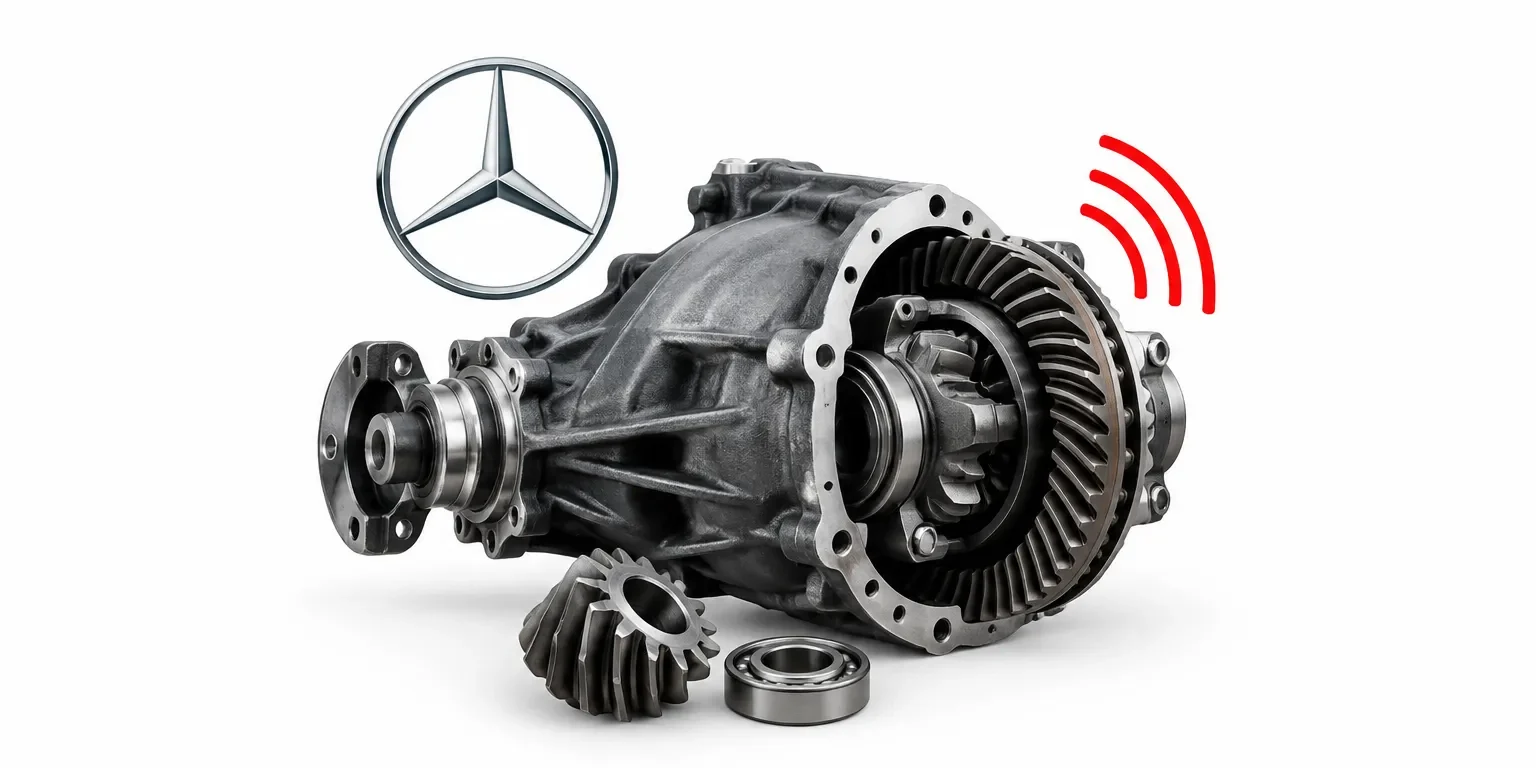
Inside the differential are several precision components, including the ring gear, pinion gear, side gears, bearings, seals, and lubrication system. When these components wear or lose proper lubrication, you may start hearing Mercedes Rear Differential Noise.
A healthy differential should operate quietly. A noticeable new noise, particularly one that changes with vehicle speed or throttle position, deserves proper inspection.
What Does Mercedes Rear Differential Noise Sound Like?
Not every noise from the rear of a Mercedes comes from the differential. Experienced technicians pay close attention to the type of sound and when it occurs.
Common differential sounds include:
| Noise | When You May Notice It | Possible Cause |
|---|---|---|
| Whining | Acceleration | Gear wear or incorrect gear contact |
| Humming | Constant cruising | Bearing or gear wear |
| Howling | Acceleration or deceleration | Ring and pinion wear |
| Grinding | Under load or during movement | Serious gear or bearing damage |
| Clunking | Taking off or changing load | Excessive backlash or worn drivetrain components |
| Rumbling | At different speeds | Bearing or differential related wear |
The sound alone does not confirm the failed component. A professional diagnosis is important because wheel bearings, tyres, driveshaft components, and suspension parts can produce similar noises.
Why Is My Mercedes Making Noise From the Rear?
The most common causes include worn differential bearings, damaged gears, low or contaminated differential fluid, leaking seals, excessive internal wear, and incorrect gear alignment.
Dubai’s high temperatures also make proper lubrication important. When a vehicle is driven frequently in heavy traffic or at high temperatures, drivetrain components experience significant heat and load. This does not automatically mean the differential will fail, but poor maintenance combined with heat and wear can accelerate problems.
Let’s look at the main causes in more detail.
1. Worn Differential Bearings
Bearings support rotating components inside the differential and help keep everything running smoothly.
As a bearing wears, its clearance changes. The rotating components may no longer remain perfectly supported, and the result can be a humming, rumbling, or whining noise.
A common mistake is to assume that every humming sound means a wheel bearing has failed. A worn differential bearing can produce a very similar sound.
This is why a mechanic should test the vehicle rather than immediately replacing the wheel bearing.
2. Low or Contaminated Differential Fluid
Differential fluid provides lubrication for the gears and bearings inside the housing.
If the fluid level becomes too low because of a leak, the internal components can experience increased friction and heat. Old or contaminated fluid can also reduce the protection available to heavily loaded gears.
A fluid inspection can sometimes reveal useful clues. Metal particles, unusual discoloration, or a burnt smell may indicate internal wear.
However, changing the fluid is not a guaranteed fix for every differential noise. If gears or bearings are already damaged, the underlying mechanical problem still needs to be addressed.
3. Damaged Ring and Pinion Gears
The ring and pinion gears are critical parts of the differential.
When gear teeth become worn, chipped, or damaged, the contact pattern between the gears can change. This can produce a noticeable whine or howl, particularly when the drivetrain is under load.
If the noise becomes louder during acceleration and changes when you lift off the accelerator, the technician will pay close attention to the ring and pinion gear condition.
Continuing to drive for a long period with damaged gears can allow the problem to become more severe.
4. Differential Fluid Leaks
A differential can lose fluid through worn seals, gaskets, or other sealing points.
You may not always see a large puddle under the car. Sometimes the leak starts as a small amount of oily residue around the differential housing or axle area.
If the fluid continues to escape, the differential can eventually operate with insufficient lubrication.
If you notice fresh oil around the rear differential, do not simply clean the area and ignore it. Find the source of the leak.
5. Incorrect Gear Alignment or Internal Wear
The gears inside a differential must operate with very specific relationships and clearances.
If internal components become worn or incorrectly positioned, the gear contact pattern can change. This can create unusual whining, humming, or howling noises.
This type of problem normally requires a proper mechanical inspection rather than a simple fluid service.
Mercedes Differential Failure Symptoms You Should Not Ignore
A noisy differential is only one possible warning sign. Mercedes differential failure symptoms can include several changes in how the vehicle sounds or feels.
Watch for:
- A whining sound that increases with speed
- Humming or rumbling from the rear
- Grinding during driving
- Clunking when accelerating or changing load
- Vibration from the rear of the vehicle
- Oil or fluid around the differential housing
- Noise that changes between acceleration and deceleration
- Difficulty identifying the source of a new rear drivetrain noise
One symptom does not automatically mean your differential has failed. The important point is that several drivetrain problems can produce similar symptoms, so proper diagnosis should come before replacing expensive components.
How Can You Tell Differential Noise From Wheel Bearing Noise?
This is one of the most important questions for Mercedes owners.
A wheel bearing often produces a steady humming or growling sound that changes with road speed. The noise may also change when the vehicle’s weight shifts during gentle cornering.
Differential noise is more closely related to the drivetrain load. A technician may notice that the sound changes when the car accelerates, maintains a constant speed, or decelerates.
However, these are only diagnostic clues. They are not a substitute for an inspection.
A skilled Mercedes mechanic will compare the sound under different driving conditions and inspect the wheel bearings, tyres, driveshaft, suspension, and differential before confirming the source.
What About Tyre Noise?
Tyres can easily confuse a driver because worn or unevenly worn tyres can create a humming sound that resembles a drivetrain problem.
This is especially common when tyres develop irregular tread wear.
Before replacing an expensive differential component, a technician should check:
- Tyre tread condition
- Uneven tyre wear
- Wheel bearing play
- Wheel alignment
- Suspension components
- Driveshaft and axle components
- Differential fluid condition
- Differential bearings and gears
This step by step approach helps prevent unnecessary repairs.
When Does Mercedes Differential Noise Become More Serious?
Pay particular attention if the noise is getting progressively louder.
For example, imagine a Mercedes that was previously quiet but starts producing a faint whine around highway speeds. After several weeks, the sound becomes louder during acceleration and a slight vibration appears from the rear.
That is not a situation where simply turning up the radio is a good strategy.
The combination of changing noise and vibration can indicate that the problem is progressing. A professional inspection at this stage may identify a worn bea