When you drive a luxury car in Dubai, suspension is about much more than having a soft ride. It affects handling, stability, ride height, tyre contact, and the overall driving experience. This is why the debate around Air Suspension vs Hydraulic Suspension comes up so often among owners of Mercedes, BMW, Range Rover, Bentley, Rolls Royce, and other premium vehicles.
After more than 22 years working around vehicle suspension systems, I have seen both technologies perform extremely well when they are properly maintained. But they work in very different ways. In this guide, we will compare air and hydraulic suspension, explain their advantages and disadvantages, and look at which system makes more sense for luxury cars in Dubai.
What Is an Air Suspension System?
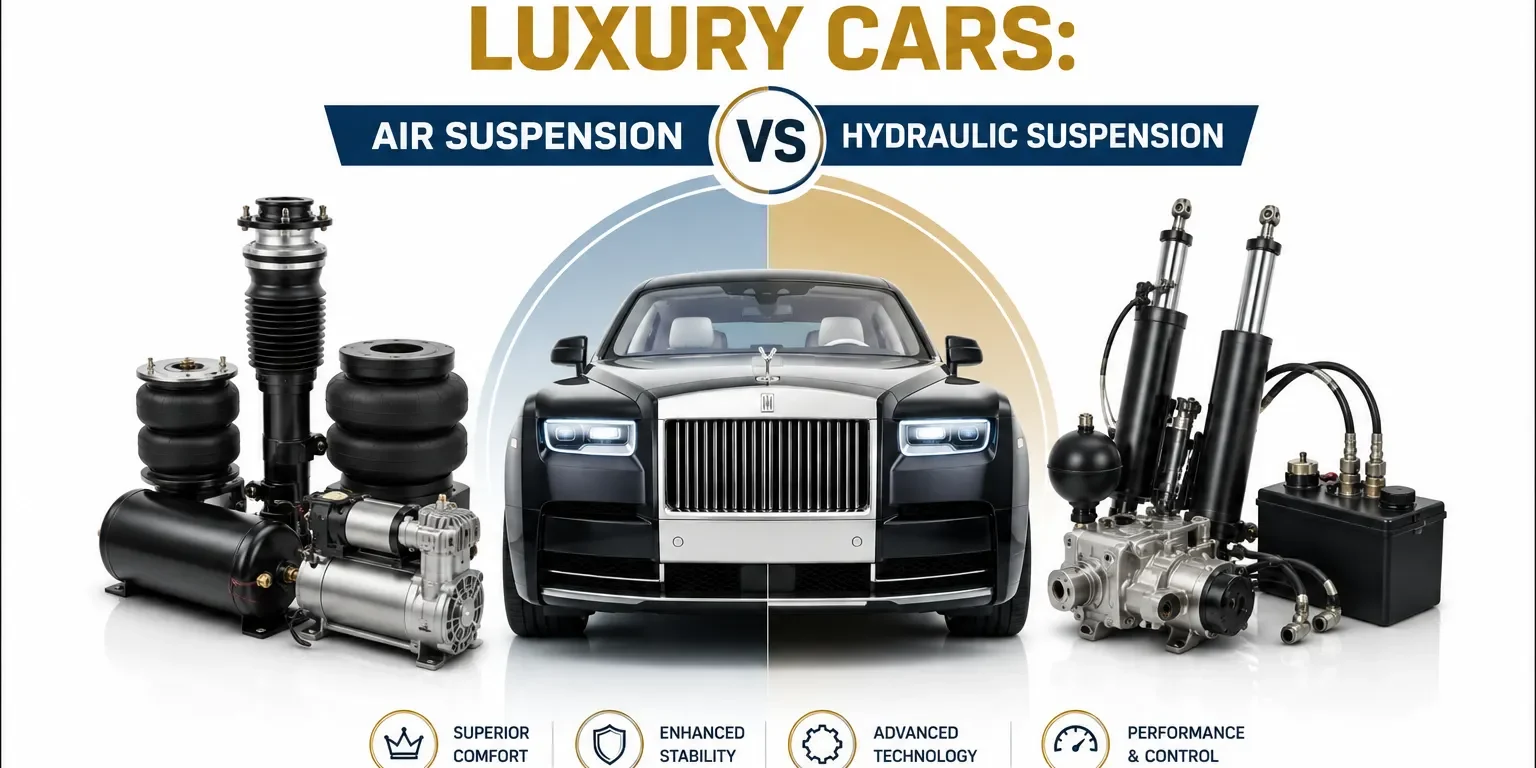
An air suspension system uses compressed air instead of conventional metal coil springs to support the vehicle. Air springs, also called air bags, work with components such as an air compressor, valve block, ride height sensors, shock absorbers, and an electronic suspension control module.
The system can adjust the vehicle’s ride height depending on driving conditions. For example, a luxury SUV may lower itself at highway speeds for improved stability and raise itself when additional ground clearance is needed.
Many premium vehicles use some form of electronically controlled air suspension because it provides a combination of comfort, adjustable ride height, and sophisticated handling.
How Air Suspension Works
The basic process is fairly straightforward:
- The compressor produces compressed air.
- The air is stored or directed through the system.
- Valves control where the air goes.
- Air springs support the weight of the vehicle.
- Ride height sensors monitor the position of each corner.
- The suspension control module adjusts pressure according to driving conditions.
The important point is that the system is not just an air bag. Every component has to work together correctly.
A leaking air spring, weak compressor, faulty ride height sensor, or damaged valve block can affect the entire system.
What Is a Hydraulic Suspension System?
A hydraulic suspension system uses pressurised hydraulic fluid to control suspension movement. Instead of relying primarily on compressed air, the system uses components such as a hydraulic pump, fluid lines, valves, accumulators, and hydraulic actuators.
Some high-end vehicles have used sophisticated hydraulic or electro-hydraulic systems to provide exceptional control over body movement. Depending on the design, hydraulic suspension can control functions such as ride height, body roll, pitch, and suspension stiffness.
Hydraulic suspension should not be confused with the hydraulic fluid inside a conventional shock absorber. A normal shock absorber may contain hydraulic oil internally, but that does not make the vehicle a hydraulic suspension system.
Air Suspension vs Hydraulic Suspension: What’s the Difference?
The main difference between air and hydraulic suspension is the medium used to control and support suspension movement.
Air suspension relies on compressed air and air springs, while hydraulic suspension uses pressurised hydraulic fluid and hydraulic components. Both can be electronically controlled, and both can provide excellent comfort and handling when properly engineered.
| Feature | Air Suspension | Hydraulic Suspension |
|---|---|---|
| Main medium | Compressed air | Hydraulic fluid |
| Main support component | Air spring | Hydraulic actuator/system |
| Ride height adjustment | Excellent | Excellent on suitable systems |
| Ride comfort | Excellent | Excellent |
| System complexity | High | High |
| Maintenance | Air leaks, compressor, sensors, valves | Fluid, pump, seals, valves, lines |
| Common luxury application | Very common | More specialised |
| Repair requirements | Specialist diagnostics | Specialist hydraulic knowledge |
So, which is better, air suspension or hydraulic suspension? There is no universal winner. The better system depends on the vehicle, driving requirements, manufacturer design, maintenance history, and repair support available.
Air Suspension Benefits for Luxury Cars
Air suspension has become popular in luxury vehicles for good reason. It gives manufacturers a lot of control over both comfort and vehicle behaviour.
1. Excellent Ride Comfort
Air springs can provide a very smooth ride by allowing the suspension to respond progressively to changes in road conditions.
This is particularly useful for luxury sedans and SUVs where passengers expect a quiet and comfortable driving experience.
2. Adjustable Ride Height
One of the biggest air suspension benefits is adjustable ride height.
A vehicle can be lowered for improved highway stability or raised when additional clearance is required. This feature is particularly useful on luxury SUVs.
3. Automatic Load Compensation
Air suspension can adjust pressure when the vehicle carries different loads.
For example, if several passengers and luggage are added to an SUV, the system can compensate for the additional weight and help maintain the correct ride height.
4. Electronic Control
Modern systems can communicate with other vehicle systems. The suspension control module can receive information from ride height sensors and other vehicle systems before making adjustments.
That creates a much more adaptable suspension setup than a simple fixed spring.
Hydraulic Suspension Benefits for Luxury Cars
Hydraulic suspension also has some impressive advantages, particularly in systems designed for advanced body control.
1. Precise Suspension Control
Hydraulic systems can deliver highly controlled suspension movement. Depending on the vehicle design, this can help manage body roll, pitch, and ride height.
2. Strong Response
Because hydraulic systems operate using pressurised fluid, they can provide very precise control when properly engineered.
This is useful in applications where the manufacturer wants to prioritise sophisticated handling and body control.
3. Advanced Active Suspension Potential
Hydraulic technology can be incorporated into highly advanced active suspension systems.
Instead of simply absorbing road impacts, the system can actively influence how the vehicle’s body moves.
However, this level of technology also means more components and more specialised servicing.
Air Suspension vs Hydraulic Suspension Pros and Cons
Neither system is perfect. From a mechanic’s perspective, the most important factor is not which technology sounds more advanced. It is how reliably the system operates over time and how easily faults can be diagnosed.
Air Suspension Pros
- Excellent ride comfort
- Adjustable ride height
- Automatic load compensation
- Common on modern luxury vehicles
- Excellent combination of comfort and handling
- Can adapt to different driving modes
Air Suspension Cons
- Air springs can develop leaks
- Compressors can wear out
- Ride height sensors can fail
- Valve blocks can develop faults
- Repairs can become expensive
- Requires specialist diagnostic equipment
Hydraulic Suspension Pros
- Highly controlled suspension movement
- Excellent potential for active suspension
- Precise ride height control
- Strong body control on sophisticated systems
- Excellent performance when correctly maintained
Hydraulic Suspension Cons
- Complex hydraulic components
- Fluid leaks can occur
- Pumps and valves can be expensive
- Repairs require specialised knowledge
- Hydraulic systems can be costly to maintain
Which Is Better for Dubai’s Climate?
Dubai presents some specific challenges for vehicle suspension.
High temperatures, dusty conditions, speed bumps, heavy traffic, and frequent highway driving can put additional stress on suspension components. Heat can also accelerate the deterioration of rubber components and seals.
For air suspension, I pay particular attention to air springs, compressor operation, air lines, valve blocks, and ride height sensors.
A small air leak is especially important. If the compressor has to work continuously to compensate for the leak, the compressor itself can eventually become overloaded.
This is one reason why air suspension maintenance should not be delayed when the vehicle starts showing symptoms.
Hydraulic systems also need careful attention. Hydraulic fluid condition, leaks, pump operation, seals, pressure, and control components should be checked according to the vehicle manufacturer’s requirements.
Common Signs of Air Suspension Problems
A luxury car does not always need to display a major warning light before suspension trouble begins.
Watch for signs such as:
- One corner of the vehicle sitting lower than the others
- The car dropping overnight
- A compressor running for unusually long periods
- Suspension warning messages
- A noticeably harder or softer ride
- Unusual noises from the compressor
- Slow changes in ride height
- Uneven vehicle height
- Poor handling or excessive body movement
If your vehicle is sitting low after being parked overnight, do not immediately assume the compressor is bad.
A leaking air spring or air line may be forcing the compressor to work harder. Replacing the compressor without finding the original leak can result in the same problem returning.
That is why proper diagnosis matters.
Common Signs of Hydraulic Suspension Problems
Hydraulic suspension faults can present differently depending on the vehicle.
Possible warning signs include:
- Hydraulic fluid leaks
- Uneven ride height
- Excessive body movement
- Suspension warning lights
- Strange pump noises
- Slow suspension response
- Hard or unusually soft ride
- Loss of active suspension functions
A hydraulic leak should not be ignored. Loss of fluid can affect system pressure and may eventually damage other components.
Air Suspension Maintenance: What Luxury Car Owners Should Know
Good maintenance is the difference between a sophisticated suspension system and an expensive headache.
For air suspension, a technician should inspect the air springs, lines, compressor, valve block, sensors, and related electronic components.
The vehicle should also be scanned for suspension fault codes when warning lights or abnormal behaviour appear.
For hydraulic systems, maintenance can include checking fluid condition and level, inspecting lines and seals, checking for leaks, and testing pump and pressure operation according to the manufacturer’s service procedure.
The most important rule is simple: diagnose before replacing parts.
A suspension warning does not automatically mean you need a new compressor, pump, air spring, or control module.
Which System Costs More to Maintain?
The answer depends heavily on the vehicle and the failed component.
Air suspension repairs can range from relatively minor leak repairs to expensive compressor, air spring, valve block, or electronic control module replacement.
Hydraulic systems can also become expensive when pumps, actuators, valves, accumulators, or other specialised components fail.
For both systems, the repair bill is usually determined by the specific vehicle and failed component rather than the suspension type alone.
This is why I would never recommend choosing a luxury car purely because its suspension system appears cheaper to maintain on paper.
The vehicle’s service history and the availability of qualified technicians matter just as much.
A Real Workshop Lesson: Don’t Replace Parts Based on Fault Codes Alone
One mistake I have seen repeatedly during my 22 years in automotive repair is replacing a component simply because a diagnostic scanner points toward it.
For example, an air suspension system may show a compressor-related fault. That does not automatically prove the compressor is defective.
A technician should check compressor operation, system pressure, air leaks, electrical supply, relay operation, valve function, and sensor readings before recommending replacement.
The same principle applies to hydraulic systems.
A professional diagnosis looks at the entire system rather than treating one fault code as the final answer.
So, Which Is Better: Air Suspension or Hydraulic Suspension?
For most modern luxury cars, air suspension is the more practical choice because it provides excellent comfort, adjustable ride height, load compensation, and sophisticated electronic control. It is also widely used across premium SUVs and sedans.
Hydraulic suspension can be the better solution for specialised vehicles where advanced body control and active suspension performance are priorities.
In other words, air suspension generally wins for versatility and luxury comfort, while hydraulic suspension can win in specialised applications where precise active control is the main goal.
But there is an important catch.
The best suspension is the one that is correctly engineered for your particular vehicle and properly maintained. Replacing a factory-designed system with another technology simply because it sounds better can create new problems with handling, electronics, ride height, and vehicle calibration.
When Should You Get Your Luxury Car Suspension Checked?
Do not wait until your car becomes difficult to drive.
Get the suspension inspected if you notice a warning light, uneven ride height, unusual noises, excessive bouncing, poor handling, uneven tyre wear, fluid leaks, or a noticeable change in ride comfort.
For air suspension vehicles, a car that sits lower after being parked is particularly worth investigating.
A proper inspection can identify whether the problem is mechanical, pneumatic, hydraulic, electrical, or software-related.
For Dubai luxury car owners, professional suspension inspection and repair can help prevent a small fault from turning into a much larger repair.
Professional Suspension Repair in Dubai
If your luxury vehicle is showing suspension problems, Car Repair Auto Services can help with professional suspension inspection and repair in Dubai.
The workshop provides suspension and steering repair services and works with a range of vehicle brands, including premium and luxury models.
You can learn more about the service here: Car Suspension Repair in Dubai.
For broader vehicle maintenance and repair, visit Car Repair Auto Services.
The sensible approach is to diagnose the suspension properly before buying expensive parts. Whether your car uses air suspension, hydraulic suspension, adaptive dampers, or a conventional setup, identifying the actual cause is the first step toward a reliable repair.
Final Thoughts
The Air Suspension vs Hydraulic Suspension debate does not have one answer that applies to every luxury vehicle.
Air suspension offers outstanding comfort, adjustable ride height, and excellent versatility, which is why it has become common in modern luxury cars. Hydraulic suspension offers highly controlled operation and can be an excellent choice for sophisticated active suspension applications.
For Dubai drivers, maintenance is just as important as the technology itself. Heat, road conditions, speed bumps, and daily driving can expose weak components quickly.
If your luxury car is showing suspension warning signs, do not guess which component has failed. Have the system properly inspected, identify the root cause, and repair the fault before it creates secondary damage.
A smooth luxury ride is not just about comfort. It is about keeping every suspension component working together correctly.