Your steering wheel is slightly off center. The car pulls to one side. At 100 km/h, you suddenly feel a vibration through the steering wheel. Many drivers assume all three problems are caused by the same thing. They are not.
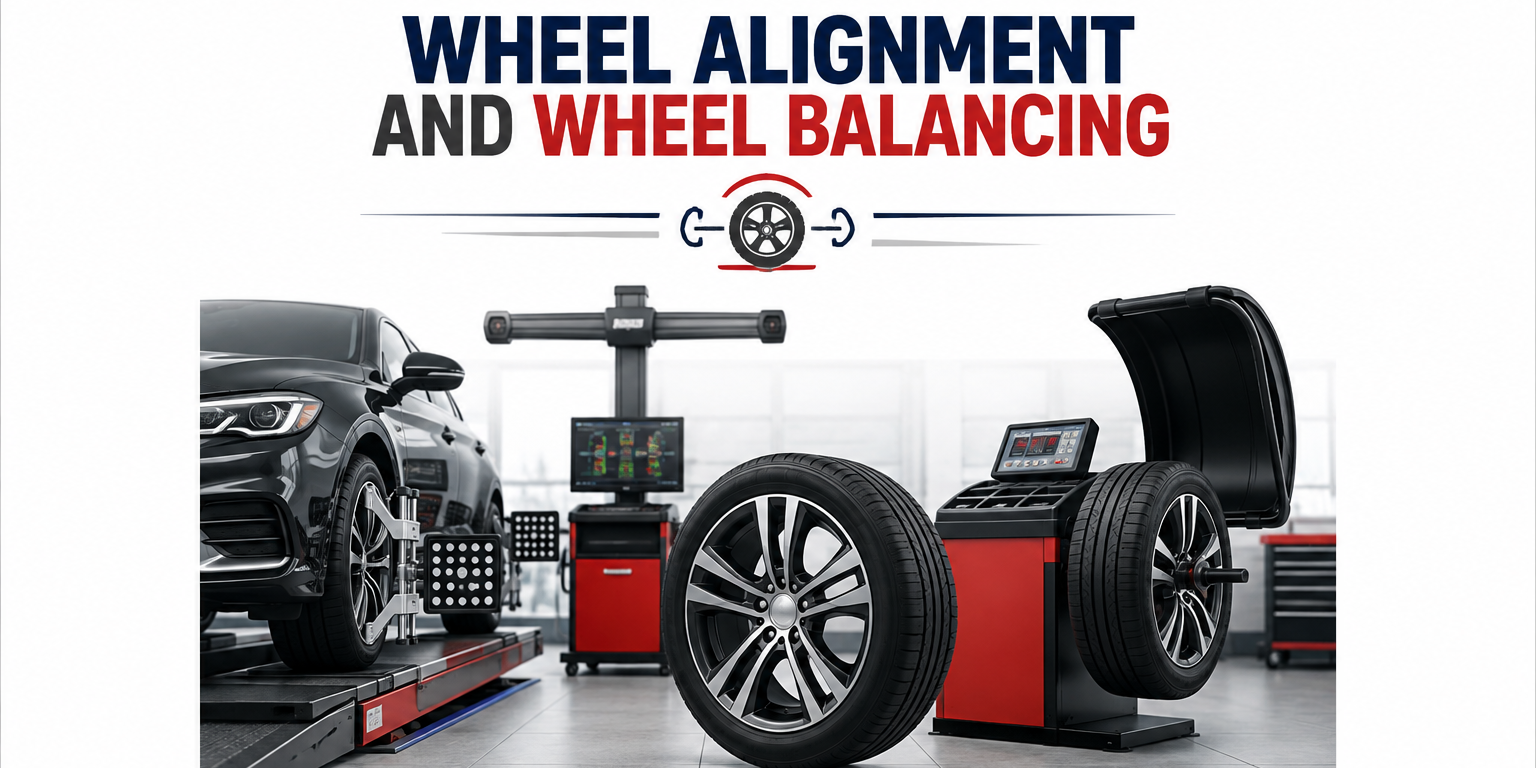
Wheel alignment and wheel balancing are two different services that solve two different problems. Alignment corrects the position and angles of the wheels, while balancing corrects uneven weight distribution between the tire and wheel assembly.
In Dubai, where cars regularly deal with high temperatures, heavy traffic, rough road surfaces, speed bumps, and long highway drives, knowing the difference can help you avoid premature tire wear and unnecessary repair costs.
What Is Wheel Alignment?
Wheel alignment is the process of checking and adjusting the angles of your vehicle’s wheels so they match the manufacturer’s specifications.
The main alignment angles include toe, camber, and caster. These settings affect how the tires sit against the road, how the car tracks in a straight line, and how evenly the tires wear.
A properly aligned vehicle should drive straight on a reasonably flat road, with the steering wheel centered and the tires maintaining proper contact with the road.
What Does a Wheel Alignment Fix?
A wheel alignment can correct problems such as:
- Car pulling to the left or right
- Crooked steering wheel while driving straight
- Uneven tire wear
- Rapid wear on the inside or outside edge of a tire
- Poor straight line stability
- Steering that feels unusual after hitting a curb or pothole
Misalignment can cause tires to wear unevenly and may reduce their usable life. Road safety guidance also recommends proper alignment to help prevent a vehicle from veering and to maximize tire life.
What Is Wheel Balancing?
Wheel balancing is different from alignment.
A tire and wheel assembly can have an uneven distribution of weight. When the wheel rotates, that imbalance can create vibration. A balancing machine identifies the heavier areas and tells the technician where balancing weights should be installed.
In simple terms:
Alignment controls how the wheels point and sit on the road. Balancing controls how smoothly the wheel and tire rotate.
New tires should also be balanced when installed because even a new tire and rim combination can have a small weight imbalance.
Wheel Alignment vs Wheel Balancing: What Is the Difference?
This is one of the most common questions we hear in a workshop.
| Wheel Alignment | Wheel Balancing |
|---|---|
| Corrects wheel and suspension angles | Corrects weight distribution |
| Deals with toe, camber and caster | Uses balancing weights |
| Helps correct pulling | Helps correct vibration |
| Helps prevent uneven tire wear | Helps wheels rotate smoothly |
| Steering wheel may sit off center | Steering wheel may shake at speed |
| Usually measured on an alignment machine | Usually performed on a wheel balancing machine |
The easiest way to remember it is this:
If the car is not tracking correctly, think alignment. If the wheel is vibrating while rotating, think balancing.
However, both problems can exist at the same time, which is why a proper inspection is more useful than simply asking for one service.
How Do You Know Your Car Needs Wheel Alignment?
One of the first signs I look for as a mechanic is how the vehicle behaves on a straight road.
If the steering wheel is centered but the car consistently wants to move toward one side, the alignment deserves inspection. Tire wear can also tell an experienced technician a lot about what is happening underneath the vehicle.
Look closely at the tread.
If the inside edge is wearing much faster than the rest of the tire, or the outside edge is disappearing unusually quickly, an alignment or suspension problem may be involved.
Common Wheel Alignment Symptoms
Watch for these signs:
- Vehicle pulls left or right
- Steering wheel is not centered
- Tire edges wear unevenly
- Vehicle feels unstable on a straight road
- Steering feels different after hitting a curb
- Tires show abnormal wear despite correct pressure
One important point is that tire pressure should be checked before diagnosing alignment. Incorrect pressure can also affect handling and tire wear.
How Do You Know Your Car Needs Wheel Balancing?
Balancing problems normally make themselves known through vibration.
A common example is a vehicle that feels perfectly normal around town but starts shaking when you reach highway speeds.
You may feel the vibration through the steering wheel, seat, or floor. The exact location can provide useful clues about which wheel or axle may be involved.
Common symptoms include:
- Steering wheel vibration at higher speeds
- Seat or floor vibration
- Uneven or cupped tire wear
- Reduced driving smoothness
- Vibration that becomes stronger at particular speeds
Road safety guidance identifies vibration through the steering wheel, seat, or floor at motorway speeds as a common sign of wheel imbalance.
A Realistic Dubai Workshop Case: Steering Wheel Vibration at Highway Speed
Here is a typical situation we see in professional workshops.
A customer brings in a Toyota Camry and says:
“The car drives fine around Dubai, but when I go onto Sheikh Zayed Road and increase the speed, the steering wheel starts shaking.”
The first mistake would be to immediately perform a wheel alignment.
The better approach is to inspect the tires, rims, tire pressures, wheel condition, and balance first.
If the alignment readings are within specification but the balancing machine shows excessive imbalance on one front wheel, adding the correct balancing weight can solve the vibration without unnecessary alignment adjustments.
This is why diagnosis matters.
A customer should not pay for every possible service simply because the symptoms involve the wheels.
Another Common Case: Car Pulling After Hitting a Pothole
Consider another realistic workshop situation.
A Nissan Patrol hits a deep pothole. The driver notices afterward that the steering wheel is no longer straight and the vehicle seems to drift toward the right.
In this situation, I would not simply perform an alignment and send the customer away.
First, I would inspect the tire and rim for damage and check suspension and steering components. A pothole can potentially damage or bend components, and alignment readings alone do not automatically prove that every mechanical part is healthy.
If the components are sound and the alignment readings are outside specification, the alignment can then be corrected.
That is the difference between checking a number on a machine and actually diagnosing a vehicle.
Why Dubai Roads Can Make Wheel Problems More Noticeable
Dubai has excellent major roads, but drivers still encounter potholes, road joints, speed bumps, curbs, construction areas, and uneven surfaces.
Even a single hard impact can affect a tire or rim. Repeated impacts can also contribute to suspension or steering problems.
Temperature is another factor worth considering. Dubai’s extreme heat puts additional stress on tires, and tire pressure changes with temperature. Maintaining the correct tire pressure according to the vehicle manufacturer’s recommendation is therefore important.
If you regularly drive long distances between areas such as Al Quoz, Business Bay, Downtown Dubai, Dubai Marina, or Jebel Ali, small handling problems can become much more noticeable because of the amount of time spent on the road.
Does Wheel Balancing Fix Wheel Alignment?
No. Wheel balancing does not fix wheel alignment.
Balancing corrects uneven weight distribution in the tire and wheel assembly. Alignment adjusts suspension and steering geometry so the wheels are positioned correctly relative to the vehicle and road.
They are separate procedures, although a vehicle can require both at the same time.
For example, a car may have a perfectly correct alignment but still shake at highway speed because one wheel is out of balance.
Likewise, a car can have perfectly balanced wheels but pull toward the left because its alignment is incorrect.
Does Wheel Alignment Fix Vibration?
Usually, no.
If your main complaint is vibration at highway speed, the technician should inspect wheel balance, tire condition, wheel runout, and other possible causes rather than automatically assuming alignment is responsible.
However, severe tire wear caused by poor alignment can eventually contribute to an uncomfortable ride.
This is why an experienced mechanic looks at the complete picture instead of treating one symptom in isolation.
When Should You Get Wheel Alignment and Balancing?
There is no single interval that applies perfectly to every vehicle.
Instead, inspection should be considered when something changes.
You should consider checking alignment and balancing when:
- You install new tires
- You hit a pothole or curb hard
- You notice steering wheel vibration
- Your car starts pulling to one side
- The steering wheel becomes off center
- You notice unusual tire wear
- Suspension or steering components are replaced
- You feel the vehicle is no longer driving smoothly
If new tires are installed, balancing should be part of the installation process.
Why Tire Condition Must Be Checked Before Alignment
This is something inexperienced workshops sometimes overlook.
A tire can have internal damage, abnormal wear, a bulge, or a distorted shape. A damaged tire cannot be made safe simply by correcting the alignment.
The same applies to a bent rim.
If a wheel has suffered a strong impact, the technician should inspect the rim before assuming that an alignment adjustment will solve everything.
A professional wheel service should therefore involve inspection, not simply putting the vehicle on a machine and printing a report.
What Happens During a Professional Wheel Alignment?
The exact procedure depends on the vehicle, but a professional alignment generally involves checking the vehicle’s current geometry and comparing the measurements with the manufacturer’s specifications.
The technician may inspect:
- Toe
- Camber
- Caster
- Steering wheel position
- Tire condition
- Suspension components
- Steering components
If adjustments are possible and the components are in good condition, the technician makes the necessary corrections and verifies the final readings.
The important part is the before and after measurement.
A customer should be able to understand what was wrong and what was corrected.
What Happens During Wheel Balancing?
During balancing, the wheel and tire assembly is mounted on a balancing machine.
The machine rotates the assembly and detects areas where weight distribution is uneven. The technician then adds the appropriate balancing weights in the locations indicated by the machine.
The wheel is spun again to verify the result.
The objective is simple: reduce imbalance so the wheel rotates smoothly with minimal vibration.
Can Bad Alignment Damage Tires?
Yes.
When wheel angles are incorrect, the tire may not maintain the intended contact with the road. This can cause uneven or accelerated tread wear.
A tire might look perfectly acceptable from the outside while the inner shoulder is becoming dangerously worn.
This is why I always recommend looking at the entire tread rather than judging a tire by the visible outer surface alone.
Proper alignment helps maximize tire life, but it cannot compensate for a tire that is already damaged or worn beyond a safe level. Tire safety guidance recommends replacing tires once tread wear reaches the manufacturer’s or applicable safety limit.
Can Bad Wheel Balance Damage Your Car?
An imbalance can create continuous vibration. Over time, that vibration can affect driving comfort and place additional stress on tires, wheels, and suspension components.
The first thing most drivers notice is the vibration, but the larger concern is allowing the underlying problem to continue unchecked.
A small balancing problem is generally much easier and cheaper to address than waiting until the tire develops severe irregular wear or another wheel related problem appears.
Wheel Alignment and Balancing for Luxury Cars in Dubai
Luxury vehicles deserve additional attention because many use larger wheels, low profile tires, performance suspension systems, or more complex steering systems.
A small issue can be much more noticeable in a Mercedes Benz, BMW, Audi, Porsche, Range Rover, or other premium vehicle.
Low profile performance tires also provide less sidewall flexibility, which means road impacts can be felt more directly.
For these vehicles, proper equipment and an experienced technician matter. A workshop should inspect the tire and wheel assembly carefully rather than simply adjusting alignment settings.
What Should You Ask a Garage Before Paying for Alignment?
You do not need to be a mechanic to ask the right questions.
Before approving the work, ask:
- What did you find during the inspection?
- Which alignment readings are outside specification?
- Is the tire wear consistent with an alignment problem?
- Did you check the rims for damage?
- Are the suspension and steering components healthy?
- Will you provide before and after alignment readings?
- Does the wheel require balancing as well?
A trustworthy mechanic should be comfortable explaining the answer.
If someone tells you, “You need alignment and balancing,” without explaining why, ask for the inspection results.
Choosing Wheel Alignment and Balancing in Dubai
Dubai has many tire shops, alignment centers, and auto repair workshops. The important thing is not simply finding the cheapest service.
A good workshop should have suitable alignment and balancing equipment, trained technicians, proper tire inspection procedures, and the ability to identify mechanical problems that may be causing the symptoms.
For example, Road Force Tyre and Dialatire.com are among the businesses currently listed in Dubai for wheel alignment related services. These examples show why customers have several options, but you should still compare the actual inspection process and suitability for your vehicle rather than choosing solely on price.
For a complete mechanical inspection rather than a tire service alone, Car Repair Auto Services can also be considered as part of your Dubai car maintenance plan. The workshop’s website describes services covering suspension and steering repair, diagnostics, brakes, engine work, and general vehicle maintenance.
Car Repair Auto Services Dubai
Why Choose Car Repair Auto Services for Wheel Related Problems?
Sometimes what appears to be a simple alignment problem is actually caused by something else.
A worn suspension component can affect wheel geometry. A damaged rim can cause vibration. A worn steering component can affect handling. A damaged tire can create symptoms that alignment alone cannot solve.
That is why a workshop that can inspect the complete vehicle has an advantage.
Car Repair Auto Services provides suspension and steering repair, brake service, diagnostics, maintenance, and other vehicle repair services in Dubai.
If your car is pulling, vibrating, wearing tires unevenly, or behaving differently after a road impact, you can start with a proper inspection rather than guessing which service you need.
Check Car Repair Auto Services in Dubai
Final Thoughts
Wheel alignment and wheel balancing are not the same service.
Alignment deals mainly with wheel and suspension geometry. Balancing deals with the weight distribution of the tire and wheel assembly.
If your car pulls to one side, the steering wheel is crooked, or the tires are wearing unevenly, alignment should be checked. If your steering wheel or seat vibrates at highway speed, balancing and tire condition should be investigated.
The most important advice from a mechanic’s perspective is simple: do not diagnose the problem from one symptom alone. Check the tires, rims, suspension, steering, alignment readings, and wheel balance together when necessary.
If you are driving in Dubai and have noticed vibration, uneven tire wear, or a steering problem, having the vehicle inspected early can prevent a small issue from becoming an expensive tire or suspension repair.
Frequently Asked Questions
What is the main difference between wheel alignment and wheel balancing?
Wheel alignment corrects the position and angles of the wheels in relation to the vehicle and road. Wheel balancing corrects uneven weight distribution in the tire and wheel assembly to reduce vibration. They are different services that can sometimes be needed together.
How do I know if my car needs alignment or balancing?
A car that pulls to one side, has an off center steering wheel, or develops uneven tire wear may need alignment. Vibration through the steering wheel, seat, or floor at higher speeds commonly points toward a wheel balance problem.
Should I balance my wheels after installing new tires?
Yes. New tire installations should include balancing because the tire and wheel assembly can have uneven weight distribution. Proper balancing helps the wheel rotate smoothly and reduces vibration.
Can a pothole affect wheel alignment?
Yes. A significant impact with a pothole or curb can affect wheel alignment and may also damage a tire, rim, steering component, or suspension part. The vehicle should be inspected rather than assuming alignment is the only problem.
Does wheel alignment improve tire life?
Proper alignment can help reduce uneven and premature tire wear by keeping the wheels positioned according to the vehicle manufacturer’s specifications. However, tire pressure, tire condition, driving habits, suspension condition, and road conditions also affect tire life.