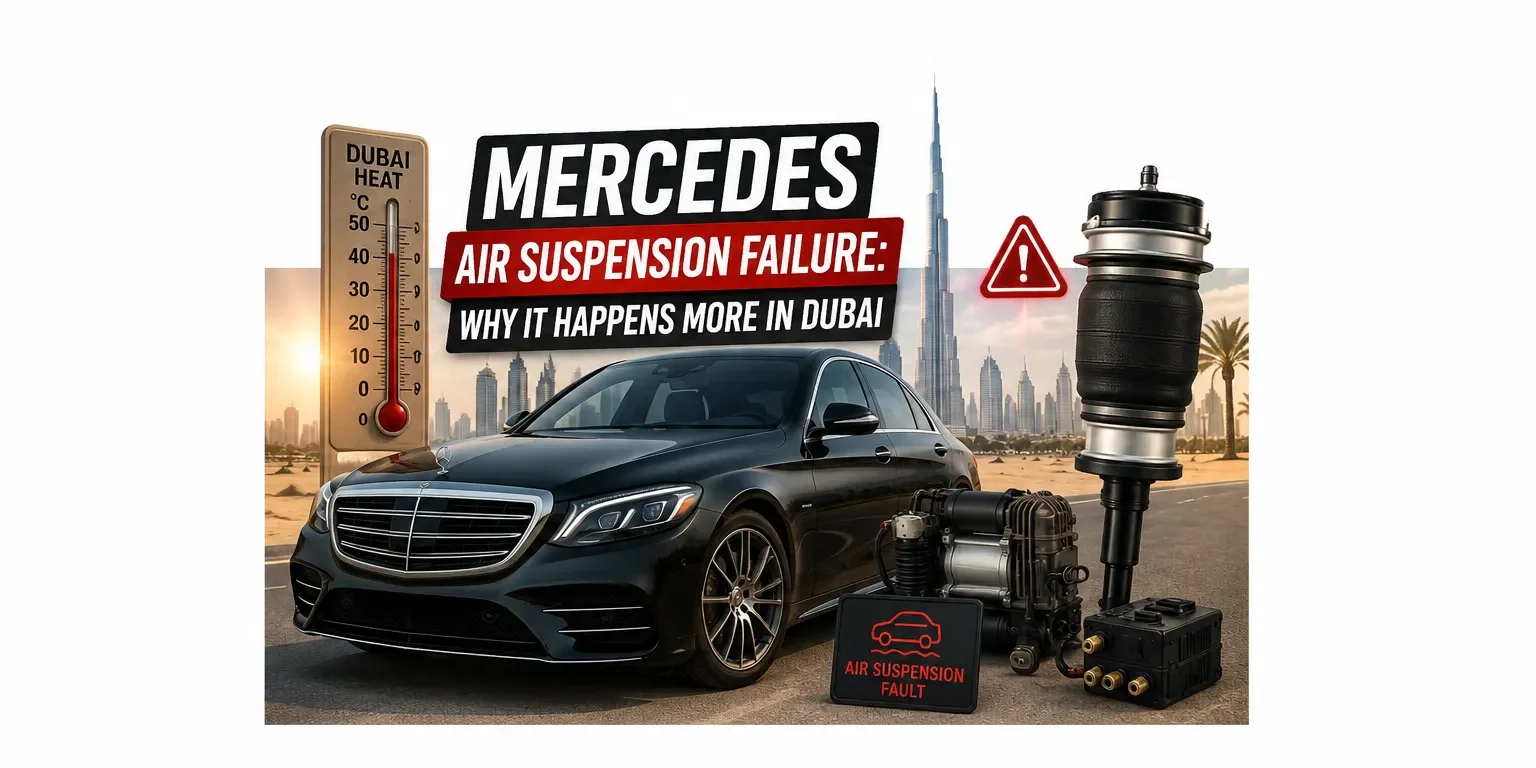
A Mercedes air suspension failure can turn a smooth, comfortable drive into an expensive repair problem, especially when your vehicle starts sitting low, leaning to one side, or showing a suspension warning. In Dubai, extreme summer heat can put additional stress on components that are already worn or aging. Mercedes AIRMATIC is designed to maintain the vehicle’s ride height and comfort, but it still needs proper inspection and maintenance.
If your Mercedes is not raising properly or the compressor seems to run longer than usual, ignoring the warning can make a small air leak develop into a larger suspension repair. Here is what causes Mercedes air suspension problems in Dubai, what symptoms to watch for, and how professional diagnosis can prevent unnecessary replacement costs.
What Is Mercedes AIRMATIC Air Suspension?
Mercedes AIRMATIC is an electronically controlled air suspension system designed to maintain the vehicle’s ride height while improving comfort and handling. Instead of relying only on conventional coil springs, the system uses air springs, sensors, valves, a compressor, and electronic controls to adjust the vehicle’s level.
Mercedes-Benz describes AIRMATIC as a system that provides automatic level control and helps maintain consistent ground clearance, even when the vehicle is carrying different loads.
The main components can include:
- Air suspension struts or air springs
- Air suspension compressor
- Air reservoir and air lines
- Valve block
- Ride height sensors
- Electronic control unit
- Pressure and temperature monitoring components
When all these components work correctly, the vehicle should maintain a stable ride height and deliver the smooth driving experience expected from a Mercedes.
Why Does Mercedes Air Suspension Fail More in Dubai?
Dubai’s climate does not automatically cause AIRMATIC failure, but high temperatures can increase the stress placed on an already worn system.
The problem often develops through a combination of extreme heat, aging rubber components, small air leaks, compressor workload, road conditions, and delayed maintenance.
Dubai’s Roads and Transport Authority regularly advises motorists to inspect and maintain their vehicles during the summer because high temperatures and increased road travel can contribute to mechanical problems.
1. Extreme Heat Puts Extra Stress on Components
High ambient temperatures can affect rubber seals, air lines, electrical connections, and other suspension components. If an air spring or fitting is already beginning to deteriorate, prolonged exposure to heat can accelerate the problem.
This does not mean every Mercedes in Dubai will develop an air suspension problem. However, an older system with existing wear may have less tolerance for the demanding conditions.
2. Small Air Leaks Make the Compressor Work Harder
A small Mercedes air suspension leak is one of the problems technicians frequently need to investigate when a vehicle starts sagging overnight.
Imagine parking your Mercedes normally in the evening and finding one corner noticeably lower the next morning. The air spring may be losing pressure while the vehicle is parked.
When you start driving, the compressor may need to run to restore the correct ride height. If the leak remains, the compressor repeatedly compensates for the lost air.
That additional workload can eventually contribute to Mercedes air suspension compressor failure.
3. Compressor Overheating Can Become a Serious Warning
The compressor is responsible for supplying pressurized air to the suspension system. If it repeatedly has to compensate for an air leak, it may operate for longer periods than intended.
Mercedes documentation also indicates that AIRMATIC can temporarily limit operation when overheating protection is activated after repeated level changes.
This is why replacing the compressor without finding the reason it was overworked can be a costly mistake.
A good technician should ask:
Why did the compressor fail?
Not simply:
How much does a new compressor cost?
Common Mercedes Air Suspension Problems in Dubai
Mercedes air suspension problems can appear gradually or suddenly. Some symptoms are easy to notice, while others only become obvious during inspection.
The most common signs include:
- Mercedes suspension warning light
- Vehicle sitting lower than normal
- Mercedes suspension sagging overnight
- Mercedes car leaning to one side
- Suspension not raising
- Compressor running unusually often
- Unusual compressor noise
- Uneven ride height
- Harsh or uncomfortable ride
- Vehicle dropping after being parked
- AIRMATIC or suspension fault warning
- Reduced ground clearance
If you notice one of these symptoms, do not automatically assume that the compressor has failed. The actual cause could be an air spring, valve block, sensor, air line, electrical fault, or another component.
What Causes Mercedes AIRMATIC Suspension Failure?
There is rarely one universal cause of Mercedes AIRMATIC suspension failure. The system contains several interconnected components, so accurate diagnosis matters.
Here are some of the most common causes.
Air Suspension Leak
An air leak can develop around an air spring, air line, connector, or valve assembly. Even a small leak can gradually lower the vehicle when parked.
A Mercedes that consistently drops overnight should be checked for leaks before other expensive components are replaced.
Failed Air Spring
The rubber material in an air spring can deteriorate with age and repeated use. Cracks, leaks, or structural damage can prevent the suspension from holding pressure correctly.
Mercedes Air Suspension Compressor Failure
A weak or failed compressor cannot generate enough pressure to raise the vehicle correctly.
However, compressor failure is sometimes the result, rather than the original cause. If the compressor has been working excessively because of an air leak, simply installing another compressor may not solve the underlying problem.
Faulty Ride Height Sensor
AIRMATIC relies on sensors to determine the vehicle’s ride height. A damaged or inaccurate sensor can provide incorrect information to the control system.
The result may be an incorrect ride height or a suspension warning.
Valve Block Problems
The valve block controls how compressed air is distributed through the suspension system. If a valve sticks or leaks, the system may struggle to maintain the correct pressure at one or more corners.
Electrical or Control System Faults
AIRMATIC depends on electronic control. Wiring damage, connector problems, sensor faults, or control module issues can affect suspension operation.
This is why proper diagnostic scanning should be part of a professional Mercedes suspension repair Dubai inspection.
Why Is My Mercedes Suspension Not Raising?
If your Mercedes suspension is not raising, the system may not be producing or distributing enough air pressure.
Common possibilities include a failed compressor, a significant air leak, faulty valve block, ride height sensor issue, electrical fault, or an overheating protection condition.
The safest approach is to avoid repeatedly commanding the vehicle to raise if the system is clearly struggling. Continued operation can place additional load on the compressor.
Why Is My Mercedes Leaning to One Side?
A Mercedes car leaning to one side often indicates a problem affecting that corner of the suspension.
A leaking air spring is one possible cause, but it is not the only explanation. A valve problem, sensor fault, damaged air line, or control issue can also produce an uneven ride height.
The key is to determine whether the vehicle is actually losing air or receiving incorrect height information.
A professional inspection can compare ride height, scan the suspension control system, check for leaks, and test the compressor and related components.
Why Dubai Heat Can Make Existing Suspension Problems Worse
It is important to separate two things: heat causing a failure and heat exposing an existing weakness.
A healthy AIRMATIC system is designed for normal vehicle operation. But when components are already aged or damaged, Dubai’s hot environment can make the weaknesses more noticeable.
For example, consider a Mercedes with an aging air spring that has developed a tiny leak. During normal conditions, the leak might initially be slow enough to escape attention.
Over time, however, the compressor may need to compensate more frequently. The driver eventually notices that the car sits lower after parking or that the compressor runs longer than expected.
That is when a relatively small issue can turn into a much larger repair.
Signs You Should Not Ignore
Some Mercedes suspension symptoms deserve immediate attention.
If your vehicle:
- Drops significantly overnight.
- Sits noticeably lower on one side.
- Shows a suspension fault warning.
- Takes unusually long to reach normal ride height.
- Produces repeated compressor noises.
- Suddenly loses ride height while driving.
Do not treat the problem as a minor comfort issue.
A malfunctioning suspension can affect ride height, handling, tyre clearance, and overall vehicle stability. If the vehicle is sitting extremely low or handling feels abnormal, it is better to have it inspected rather than continuing to drive unnecessarily.
How to Fix Mercedes Air Suspension Problems
There is no single repair for every Mercedes air suspension failure.
The correct repair depends on the failed component.
A professional diagnostic process may include:
- Scanning the vehicle for AIRMATIC fault codes.
- Checking the actual ride height at each corner.
- Inspecting air springs and suspension struts.
- Testing the system for air leaks.
- Checking compressor operation and pressure.
- Inspecting the valve block.
- Testing ride height sensors.
- Checking wiring and electrical connections.
- Inspecting the air lines and fittings.
- Clearing and retesting the system after repair.
This approach helps identify the root cause instead of replacing parts based only on symptoms.
Mercedes Air Suspension Repair vs Replacement
One of the biggest concerns for Mercedes owners is whether the suspension can be repaired or needs replacement.
The answer depends on the condition of the affected component.
If an air line, connector, sensor, or certain serviceable component has failed, a targeted repair may be possible. If an air spring or compressor is severely damaged or beyond serviceable condition, replacement may be the more reliable solution.
The important point is that Mercedes air suspension replacement Dubai should not be recommended until the system has been properly diagnosed.
Replacing multiple expensive components without confirming the fault can quickly increase your repair bill.
How to Prevent Mercedes Air Suspension Failure in Dubai
You cannot eliminate every possible suspension failure, but you can reduce the risk of major problems through regular inspection.
A practical air suspension maintenance Dubai routine should include checking for:
- Uneven ride height
- Overnight suspension sagging
- Cracked or deteriorated air springs
- Air leaks
- Compressor noise
- Suspension warning messages
- Damaged air lines
- Sensor or electrical issues
Pay attention to changes in how your Mercedes behaves.
If the compressor suddenly sounds louder than usual, the vehicle takes longer to rise, or one corner begins dropping after parking, get it checked early.
Early diagnosis is often much cheaper than waiting until the compressor, air spring, and other components are affected.
What Does a Mercedes Air Suspension Inspection Involve?
A proper inspection should go beyond simply connecting a diagnostic scanner.
The technician should combine electronic diagnostics with physical inspection.
For example, a fault code may indicate a pressure or level problem, but the code alone does not necessarily tell you whether the cause is a leaking air spring, compressor problem, valve issue, or sensor fault.
A qualified technician can use the diagnostic information as a starting point and then physically test the relevant components.
This is especially important when dealing with Mercedes AIRMATIC problems Dubai, where owners may be tempted to replace the most expensive component first.
When Should You Visit a Mercedes Suspension Specialist?
You should arrange an inspection when you notice repeated suspension warnings, abnormal ride height, sagging, leaning, unusual compressor activity, or difficulty raising the vehicle.
For Dubai drivers, dealing with the problem early is particularly sensible because long periods of heat and daily driving can place additional demands on an already aging system.
If you need professional help diagnosing a Mercedes suspension issue, Car Repair Auto Services can inspect the suspension system and identify the likely source of the fault before recommending the appropriate repair.
You can learn more about the available automotive repair services through Car Repair Auto Services.
Frequently Asked Questions
Why does Mercedes air suspension fail?
Mercedes air suspension can fail because of air leaks, aging air springs, compressor wear, valve block problems, faulty ride height sensors, electrical faults, or other component failures. In Dubai, high temperatures can place additional stress on already worn components.
How do I know if my Mercedes air suspension compressor is failing?
Common signs include a compressor that runs for unusually long periods, unusual compressor noise, slow suspension raising, repeated suspension warnings, or a vehicle that cannot maintain its normal ride height. However, a leak can also cause the compressor to overwork, so the complete system should be tested.
Can a Mercedes air suspension leak be repaired?
Yes, depending on where the leak is located and the condition of the component. An air line, connector, or other affected component may be repairable, while a damaged air spring or severely worn component may require replacement.
How long can I drive with a Mercedes suspension warning?
It depends on the severity of the fault. If the vehicle has dropped significantly, is leaning, has very low ground clearance, or feels unstable, continued driving is not advisable. Have the vehicle inspected as soon as possible.
How can I prevent Mercedes AIRMATIC problems in Dubai?
Regular inspections, early leak detection, monitoring ride height, and addressing suspension warnings quickly can help prevent minor faults from becoming major repairs. Checking the system before long journeys is also a sensible precaution.
Final Thoughts
A Mercedes air suspension failure does not always mean that the entire AIRMATIC system needs to be replaced. In many cases, the most important step is finding the original cause of the problem.
An air leak can overwork the compressor. A faulty sensor can create incorrect ride-height behaviour. A worn air spring can cause the vehicle to sag. Heat can add stress to components that are already approaching the end of their service life.
The best strategy is simple: diagnose first, replace second.
If your Mercedes is leaning, sagging, refusing to raise, or displaying a suspension warning in Dubai, arrange a professional inspection before the problem becomes more expensive. For Mercedes suspension diagnostics and repair assistance, visit Car Repair Auto Services and discuss the symptoms with a qualified automotive technician.