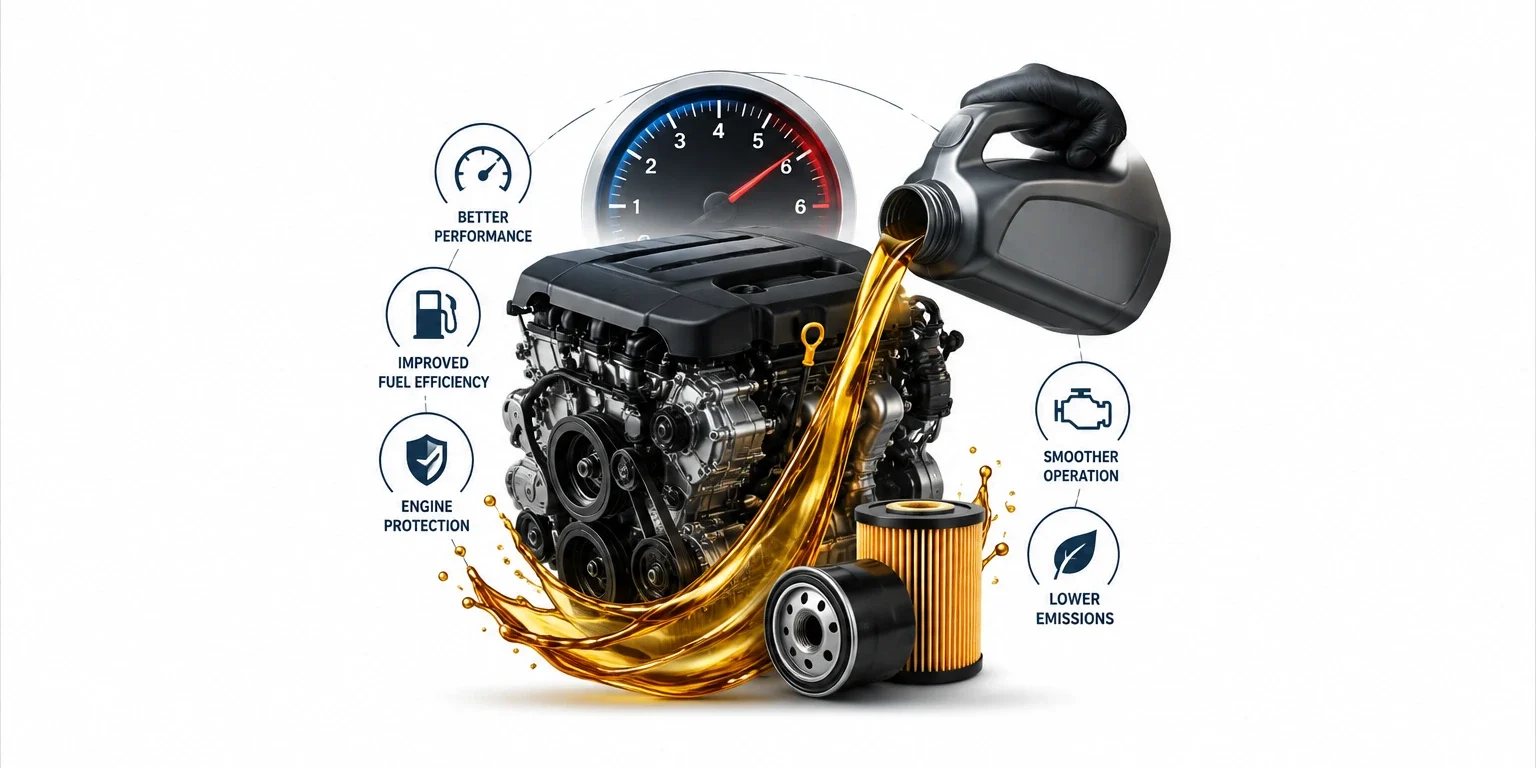
Have you ever picked up your car after an oil change and noticed that the engine feels quieter, smoother, or more responsive? That change can be real, especially when old engine oil has become contaminated, degraded, or too thick for the engine’s operating conditions. Understanding Engine Performance After Oil Change helps you separate normal improvements from problems that need further diagnosis. In this guide, we explain what actually changes inside the engine, how quickly you may notice the difference, and when an oil change is not enough.
What Happens to Engine Performance After an Oil Change?
A fresh oil change gives the engine clean lubricant with the correct viscosity and specification for its design. Engine oil reduces friction between moving components such as bearings, camshafts, piston rings, and other parts inside the internal combustion engine.
When old oil becomes contaminated or loses some of its protective properties, the engine may have to work under less ideal lubrication conditions. Replacing it with the correct fresh oil can help the engine operate more smoothly.
After a proper oil change, some drivers may notice:
- A smoother idle
- Less mechanical engine noise
- More consistent throttle response
- Smoother acceleration
- Reduced friction related vibration
- Better overall driving feel
However, an oil change does not magically repair a worn engine or add significant power. The improvement depends heavily on the condition of the old oil, the engine’s condition, the correct oil specification, and whether the oil filter was replaced.
Does Oil Change Improve Engine Performance?
Yes, an oil change can improve engine performance when the existing oil is old, degraded, contaminated, incorrectly specified, or low in level. Fresh oil reduces friction and provides better lubrication, which can help the engine operate more efficiently.
The important point is that an oil change usually restores lost performance rather than creating new horsepower. If your engine was already properly maintained and running on suitable oil, the difference after changing it may be small.
Think of it like changing a pair of worn shoes. New shoes do not make you stronger, but they can make walking feel easier because you are no longer dealing with the problems caused by worn equipment.
How Does New Engine Oil Affect Engine Performance?
Engine oil performs several jobs at the same time. It lubricates moving parts, helps manage heat, carries contaminants away from critical components, and helps reduce metal to metal contact.
Inside a modern engine, many components move thousands of times per minute. The oil must maintain a protective film between these surfaces while operating under changing temperatures and loads.
When the correct fresh oil is installed, it can help:
Reduce Internal Friction
Friction is one of the biggest reasons engines lose efficiency. Fresh oil creates a protective lubricating film that helps moving components operate with less resistance.
This does not mean the engine suddenly becomes more powerful. It means the engine can operate under the conditions it was designed for.
Support Smooth Engine Operation
If old oil has become heavily contaminated or degraded, the engine may sound rougher or more mechanical than usual. Fresh oil can sometimes make the engine noticeably quieter.
This is particularly noticeable on some engines with hydraulic components that depend on proper oil pressure and lubrication.
Help Maintain Proper Lubrication
Oil must reach critical components quickly after startup. The correct oil specification and viscosity are important because oil that is too thick or too thin can affect how the engine behaves.
That is why simply choosing an oil because it is expensive or marketed as “premium” is not enough. The oil needs to match the manufacturer’s requirements.
Why Is My Engine Smoother After an Oil Change?
The most common reason is improved lubrication. Fresh oil can reduce friction and help moving engine components operate more smoothly.
Another factor is oil condition. Engine oil collects contaminants over time and can experience thermal and chemical degradation. As the oil ages, its properties can change.
If your previous oil was overdue for replacement, the difference can be more noticeable. Drivers may describe the result as a smoother idle, quieter engine, lighter throttle response, or less vibration.
A workshop technician should still treat these changes as one part of the overall picture. If an engine becomes dramatically smoother after an oil change, that does not necessarily mean every underlying problem has disappeared.
How Long After an Oil Change Does Engine Performance Improve?
In many cases, any noticeable difference can appear immediately after the new oil circulates through the engine. Some drivers notice the change within the first few minutes of driving, while others may not feel any difference at all.
There is no fixed waiting period because every vehicle is different. The result depends on the engine, previous oil condition, driving pattern, oil specification, and overall mechanical condition.
A simple guide is:
- Immediately: Fresh oil begins circulating once the engine is started.
- First drive: You may notice smoother operation or reduced engine noise.
- First few days: Any improvement in drivability or consistency may become easier to notice.
- No noticeable improvement: This is also normal if the old oil was still in good condition.
An oil change should not require several weeks before the engine starts benefiting from fresh oil.
Does an Oil Change Improve Acceleration?
An oil change can sometimes make acceleration feel smoother, but it normally does not produce a major increase in acceleration.
If old oil was causing increased friction or the engine was overdue for maintenance, fresh oil may help the engine operate more efficiently. The driver may interpret this as improved throttle response or smoother acceleration.
But if your car has a genuine acceleration problem, an oil change alone may not fix it.
Poor acceleration can be caused by problems such as:
- Dirty or failing air flow sensors
- Fuel delivery problems
- Worn spark plugs
- Ignition faults
- Restricted air or fuel filters
- Turbocharger problems
- Transmission issues
- Carbon buildup
- Engine management faults
This is where proper diagnosis becomes important. If your car still struggles to accelerate after an oil change, do not keep changing the oil and expect the problem to disappear.
Can an Oil Change Increase Horsepower?
No, a normal oil change does not add meaningful horsepower to a healthy engine.
Fresh oil can help an engine operate closer to its intended condition by reducing friction and maintaining proper lubrication. If old oil was causing increased resistance or poor operation, you might feel that the engine has become more responsive.
That is different from increasing the engine’s actual power output.
For example, replacing badly degraded oil in an older engine might make the car feel noticeably better. A healthy engine that received its oil change on schedule may feel almost exactly the same afterward.
This distinction matters because many online claims confuse restored performance with increased horsepower.
Does Fresh Engine Oil Improve Fuel Economy?
It can help maintain efficient engine operation, but the improvement is usually modest and should not be treated as a guaranteed fuel saving.
Engine oil contributes to internal friction, so using the correct oil can support efficient operation. If the old oil was significantly degraded or the wrong viscosity was being used, replacing it with the correct specification may improve efficiency.
However, fuel economy depends on much more than engine oil.
Driving style, tyre pressure, traffic, air conditioning use, vehicle load, engine condition, fuel quality, and wheel alignment can all affect fuel consumption.
In Dubai, stop and go traffic and extended idling can make fuel economy particularly sensitive to driving conditions.
Benefits of Oil Change for Engine Performance
Regular oil changes are primarily about protecting the engine, but that protection also supports long term performance.
The main benefits include:
- Better lubrication of internal engine components
- Reduced friction and wear
- Cleaner oil circulation
- Better protection against sludge and deposits
- Support for stable engine operation
- Protection of expensive internal components
- Better consistency between service intervals
- Early opportunity to identify oil leaks or other issues
The biggest benefit is not that your car suddenly becomes faster. It is that regular oil maintenance helps preserve the performance the engine was designed to deliver.
Why Dubai Driving Makes Engine Oil Maintenance Important
Dubai presents some demanding conditions for vehicles. High ambient temperatures, heavy traffic, frequent short journeys, long periods of idling, and repeated stop and go driving can all place additional demands on a vehicle.
Engine oil operates in this environment while also dealing with heat generated inside the engine.
This does not mean every Dubai driver needs to change oil more frequently than the manufacturer’s recommendation. Instead, the service interval should be considered alongside the vehicle manufacturer’s schedule and the actual way the car is driven.
For example, a vehicle used mainly for long highway journeys may experience different operating conditions from a car that spends most of its day in congested city traffic.
If you are unsure about your correct service interval, a professional inspection is better than guessing.
What Should Be Checked During an Oil Change?
A professional oil service should be more than simply draining the old oil and adding new oil.
A technician should confirm the correct oil specification for the particular engine and check the oil level after filling. The oil filter should also be replaced when required by the service procedure.
A good oil service may include:
- Confirming the vehicle and engine specification
- Checking the recommended oil grade and viscosity
- Draining the old engine oil
- Replacing the oil filter
- Installing the correct quantity of fresh oil
- Checking the final oil level
- Inspecting for visible oil leaks
- Checking the area around the drain plug and filter
- Starting the engine and checking for leaks
- Resetting the maintenance reminder when applicable
This process can also reveal problems that a basic oil change might otherwise miss.
For example, a technician may notice excessive oil consumption, an oil leak, metal contamination, or an unusually low oil level.
Oil Filter: The Part That Should Not Be Ignored
The oil filter removes contaminants from the engine oil. As the filter collects particles and debris, its condition becomes important to the overall lubrication system.
Installing fresh engine oil while leaving an overdue filter in place is not always the best approach. The correct filter should be selected according to the vehicle and engine specification.
A quality oil service therefore considers both the Engine Oil and the Oil Filter rather than treating them as completely separate maintenance items.
This is especially important for modern engines that depend on precise oil flow and pressure.
Why Does My Car Run Better After an Oil Change?
If your car feels noticeably better after an oil change, the previous oil may have been degraded, contaminated, low, or simply overdue for replacement.
The engine may also respond differently because fresh oil has restored the lubrication conditions needed by its internal components.
However, there is another possibility. The service itself may have included additional checks or maintenance that contributed to the improvement.
For example, a technician may have corrected the oil level, replaced the oil filter, identified a minor leak, or noticed another maintenance issue during the inspection.
That is why it is useful to ask what was actually done during the service rather than assuming the oil alone caused every improvement.
Why Is My Car Still Running Poorly After an Oil Change?
If the engine still runs poorly after an oil change, the problem may be unrelated to engine oil.
An oil change cannot repair every engine or drivability problem. If your vehicle has rough idling, hesitation, poor acceleration, excessive smoke, stalling, warning lights, or unusual noises, further diagnosis may be necessary.
Possible causes include ignition problems, fuel system faults, sensor issues, air intake problems, vacuum leaks, compression problems, cooling system faults, or transmission issues.
At Car Repair Auto Service, engine diagnostics can help identify the underlying problem instead of repeatedly replacing parts without finding the cause. Their Dubai workshop provides vehicle diagnostics and engine repair services, including diagnostic scanning and inspection for engine related problems.
You can explore their Engine Diagnostics and Repair in Dubai service if your car continues to perform poorly after maintenance.
What an Experienced Dubai Mechanic Looks For After an Oil Change
A good technician does not judge engine health only by whether the car sounds quieter.
When a customer says, “The car feels different after the oil change,” the useful question is why.
The technician should consider:
- What oil was removed?
- Was the oil level previously low?
- Was the correct specification used?
- Was the oil filter replaced?
- Is there evidence of an oil leak?
- Does the engine have abnormal noise?
- Are there dashboard warning lights?
- Is the engine consuming excessive oil?
- Are there stored diagnostic fault codes?
- Does the vehicle have any other drivability symptoms?
This approach helps separate a normal improvement from a symptom that needs additional investigation.
Real World Example: When a Car Feels Better After an Oil Change
Imagine a customer brings a five year old vehicle into a Dubai workshop. The owner says the engine sounds louder than it used to and the car feels slightly sluggish.
During inspection, the technician discovers that the oil is heavily degraded and the vehicle is approaching its scheduled service interval. The correct engine oil and oil filter are installed, the oil level is checked, and the engine is inspected for leaks.
After the service, the owner notices that the engine idles more smoothly and feels more responsive.
That is a realistic example of engine performance improvement after an oil change. The oil change did not create extra horsepower. It helped restore proper lubrication and maintenance condition.
When an Oil Change Is Not Enough
Sometimes an oil change exposes a problem rather than solving one.
For example, if a vehicle has very low oil because of an external leak, simply adding fresh oil does not fix the leak. Similarly, if an engine is burning oil internally, the oil may become low again after a short period.
You should arrange a proper inspection if you notice:
- Persistent engine knocking or ticking
- Blue or excessive exhaust smoke
- Repeated low oil levels
- Visible oil underneath the vehicle
- Engine warning lights
- Severe vibration
- Persistent rough idle
- Poor acceleration
- Overheating
- Unusual oil pressure warnings
These symptoms deserve diagnosis rather than repeated oil changes.
Choosing the Correct Engine Oil Matters
One of the most common mistakes is choosing engine oil based only on brand or price.
The correct oil must meet the requirements specified for your particular engine. Viscosity, performance standards, manufacturer approvals, and engine design all matter.
For example, a modern European performance engine may require a specific manufacturer approval that is different from what a Japanese or American vehicle requires.
Using the wrong oil can affect lubrication, oil pressure, engine operation, and long term protection.
If you are uncertain, check the vehicle owner’s manual or have a qualified technician confirm the correct specification before servicing the vehicle.
How Often Should You Change Engine Oil in Dubai?
There is no single oil change interval that applies to every vehicle.
The correct interval depends on the manufacturer’s recommendation, oil type, engine design, mileage, age, and driving conditions.
Drivers who spend a lot of time in heavy Dubai traffic should pay attention to the vehicle’s maintenance schedule and any severe service recommendations provided by the manufacturer.
Do not rely only on the color of the oil. Dark oil does not automatically mean it is bad, and clean looking oil does not automatically mean it is still within its recommended service life.
Mileage, time, oil specification, driving conditions, and service history provide a much better basis for deciding when maintenance is due.
Oil Change vs Engine Repair: Know the Difference
An oil change is preventive maintenance. Engine repair is corrective work.
If the engine is healthy and the oil is due for replacement, an oil service may be all you need. If the engine has low compression, abnormal noises, oil pressure problems, severe oil consumption, or internal mechanical damage, an oil change will not solve the underlying fault.
This distinction can save you money.
Instead of paying for repeated maintenance services that do not address the real problem, have the vehicle diagnosed when symptoms continue.
For drivers looking for a professional workshop, Car Repair Auto Service in Dubai provides oil changes, preventive maintenance, engine diagnostics, engine repairs, and other vehicle services. The workshop is based in Al Quoz and serves drivers across Dubai.
Frequently Asked Questions
Does an oil change improve engine performance?
Yes, an oil change can improve engine performance when old or degraded oil is affecting lubrication. Fresh oil with the correct specification can reduce friction and support smoother engine operation. The improvement is usually a restoration of normal performance rather than a significant increase in horsepower.
How long after an oil change does engine performance improve?
Any benefit from fresh engine oil begins as soon as the new oil circulates through the engine. Some drivers notice smoother operation during the first drive, while others notice little or no change. The result depends on the condition of the old oil and the overall health of the engine.
Can an oil change increase horsepower?
A normal oil change does not add meaningful horsepower to a healthy engine. It can reduce friction and help the engine operate closer to its intended condition. If old oil was degrading engine operation, the car may feel more responsive after servicing.
Does fresh engine oil improve fuel economy?
Fresh, correctly specified engine oil can support efficient engine operation and may help fuel economy when the previous oil was degraded or unsuitable. However, fuel consumption is also affected by tyre pressure, traffic, driving style, air conditioning, vehicle condition, and many other factors.
Why is my car still running poorly after an oil change?
If the car still runs poorly after an oil change, the problem may be related to ignition, fuel delivery, sensors, air intake, compression, turbocharging, transmission, or another mechanical or electrical system. A diagnostic inspection is the better next step instead of changing the oil again.
Final Thoughts
The Engine Performance After Oil Change can improve when fresh, correctly specified oil replaces degraded or unsuitable oil. Drivers may notice a smoother idle, quieter operation, better throttle response, or a more consistent driving feel.
But an oil change is maintenance, not a performance modification. It does not normally add horsepower or fix mechanical faults that are unrelated to lubrication.
For Dubai drivers, regular oil maintenance is particularly important because heat, traffic, idling, and frequent short journeys can place demanding conditions on vehicles. Use the correct oil specification, replace the oil filter when required, follow the manufacturer’s service schedule, and investigate persistent symptoms rather than ignoring them.
If your car feels rough, sluggish, noisy, or unusual even after an oil change, the next step should be proper diagnosis. Car Repair Auto Service provides oil change, preventive maintenance, engine diagnostics, and repair services in Dubai, helping drivers identify the actual cause instead of guessing.
For routine maintenance or a performance concern that has not gone away, you can contact the workshop through Car Repair Auto Service and arrange an inspection.