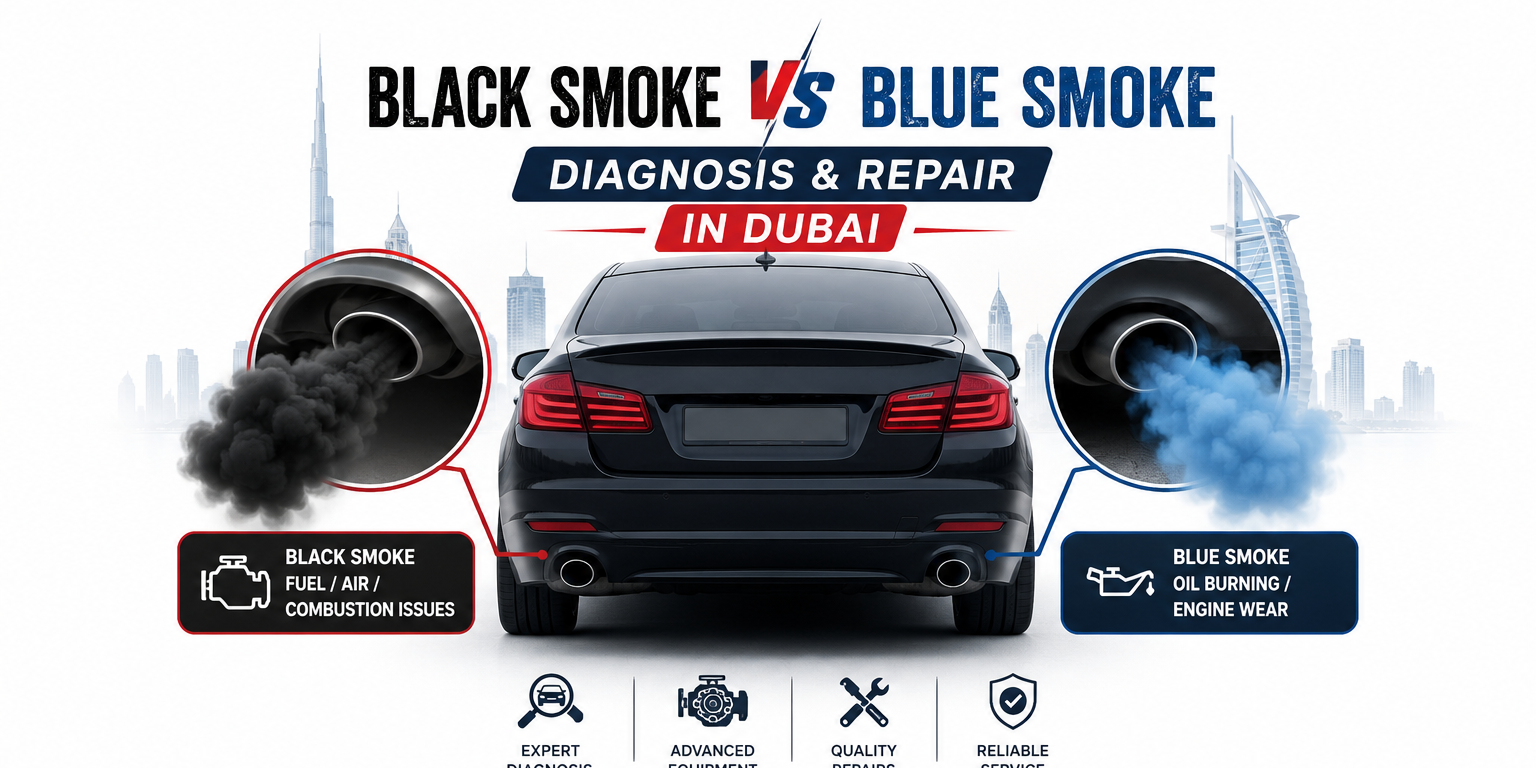
You are sitting at a red light on Sheikh Zayed Road, and the car behind you flashes its lights because your exhaust just puffed out a cloud of smoke. Or maybe it happened right in your own driveway, and now you are wondering if it is something serious or just a quirk of Dubai’s heat and dust. Either way, smoke from your tailpipe is your engine trying to tell you something, and ignoring it rarely ends well.
In this guide, we will break down the real difference between black smoke and blue smoke, what each one means for your engine, and how proper black smoke vs blue smoke diagnosis and repair in Dubai actually works. You will learn what causes each type of smoke, how a mechanic pinpoints the problem, and what it typically takes to fix it before it turns into an expensive repair.
Why Exhaust Smoke Color Actually Matters
Your exhaust pipe is basically a window into your engine’s health. The color of the smoke coming out of it tells a trained mechanic a lot about what is happening inside the combustion chamber, long before you would notice a loss of power or hear a strange noise.
Most drivers assume all exhaust smoke is the same problem with different levels of severity. That is not true. Black smoke and blue smoke come from completely different mechanical issues, and treating one like the other can lead to wasted money on the wrong repair. A good technician does not guess. They diagnose based on smoke color, smell, engine behavior, and a few targeted tests.
What Is Black Smoke From a Car Exhaust?
Black smoke from your exhaust means your engine is burning too much fuel relative to the air it is taking in, a condition known as a rich fuel mixture. It usually smells like unburnt fuel and tends to get worse under acceleration.
In Dubai, this is one of the most common complaints we see, especially in older diesel vehicles, imported cars with tuned engines, and vehicles that spend a lot of time idling in traffic. Here is what commonly causes it:
- Clogged air filter. Dust from Dubai’s roads and desert winds clogs air filters faster than in most cities. A dirty filter starves the engine of air, forcing a rich mixture.
- Faulty fuel injectors. Injectors that are stuck open or spraying too much fuel will flood the combustion chamber.
- Bad oxygen sensor. If the sensor is feeding wrong data to the engine control unit, the computer cannot correct the air fuel ratio properly.
- Malfunctioning turbocharger, on turbo diesel or petrol vehicles. A failing turbo can push too much fuel through the system without matching airflow.
- Wrong fuel type or poor fuel quality. This is rare in the UAE given fuel standards, but it can still happen with contaminated tanks.
We have pulled apart engines where the owner assumed it was “just dust in the air” for months, only to find a clogged injector that had been silently costing them fuel economy and engine life the entire time. Black smoke rarely fixes itself, and driving with it for too long can foul spark plugs, damage the catalytic converter, and increase fuel consumption significantly.
What Is Blue Smoke From a Car Exhaust?
Blue smoke from the exhaust means your engine is burning oil, not fuel. It has a distinct burnt oil smell and often appears heavily on startup or during hard acceleration, then may reduce once the engine warms up.
This one tends to worry people more, and honestly, it should. Oil burning inside your combustion chamber usually points to worn internal engine parts. Common causes include:
- Worn piston rings. These rings are supposed to keep oil in the crankcase and out of the combustion chamber. Once they wear down, oil seeps past them and burns with the fuel.
- Damaged valve seals. Old or brittle valve seals let oil drip into the cylinders, especially noticeable as smoke right after starting the car.
- Failing turbocharger seals. On turbocharged engines, this is a very frequent cause of blue smoke in our experience, particularly on vehicles that have crossed 100,000 kilometers without turbo servicing.
- Overfilled engine oil. Sometimes it is as simple as too much oil in the system, which gets pushed into places it should not reach.
Dubai’s summer heat makes this worse. High temperatures thin out engine oil, which makes it easier for oil to slip past worn seals and rings. We see a noticeable spike in blue smoke complaints between May and September every year, and it is rarely a coincidence.
Black Smoke vs Blue Smoke: A Quick Comparison
| Factor | Black Smoke | Blue Smoke |
|---|---|---|
| Root cause | Fuel burning issue (rich mixture) | Oil burning issue |
| Common smell | Unburnt fuel, sharp | Burnt oil, sweet and heavy |
| When it appears | Often during acceleration | Often at startup or under load |
| Typical culprits | Air filter, injectors, oxygen sensor, turbo | Piston rings, valve seals, turbo seals |
| Urgency | Address soon to avoid engine and converter damage | Address quickly, often signals internal wear |
How Mechanics Diagnose Smoke Issues in Dubai
A proper diagnosis is not just looking at smoke color and guessing. At Car Repair Auto Service, our technicians follow a structured process because two cars showing the same smoke color can have completely different underlying causes.
- Visual and smell inspection. We start by observing the smoke color, thickness, and timing, along with the smell, since this narrows down the possibilities immediately.
- OBD scan. A diagnostic scan reads fault codes from the engine control unit, which often points directly to a misfiring cylinder, a sensor fault, or a fuel delivery issue.
- Compression test. For suspected blue smoke cases, we run a compression test on each cylinder to check for worn piston rings or valve problems.
- Fuel pressure test. For black smoke, we check the fuel system pressure to see if injectors are delivering more fuel than needed.
- Turbocharger inspection. Since turbo issues cause both black and blue smoke depending on the failure type, we inspect turbo seals, boost pressure, and oil residue in the intake.
- Oil consumption check. We track how much oil the engine is using between services, which helps confirm internal wear before recommending a rebuild or replacement.
This step-by-step approach avoids the common mistake of replacing parts based on a guess, which we see happen often with owners who try quick fixes from online forums before bringing the car in.
Real Scenario: What This Looks Like in Practice
A customer brought in a 2016 Toyota Land Cruiser last year, complaining of thick black smoke every time he accelerated on Al Khail Road. He had already replaced the air filter himself, assuming that would solve it. It did not.
Our OBD scan showed a fuel trim error on two cylinders, and a fuel pressure test confirmed one injector was stuck partially open, dumping excess fuel into the cylinder. We replaced the faulty injector, cleared the fuel trims, and the smoke disappeared completely on the test drive. Total diagnosis time was under an hour, because we followed the process instead of replacing parts one by one and hoping for the best.
That is the difference proper diagnosis makes. It saves money, saves time, and protects the engine from further damage caused by delayed or incorrect repairs.
How Repairs Are Typically Carried Out
Once the cause is confirmed, repair work depends entirely on what is actually broken. For black smoke issues, this might mean cleaning or replacing fuel injectors, replacing a faulty oxygen sensor, or servicing the air intake system. For blue smoke, repairs range from replacing valve seals, which is a moderate job, to a full piston ring replacement or engine rebuild, which is more involved and costly.
If your car is showing early signs of either issue, getting it checked through a professional car diagnostic service in Dubai before the problem worsens can save you from a much larger repair bill down the line. Catching a worn valve seal early, for example, is far cheaper than waiting until it turns into a full engine overhaul.
Common Mistakes Car Owners Make With Exhaust Smoke
We see the same avoidable mistakes repeatedly, and it is worth calling them out directly:
- Ignoring occasional smoke because “it goes away after a few minutes.” This is often the earliest and cheapest stage to fix a problem.
- Assuming it is always the air filter. Dubai’s dusty roads make this a convenient excuse, but it is not always the real cause.
- Topping up oil repeatedly without asking why it keeps dropping. If your engine oil level keeps falling, that oil is going somewhere, usually into the combustion chamber.
- Driving long distances with visible smoke. This accelerates damage to the catalytic converter and can lead to a complete engine failure in worse cases.
- Choosing the cheapest quick fix instead of a proper diagnosis. A cleared fault code without addressing the root cause almost always brings the problem back within weeks.
How Car Repair Auto Service Helps
At Car Repair Auto Service, we have handled black smoke and blue smoke cases across a wide range of vehicles common on Dubai roads, from Japanese sedans to European SUVs and heavy diesel pickups. Our approach is straightforward. We diagnose properly using the right equipment, explain what we find in plain language, and give you a clear repair option before any work begins.
We understand that engine repairs can feel intimidating, especially when you are not sure if it is a minor fix or something that will cost thousands of dirhams. That is why our diagnostic process focuses on accuracy first, so you are only paying for the repair your car actually needs. If you are dealing with unusual exhaust smoke, unusual oil consumption, or a rough running engine, our team can run a full inspection and walk you through exactly what is happening under the hood.
What Is the Difference Between Black Smoke and Blue Smoke?
Black smoke comes from an engine burning too much fuel, usually due to a rich air fuel mixture. Blue smoke comes from an engine burning oil, typically due to worn piston rings, valve seals, or turbo seals. The two problems are unrelated and require different repairs.
How Do I Know if My Car Needs Immediate Repair?
If the smoke is thick, constant, or accompanied by a strong burning smell, loss of power, or a check engine light, your car needs immediate attention. Occasional light smoke on cold starts is less urgent but should still be checked soon to prevent it from worsening.
Can Driving With Exhaust Smoke Damage the Engine Further?
Yes. Continued driving with black or blue smoke accelerates wear on the catalytic converter, spark plugs, and internal engine components. What starts as a manageable repair can turn into a full engine rebuild if left unaddressed for too long.
Final Thoughts
Black smoke and blue smoke are not just cosmetic annoyances, they are your engine’s way of flagging a real mechanical issue. Black smoke usually points to a fuel delivery problem, while blue smoke almost always means your engine is burning oil somewhere it should not be. The good news is that both issues are diagnosable with the right process, and most are fixable before they turn into major engine damage.
If you have noticed smoke from your exhaust, do not wait for it to get worse. Book a proper inspection with Car Repair Auto Service and get a clear, honest diagnosis before deciding on any repair. Catching the problem early is almost always the cheaper and safer route.
FAQs
Q1: Why is my exhaust smoking black when I accelerate? Black smoke during acceleration usually means your engine is burning excess fuel, often due to a clogged air filter, faulty injector, or failing oxygen sensor.
Q2: Is blue smoke from the exhaust dangerous? Yes. Blue smoke means your engine is burning oil, which often points to worn piston rings or valve seals. Left unchecked, it can lead to serious internal engine damage.
Q3: Can a dirty air filter really cause black smoke? Yes, especially in dusty environments like Dubai. A clogged filter restricts airflow, forcing the engine into a fuel rich condition that produces black smoke.
Q4: How much does it cost to fix blue smoke issues? Costs vary widely depending on the cause, from a moderate valve seal replacement to a more expensive piston ring job or engine rebuild. A proper diagnosis will confirm the exact cost.
Q5: Should I keep driving if I see white or blue smoke occasionally? It is best to get it checked soon rather than wait. Occasional smoke is often an early warning sign that is far cheaper to fix than a full breakdown later.