You have just replaced a cracked windshield, the glass looks perfect, and the car drives normally. So, is the job really finished? Not always. If your vehicle has a camera mounted behind the windshield, ADAS calibration after windshield replacement may be essential before you get back on Dubai’s roads. Modern safety systems depend on accurate camera positioning to detect lanes, vehicles, pedestrians, and road markings. In this guide, I’ll explain why calibration matters, when it is required, how it works, and what Dubai drivers should check before accepting a windshield replacement.
What Is ADAS Calibration?
ADAS calibration is the process of checking and adjusting a vehicle’s cameras and sensors so they operate according to the manufacturer’s specifications.
ADAS stands for Advanced Driver Assistance Systems. These systems can include lane departure warning, lane keeping assistance, forward collision warning, automatic emergency braking, adaptive cruise control, and traffic sign recognition.
On many modern vehicles, a forward-facing camera is mounted behind the rear-view mirror and looks through the windshield. Its position and viewing angle are extremely precise. If the windshield is replaced or the camera mounting position changes, the camera may need to be recalibrated.
I-CAR explains that OEM calibration requirements can vary by vehicle and that windshield removal or replacement can be one of the events that requires calibration.
Why Is ADAS Calibration After Windshield Replacement Important?
The simple answer is this: replacing the windshield can affect the position, angle, or optical path of a windshield-mounted camera, which can affect the accuracy of ADAS safety systems.
A camera may look perfectly straight to the human eye but still be outside the vehicle manufacturer’s required tolerance. The difference can be very small, yet the camera uses precise measurements to interpret the road ahead.
For example, imagine a vehicle travelling at highway speed on Sheikh Zayed Road. The camera is responsible for identifying lane markings and vehicles ahead. If its angle is incorrect, the system may interpret the road differently from how it was designed to.
That is why professional windshield ADAS calibration in Dubai should be treated as part of the safety procedure, not as an optional electronic add-on.
What Happens to the ADAS Camera During Windshield Replacement?
The camera itself may not necessarily be damaged during a windshield replacement. The issue is that its relationship with the windshield can change.
The camera is normally mounted in a fixed position relative to the glass. When the old windshield is removed and a new one is installed, several things must be correct:
- The replacement windshield must be the correct specification for the vehicle.
- The camera bracket must be correctly positioned.
- The glass must provide the required optical clarity in the camera viewing area.
- The camera must be mounted correctly.
- The vehicle must meet the manufacturer’s calibration conditions.
- The calibration procedure must be completed and verified where required.
Some manufacturers provide very specific procedures. For example, an OEM technical bulletin available through NHTSA states that a front camera may require calibration after windshield removal or replacement and specifies conditions such as correct windshield installation, clean camera viewing area, correct tire pressure, steering position, alignment, and a level calibration surface.
This is why simply replacing the glass and checking whether the dashboard warning light disappears is not enough.
Which ADAS Systems Can Be Affected?
The exact systems depend on the vehicle’s make, model, year, and equipment. A windshield mounted camera may support several functions at the same time.
Common examples include:
- Lane departure warning calibration: Helps the vehicle recognize lane markings and warn when it detects unintended lane departure.
- Lane keeping assistance: Uses camera information to help the vehicle remain within its lane.
- Automatic emergency braking calibration: Helps the vehicle detect potential frontal collisions and activate braking assistance when conditions require it.
- Forward collision warning: Monitors the road ahead for potential collision risks.
- Adaptive cruise control: On some vehicles, works with radar and camera information to maintain a selected following distance.
- Traffic sign recognition: Uses camera information to identify certain road signs.
- Automatic high beam: Can use the forward-facing camera to detect vehicles and lighting conditions.
Not every vehicle uses the windshield camera for all of these functions, and some systems use radar, lidar, ultrasonic sensors, or additional cameras.
The important point is that ADAS calibration in Dubai should always be based on the specific vehicle manufacturer’s requirements, rather than a generic procedure.
Static vs Dynamic ADAS Calibration
There are two common approaches to ADAS calibration: static and dynamic calibration.
Static Calibration
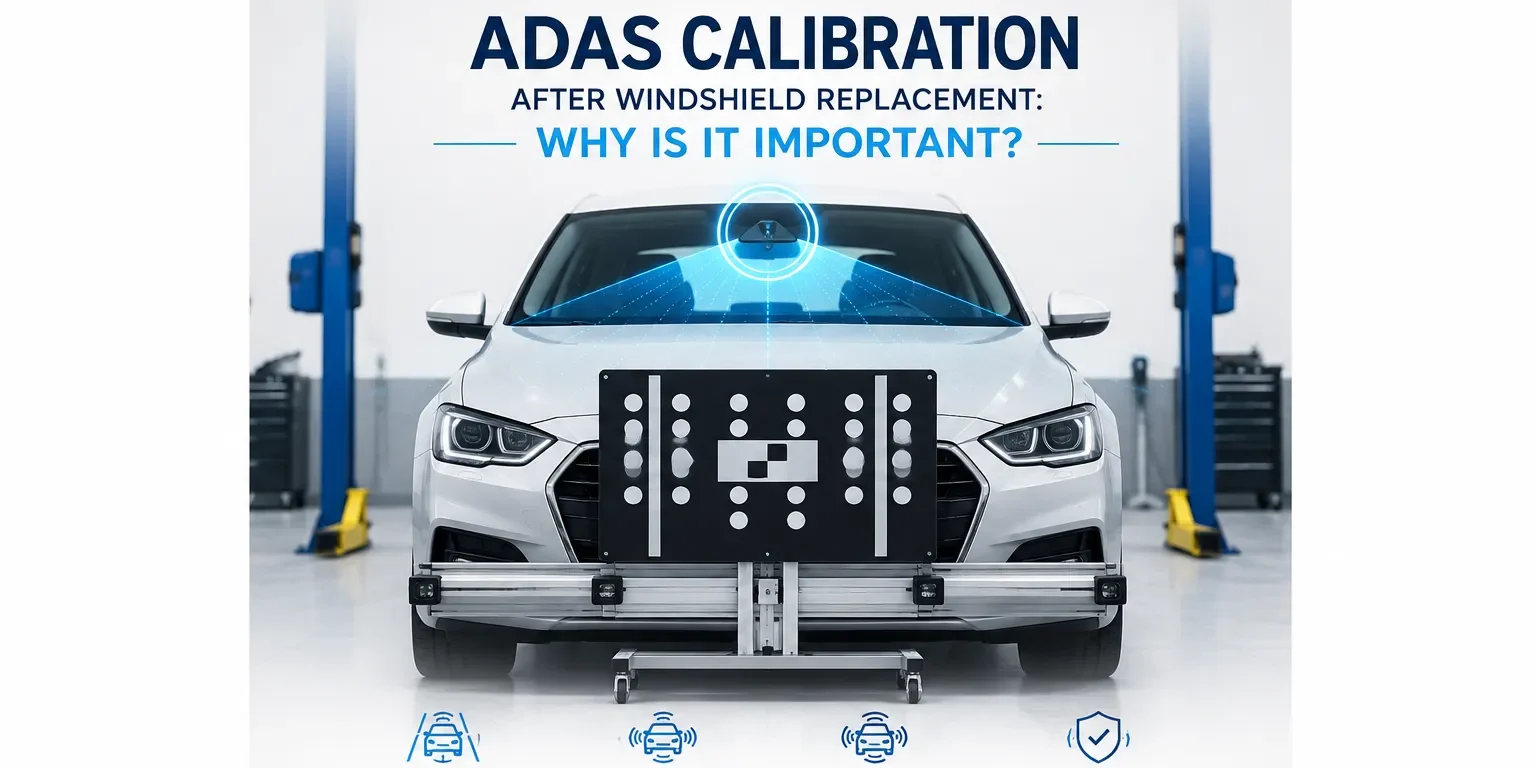
Static calibration is normally performed inside a workshop using specialized targets, measuring equipment, and a controlled environment.
The vehicle is positioned according to manufacturer specifications. The technician then places calibration targets at precise distances and heights before using diagnostic equipment to calibrate the camera or sensor.
The floor, tire pressure, steering position, vehicle loading, alignment, lighting, and target positioning can all matter.
Dynamic Calibration
Dynamic calibration involves driving the vehicle under specific conditions so the system can learn or confirm the required reference information.
The exact road conditions, speed, lane markings, weather, and other requirements depend on the vehicle manufacturer.
Some vehicles may require static calibration, some dynamic calibration, and some require a combination of procedures.
This is why there is no universal “one calibration fits every car” method. A professional technician should identify the vehicle first and follow the appropriate procedure.
A Realistic Example From the Workshop
Let’s take a common situation.
A customer brings in a 2022 SUV after a stone has caused a large crack across the windshield. The windshield is replaced with apparently correct glass. The customer then notices that the lane assistance warning appears occasionally.
The first assumption might be that the new windshield is defective.
However, the problem could be related to camera calibration, camera mounting, the viewing area of the windshield, or another ADAS-related fault.
A proper diagnostic process starts by identifying the vehicle’s ADAS configuration and checking the system for fault codes. The technician then verifies the windshield and camera installation before carrying out the required calibration procedure.
This approach is important because replacing parts without diagnosing the actual problem can waste money and still leave the safety system operating incorrectly.
Why the Replacement Windshield Matters
A common mistake is thinking that all windshields for the same car are identical.
They may not be.
Modern windshields can have different specifications for camera mounting, rain and light sensors, acoustic glass, head-up displays, heating elements, and other features.
For an ADAS-equipped vehicle, the area in front of the camera is especially important. Poor optical quality, incorrect glass specification, contamination, or an incorrectly positioned camera bracket can interfere with calibration.
An OEM technical document available through NHTSA specifically emphasizes installing the correct windshield and ensuring that the camera’s field of view is clean before calibration.
So, when replacing a windshield, don’t only ask, “Will this glass fit my car?”
Ask whether it is the correct specification for your vehicle’s ADAS equipment.
Can You Drive Without ADAS Calibration?
If your vehicle manufacturer requires calibration after windshield replacement, driving without completing it is not a sensible risk.
Your car may still start, steer, brake, and accelerate normally. That does not necessarily mean every driver assistance feature is working correctly.
Some vehicles will display a warning message when calibration is incomplete. Others may disable certain functions until calibration is completed.
A Subaru technical bulletin, for example, states that after windshield replacement the vehicle’s EyeSight camera system must undergo the specified inspection and calibration procedures before the vehicle is returned to the customer.
The safest approach is straightforward: check the manufacturer’s calibration requirement before driving the vehicle normally after windshield replacement.
Signs Your ADAS May Need Attention
After windshield replacement, pay attention to unusual warnings or changes in driver assistance behavior.
Possible signs include:
- Lane assistance not functioning.
- Forward collision warning showing an error.
- Automatic emergency braking becoming unavailable.
- Adaptive cruise control being disabled.
- An ADAS or camera warning appearing on the dashboard.
- Traffic sign recognition behaving unusually.
- A message stating that the camera is obstructed or calibration is incomplete.
However, don’t assume that every ADAS warning automatically means calibration is the problem.
A warning can also be caused by a dirty windshield, damaged camera hardware, wiring faults, incorrect installation, wheel alignment issues, or another electronic fault.
Proper diagnosis should come before replacing components.
What Does a Professional ADAS Calibration Process Look Like?
A professional windshield camera calibration should be more than plugging in a scanner and clearing a warning light.
A sensible process generally includes:
- Identify the vehicle and ADAS equipment.
The technician determines which cameras and sensors are installed and checks the manufacturer’s requirements. - Inspect the windshield and camera mounting area.
The glass, bracket, camera position, and viewing area are checked for installation or obstruction issues. - Check vehicle conditions.
Depending on the manufacturer, tire pressures, wheel alignment, steering position, vehicle loading, and other conditions may need to be correct. - Perform the required calibration.
Static, dynamic, or combined calibration is performed using suitable diagnostic and calibration equipment. - Check for faults.
Diagnostic systems are used to verify that relevant ADAS faults are addressed. - Confirm system operation.
The technician verifies that calibration has been completed successfully according to the applicable procedure.
This process is especially important on modern premium vehicles where multiple driver assistance systems communicate with each other.
Why Dubai Drivers Should Take ADAS Calibration Seriously
Dubai roads include high-speed highways, busy urban routes, multi-lane junctions, and constantly changing traffic conditions. Driver assistance systems are designed to support the driver in these environments, but they are only as reliable as their sensors and calibration.
The UAE’s heat can also make proper vehicle maintenance particularly important. While extreme temperatures do not automatically mean that an ADAS camera needs calibration, any warning, malfunction, or physical repair should be investigated rather than ignored.
If you have recently had your windshield replaced in Dubai and your vehicle has a camera mounted behind the rear-view mirror, ask the workshop whether windshield ADAS calibration is required for your exact vehicle.
How to Choose an ADAS Calibration Workshop in Dubai
Don’t choose a workshop only because it offers the cheapest calibration price.
Ask a few practical questions first:
- Do you check the vehicle’s make, model, and year before calibration?
- Do you follow the manufacturer’s calibration procedure?
- Do you have suitable diagnostic and calibration equipment?
- Can you perform the required static or dynamic procedure?
- Do you inspect the windshield and camera mounting area?
- Will you verify the system after calibration?
- Can you explain what was calibrated and why?
A good workshop should be comfortable answering these questions. If the technician cannot explain why your vehicle needs calibration or what procedure is being used, it is worth asking more questions before approving the work.
ADAS Calibration After Windshield Replacement in Dubai
At Car Repair Auto Service, the focus should be on diagnosing the vehicle properly rather than treating every warning as a simple reset.
The workshop provides professional car diagnostics and repair services in Dubai, with modern diagnostic equipment and support for a wide range of vehicle brands.
If your vehicle has recently undergone windshield replacement and you are experiencing an ADAS warning, camera-related fault, or driver assistance issue, you can contact Car Repair Auto Service for professional vehicle inspection and diagnostics.
You can also explore the Car Repair Auto Service garage in Al Quoz, Dubai if you need a local workshop for diagnosis or related vehicle repairs.
The important thing is not simply to “clear the light.” The goal is to identify the cause and make sure the vehicle’s safety systems are operating as intended.
Common Mistakes to Avoid After Windshield Replacement
Several mistakes can turn a straightforward windshield replacement into a safety problem.
Assuming every windshield is the same
The cheapest glass may fit physically but may not have the correct specification for your camera, sensors, HUD, or other equipment.
Skipping calibration because there is no warning light
A lack of a dashboard warning does not automatically prove that calibration is unnecessary. Always check the vehicle-specific requirements.
Using a generic scanner as a substitute for calibration
Reading fault codes and performing an actual camera calibration are not necessarily the same thing.
Ignoring ADAS warnings
If lane assistance, collision warning, or automatic braking becomes unavailable after windshield replacement, investigate it promptly.
Choosing price over procedure
A low-cost service is not a bargain if the calibration is incomplete or performed incorrectly. With safety-related systems, the procedure matters as much as the equipment.
Frequently Asked Questions
Does every windshield replacement require ADAS calibration?
No. It depends on the vehicle and its equipment. Vehicles with windshield-mounted ADAS cameras may require calibration after windshield removal or replacement, while vehicles without such systems may not. Always check the manufacturer’s requirements for the specific make, model, and year.
How long does ADAS calibration take?
The time varies by vehicle and calibration method. Static calibration can require workshop setup and precise target positioning, while dynamic calibration may require a controlled road drive. Additional diagnostic checks can also affect the total time.
What happens if ADAS calibration is not done?
If calibration is required but skipped, the camera may not accurately interpret lanes, vehicles, or other objects. Depending on the vehicle, some assistance features may be unavailable, produce warnings, or operate inaccurately.
Does a new windshield affect lane departure warning?
It can. If the vehicle uses a windshield-mounted camera for lane detection, windshield replacement can affect the camera’s position or optical path. If calibration is specified by the manufacturer, it should be completed before relying on the system.
Is ADAS calibration the same for every car?
No. Calibration procedures vary significantly between manufacturers and models. Some vehicles use static targets, some use dynamic calibration, and some require both. Proper calibration should follow the applicable manufacturer procedure rather than a generic setting.
Final Thoughts
A windshield replacement may look like a simple glass repair, but on a modern vehicle it can involve much more than removing cracked glass and installing a new panel.
If your vehicle uses a windshield-mounted camera, ADAS calibration after windshield replacement can be an important part of restoring the vehicle’s safety systems. Lane departure warning, lane keeping assistance, automatic emergency braking, forward collision warning, and other features depend on accurate sensor information.
From a mechanic’s perspective, the rule is simple: don’t guess with safety systems. Confirm the vehicle’s requirements, use the correct windshield, inspect the camera installation, perform the required calibration, and verify the system before considering the job complete.
If you have recently replaced your windshield in Dubai and are unsure whether your vehicle needs calibration, have it checked by a qualified automotive workshop rather than assuming everything is fine.