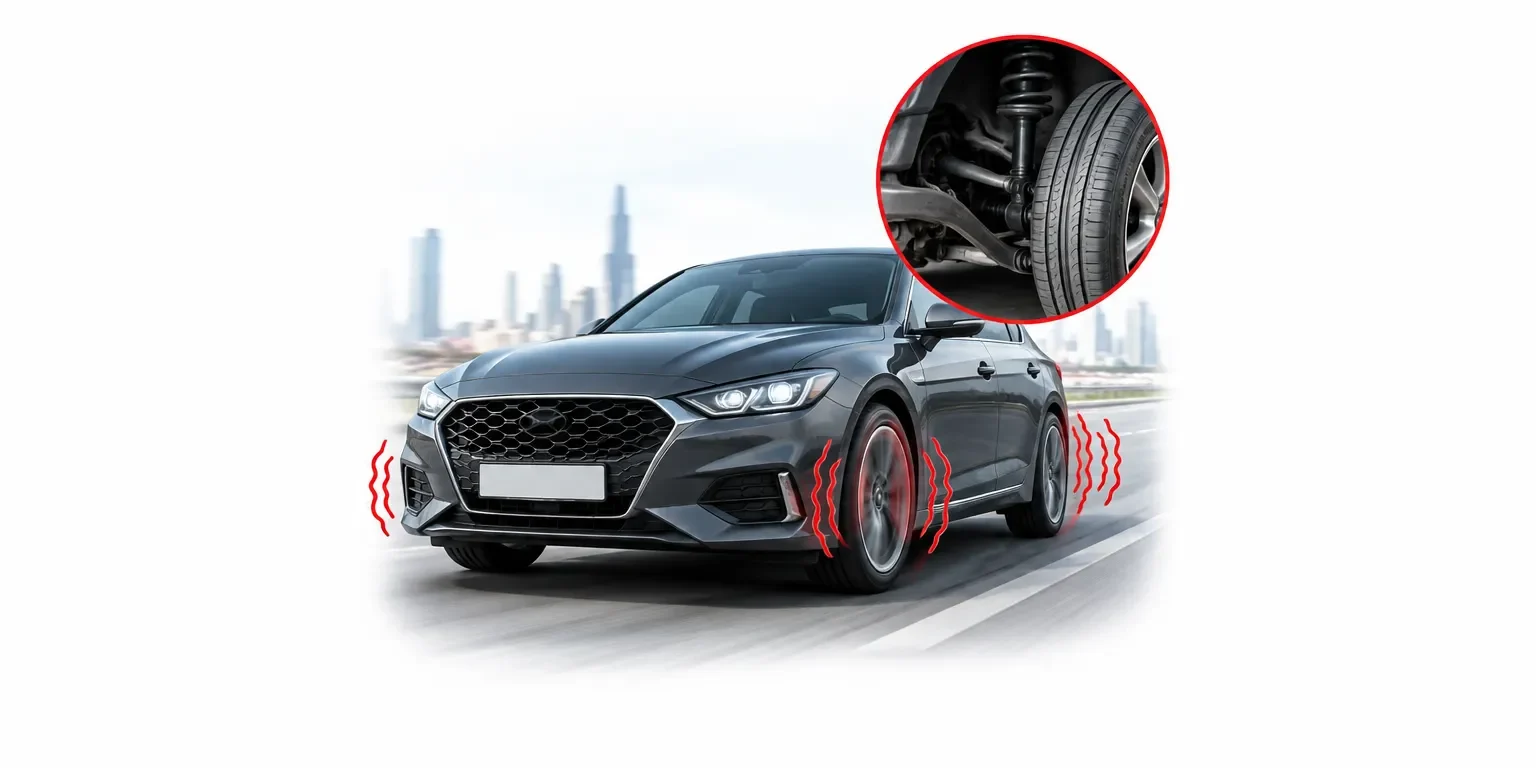
Have you ever noticed your car shaking through the steering wheel, seat, or floor while driving? If you are wondering why your car vibrating while driving is happening, the cause could be something as simple as an unbalanced tyre or something more serious, such as a worn suspension component, damaged wheel, brake problem, or drivetrain fault.
In Dubai, high temperatures, heavy traffic, long highway drives, potholes, and rough road surfaces can put extra stress on tyres, wheels, brakes, and suspension components. In this guide, we explain the most common causes of car vibration, how to identify where the vibration is coming from, and what a professional mechanic should check before recommending repairs.
What Does It Mean When Your Car Vibrates While Driving?
Car vibration means that something in the vehicle is not rotating, moving, or operating as smoothly as it should. The vibration can come from the tyres, wheels, suspension, steering system, brakes, engine, transmission, driveshaft, or other rotating components.
The most important clue is when the vibration happens.
For example, a vibration that starts around highway speeds often points toward tyres or wheels. A vibration that appears mainly when braking can indicate a brake problem. If the car shakes while accelerating, the drivetrain or engine may need inspection.
Do not assume every vibration is a wheel alignment problem. A proper diagnosis should identify the actual source before parts are replaced.
Why Is My Car Vibrating While Driving?
There are several possible causes, but the following are among the most common problems mechanics check first.
1. Unbalanced Tyres or Wheels
An unbalanced wheel is one of the most common reasons for a car vibrating while driving, particularly at higher speeds.
When the weight around a tyre and wheel is not distributed evenly, the wheel can develop a rotational imbalance. You may feel the vibration through the steering wheel, especially when driving on highways.
A technician normally checks the wheel balance using a balancing machine and adds or adjusts wheel weights when necessary.
Michelin also identifies tyre imbalance as a common cause of vibration and recommends checking alignment and suspension if balancing does not solve the problem.
2. Wheel Alignment Problems
Wheel alignment affects how the tyres sit and move against the road.
Incorrect alignment can happen after hitting a pothole, kerb, or road obstruction. It can also develop because of worn suspension or steering components.
Common signs include:
- Steering wheel vibration
- Vehicle pulling to one side
- Uneven tyre wear
- Steering wheel not sitting straight
- Poor handling
- Increased tyre noise
Wheel alignment alone may not fix the problem if a suspension component is already worn. The suspension should be inspected first when there are signs of physical damage or excessive play.
3. Damaged or Bent Wheels
Dubai drivers regularly deal with speed bumps, road edges, potholes, and uneven surfaces. A strong impact can bend an alloy wheel or damage its structure.
A bent wheel may produce vibration even after tyre balancing.
A mechanic can check the wheel for visible damage and measure wheel runout. If the wheel does not rotate correctly, replacement or professional repair may be necessary depending on the wheel and the extent of damage.
4. Tyre Damage or Uneven Tyre Wear
A tyre can cause vibration even when its pressure appears normal.
Look for bulges, cuts, irregular tread wear, flat spots, or separated tread. Uneven wear can also indicate an underlying alignment, suspension, or balancing problem.
This is particularly important because a damaged tyre is not simply a comfort issue. It can affect grip and vehicle stability.
The National Highway Traffic Safety Administration recommends regular tyre inspections and notes that proper tyre balance and wheel alignment are important for tyre life and safe vehicle operation.
5. Worn Suspension Components
Your suspension system controls wheel movement and helps keep the tyres in proper contact with the road.
Worn shocks, struts, control arms, bushings, ball joints, stabilizer links, or other suspension components can create vibration, instability, knocking sounds, and uneven tyre wear.
If the vibration comes together with a rough ride, knocking noise, excessive bouncing, or unstable handling, suspension inspection should be part of the diagnosis.
This is especially relevant for vehicles that regularly travel long distances around Dubai.
For related information, see our car suspension repair service in Dubai to understand what components are inspected and how suspension faults can affect handling.
Car Vibrates When Accelerating
If your car vibrates mainly when you accelerate, do not immediately blame the tyres.
Acceleration related vibration can sometimes come from drivetrain components such as:
- Driveshafts
- CV joints
- CV axles
- Engine mounts
- Transmission mounts
- Propeller shafts
- Differential components
For example, a worn CV joint may produce vibration or clicking during acceleration or cornering. A damaged engine mount can allow excessive engine movement, which may be felt through the cabin.
The exact diagnosis depends on the vehicle and the conditions under which the vibration occurs.
Car Vibrates When Braking
If your car only vibrates when you press the brake pedal, the braking system should be inspected.
Brake vibration can be associated with uneven brake rotor surfaces, excessive runout, overheating, or other brake component problems. The vibration may be felt through the steering wheel or brake pedal.
A professional inspection should check the brake discs, pads, calipers, wheel condition, and related components.
If you notice strong shaking while braking, do not continue driving aggressively until the braking system has been inspected.
You can also read our guide to Audi brake inspection in Dubai for an example of how a professional brake inspection should be approached.
Car Vibrates at High Speed
A car that vibrates at a specific speed often gives an important diagnostic clue.
For example, if the vehicle feels smooth around 50 km/h but begins vibrating around 90 to 110 km/h, tyre and wheel balance, wheel runout, tyre condition, and alignment are some of the first areas a technician may investigate.
However, speed related vibration does not automatically mean the tyres are the problem. Suspension, wheel bearings, and drivetrain components can produce similar symptoms.
The correct approach is to reproduce the vibration during a controlled road test and then inspect the relevant components.
Steering Wheel Vibrates While Driving
If the vibration is strongest through the steering wheel, the problem is often associated with the front wheels, tyres, steering, or front suspension.
Possible causes include:
- Front wheel imbalance
- Damaged front tyre
- Bent wheel
- Alignment problems
- Worn tie rod ends
- Worn control arm bushings
- Ball joint problems
- Wheel bearing issues
A technician should check the front end carefully rather than simply performing an alignment and assuming the problem is solved.
Vibration Through the Seat or Floor
If you feel the vibration more through the seat or floor than the steering wheel, the source may be toward the rear of the vehicle or within the drivetrain.
Possible causes include rear wheel imbalance, rear suspension problems, driveshaft issues, differential problems, or other rotating components.
This type of vibration is a good example of why the location of the vibration matters during diagnosis.
Real World Diagnostic Example: Wheel and Tyre Vibration
A useful example comes from General Motors service documentation for diagnosing a smooth road shake.
The documented procedure starts with checking tyre pressure and wheel mounting, followed by inspection for missing balance weights, bent wheels, irregular tyre wear, tyre irregularities, and other conditions. The procedure also uses a controlled road test to reproduce the vibration and determine whether braking changes the symptom.
This shows an important point that experienced technicians know well: vibration diagnosis should not begin with replacing random parts. The technician needs to reproduce the complaint and systematically eliminate possible causes.
Another practical example comes from Michelin’s tyre guidance. Michelin explains that vibration can result from tyre imbalance or steering and suspension problems. If balancing does not remove the vibration, the alignment and suspension should also be checked.
These examples support a simple diagnostic rule: find the source first, then repair it.
How Do Mechanics Diagnose a Vibrating Car?
A professional vibration diagnosis usually starts with questions about the exact driving conditions.
A mechanic may ask:
- At what speed does the vibration begin?
- Does it happen during acceleration?
- Does it happen only while braking?
- Is it worse when turning?
- Do you feel it in the steering wheel, seat, or floor?
- Did the problem start after hitting a pothole or kerb?
- Were the tyres recently changed or repaired?
The vehicle can then be inspected and road tested.
Depending on the symptoms, the inspection may include tyre pressure, tyre condition, wheel balance, wheel runout, alignment, suspension components, steering components, wheel bearings, brakes, engine mounts, CV joints, driveshafts, and other drivetrain components.
How Can You Fix a Car That Is Vibrating While Driving?
The correct fix depends entirely on the cause.
A minor vibration caused by wheel imbalance may only require wheel balancing. A damaged tyre may require replacement. A bent wheel may need repair or replacement.
If the vibration is caused by worn suspension components, the damaged parts need to be replaced and the wheel alignment checked afterward.
For brake related vibration, the braking system needs to be inspected and the affected components repaired or replaced according to their condition.
For drivetrain vibration, a mechanic may need to inspect CV joints, driveshafts, engine mounts, transmission mounts, and related components.
The important thing is not to treat the symptom without identifying the cause.
Can You Keep Driving With a Vibrating Car?
A very minor vibration does not always mean an immediate breakdown, but persistent or worsening vibration should not be ignored.
Vibration can be caused by something relatively simple, such as wheel imbalance, but it can also indicate a damaged tyre, suspension problem, wheel bearing fault, brake issue, or drivetrain problem.
Stop driving and arrange an inspection if the vibration is severe or appears together with:
- Strong steering wheel shaking
- Brake pedal pulsation
- A damaged or bulging tyre
- Loud grinding or knocking
- Sudden pulling to one side
- Loss of steering control
- Burning smell
- New warning lights
- Rapidly worsening vibration
Early diagnosis can prevent a small fault from becoming a larger repair.
Why Dubai Driving Conditions Can Make Vibration Problems Worse
Dubai driving conditions can be demanding on tyres and suspension.
High temperatures can increase tyre stress, while frequent highway driving means wheels and tyres spend long periods rotating at higher speeds. Potholes, kerbs, road debris, and repeated speed bumps can also affect wheel and suspension components.
This does not mean every vibration in Dubai is caused by heat or roads. However, these conditions make regular tyre, wheel, brake, and suspension inspections especially useful.
If your vehicle has recently hit a pothole or kerb and you notice a new vibration, have the wheel and suspension checked rather than assuming it will disappear.
How Car Repair Auto Service Can Help With Vehicle Vibration
At Car Repair Auto Service, vibration complaints can be approached through inspection and diagnosis rather than guessing.
The first step is understanding when the vibration occurs and where you feel it. The vehicle can then be checked for tyre, wheel, alignment, suspension, brake, steering, and drivetrain related problems based on the symptoms.
Our workshop in Dubai also provides suspension and steering repairs, brake inspections, vehicle diagnostics, and general car repair services.
For drivers who notice vibration while driving, the goal should be simple: identify the actual cause, explain the repair clearly, and fix the affected component instead of replacing parts unnecessarily.
You can also explore our garage near me in Dubai page if you need a workshop for vehicle inspection, diagnostics, suspension work, brake repair, or other car problems.
Quick Guide: What Your Car Vibration May Be Telling You
| When the vibration happens | Possible causes |
|---|---|
| Around highway speeds | Wheel balance, tyre condition, bent wheel |
| During braking | Brake rotor or brake system problem |
| During acceleration | CV joint, driveshaft, engine mount, drivetrain |
| While turning | CV joint, suspension, steering components |
| Through steering wheel | Front tyre, wheel, alignment, steering or suspension |
| Through seat or floor | Rear wheel, suspension or drivetrain |
| After hitting a pothole | Bent wheel, damaged tyre, alignment or suspension |
| Along with bouncing | Worn shocks or suspension components |
This table can help identify the direction of the diagnosis, but it cannot replace a physical inspection.
Final Thoughts
A car vibrating while driving is a symptom, not a diagnosis. The source could be a simple wheel imbalance, but it could also involve tyres, wheels, brakes, steering, suspension, bearings, engine mounts, or drivetrain components.
Pay attention to when the vibration occurs, what speed it starts at, and where you feel it. Those details can help a mechanic find the problem much faster.
If the vibration is new, persistent, or getting worse, have the vehicle inspected instead of continuing to drive and hoping it disappears. Car Repair Auto Service in Dubai can help diagnose vibration related problems and identify the repair your vehicle actually needs.
Frequently Asked Questions
Why is my car vibrating while driving?
The most common causes include unbalanced tyres, damaged tyres, bent wheels, incorrect wheel alignment, worn suspension components, brake problems, wheel bearings, and drivetrain faults. The exact cause depends on when the vibration occurs and where you feel it.
Why does my car vibrate at high speed?
High speed vibration is commonly associated with wheel or tyre imbalance, uneven tyre wear, damaged tyres, bent wheels, or alignment issues. If balancing does not solve the problem, the wheels, tyres, suspension, and steering system should be inspected.
Why does my car shake when I brake?
A vibration that mainly appears during braking can be related to brake discs or other braking components. A technician should inspect the brake discs, pads, calipers, wheel condition, and related components before deciding on the repair.
Is wheel alignment enough to fix car vibration?
Not always. Alignment can correct certain steering and tyre wear problems, but it will not repair a damaged tyre, bent wheel, worn suspension component, bad wheel bearing, or drivetrain fault. The underlying problem should be diagnosed first.
Is it safe to drive a car that is vibrating?
It depends on the cause and severity. Mild vibration may come from a relatively simple issue, but severe or worsening vibration can indicate a tyre, brake, steering, suspension, or drivetrain problem. Strong shaking, steering problems, brake vibration, or tyre damage should be inspected immediately.