Does your Nissan Patrol make a clunking noise when driving slowly over speed bumps, uneven roads, or parking ramps in Dubai? A suspension clunk can be a sign of worn components, loose mounting hardware, or a problem with the steering system. Ignoring the noise may allow a small fault to develop into a more expensive repair.
Understanding the cause of a Nissan Patrol suspension clunk helps you decide what to check and when to visit a professional garage. In this guide, we explain the common causes, warning signs, diagnostic methods, and repair options to help you keep your Nissan Patrol safe and comfortable on Dubai roads.
Why Does a Nissan Patrol Make a Clunking Noise at Low Speeds?
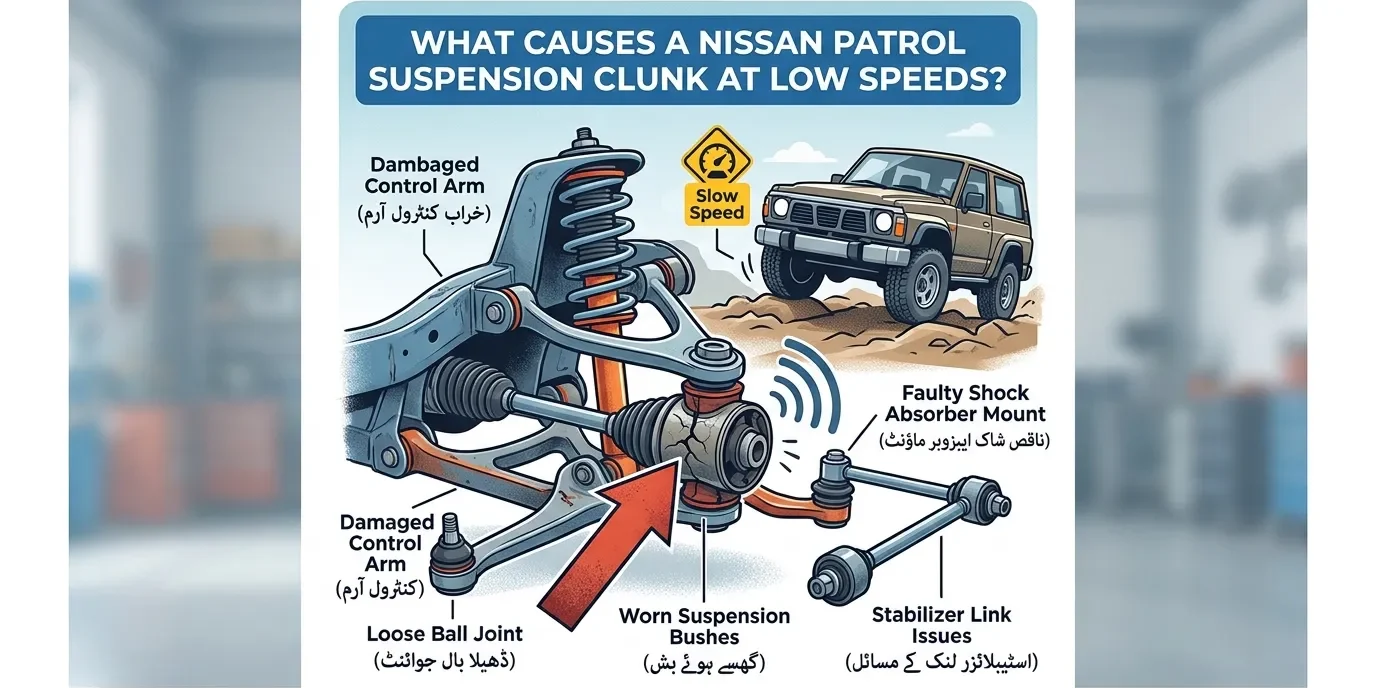
A Nissan Patrol suspension clunk at low speeds often comes from worn sway bar links, damaged suspension bushings, loose mounting bolts, or worn ball joints. These components help control wheel movement and absorb road impacts. When a part develops excessive movement, it can produce a knocking or clunking sound as the suspension moves over bumps.
The noise may be easier to hear when driving slowly because the suspension moves through its travel at a different rate than it does at higher speeds. You may notice it when entering a parking garage, crossing a speed bump, turning into a driveway, or driving over uneven pavement.
However, the sound alone cannot confirm which part has failed. A proper inspection is important because several suspension and steering components can produce similar noises.
6 Common Causes of a Nissan Patrol Suspension Clunk
1. Worn Sway Bar Links or Bushings
Sway bar links connect the stabilizer bar to the suspension. The stabilizer bar helps reduce excessive body roll when the vehicle turns or changes direction. Rubber bushings cushion movement and help prevent metal components from knocking against each other.
Over time, the joints and rubber bushings can wear out. When this happens, the links may develop excessive play and produce a sharp clunk over small bumps or uneven road surfaces.
Common warning signs include:
- A knocking noise over speed bumps.
- A clunk when one wheel crosses a bump before the other.
- Noise from the front or rear suspension area.
- Increased body movement when cornering.
For example, if your Nissan Patrol makes a sharp knock when one front wheel passes over a parking ramp, the sway bar links and bushings are worth checking. However, other suspension components can produce the same symptom.
Replacing worn parts can restore proper movement and reduce unwanted noise. The mechanic should inspect the links, bushings, brackets, and mounting hardware before recommending repairs.
2. Damaged Control Arm Bushings
Control arms help maintain the correct position of the wheels as the suspension moves. Their bushings are usually made from rubber or another flexible material that absorbs vibration and allows controlled movement.
Heat, age, road impacts, and repeated suspension movement can cause these bushings to crack, soften, or separate from their metal sleeves. When that happens, the control arm may move more than it should, creating a dull clunk during braking, acceleration, or when driving over uneven surfaces.
You might also notice vague steering, uneven tyre wear, or a feeling that the vehicle is moving slightly when you apply the brakes.
In Dubai, vehicles regularly exposed to high temperatures and rough road surfaces may experience wear in rubber components over time. This does not mean every Nissan Patrol has a bushing problem, but it makes regular suspension inspections worthwhile.
A professional mechanic can check the bushings for cracks, separation, and excessive movement. Depending on the damage and the vehicle’s design, the repair may involve replacing the bushings or the complete control arm assembly.
3. Worn Ball Joints
Ball joints connect suspension components while allowing the movement needed for steering and wheel travel. They are important because they help maintain the correct relationship between the wheels and the suspension.
When a ball joint wears out, excessive play can develop inside the joint. This may cause a clunk when driving over bumps, turning at low speeds, or moving the steering wheel.
Other warning signs include uneven tyre wear, steering instability, and unusual movement around the affected wheel.
A worn ball joint should never be ignored. A severely damaged joint can compromise wheel control and create a serious safety risk.
If you hear a clunk alongside loose steering or notice that your Nissan Patrol no longer handles normally, arrange an inspection promptly. Avoid driving the vehicle if the steering feels unsafe or the wheel appears to be sitting incorrectly.
A mechanic should check the joint for excessive play, inspect its protective boot, and compare the findings with the manufacturer’s specifications. The correct repair depends on the component’s condition and the specific Nissan Patrol model.
4. Worn Shock Absorbers or Loose Mounts
Shock absorbers control spring movement and help keep the tyres in contact with the road. Their mounts hold the components securely in position while absorbing vibration.
When a shock absorber loses its damping ability or a mounting component becomes worn or loose, you may hear a clunk over bumps. The vehicle may also bounce more than usual after passing over an uneven surface.
Look for these symptoms:
- Repeated bouncing after a speed bump.
- A knocking sound from one corner of the vehicle.
- A harsher ride than usual.
- Visible fluid leakage from a shock absorber.
- Uneven handling on rough roads.
A loose mount can produce a noise even when the shock absorber itself is still working. Replacing the shock absorber without checking the mounting hardware may therefore fail to solve the problem.
A suspension inspection should cover the shock absorbers, mounting points, fasteners, and surrounding components. If a part is damaged, the mechanic can recommend the appropriate replacement.
5. Loose Suspension Bolts or Mounting Hardware
Not every suspension clunk means an expensive component has failed. Sometimes, the cause is loose or incorrectly secured mounting hardware.
Suspension parts experience repeated forces whenever the vehicle accelerates, brakes, turns, or crosses bumps. Incorrect installation, previous repairs, or damaged fasteners can allow unwanted movement.
This may create a metallic clunk that becomes noticeable at low speeds, particularly when the vehicle changes direction or the suspension shifts under load.
A mechanic should inspect the relevant mounting points and tighten fasteners according to the manufacturer’s specified torque values. Simply tightening every visible bolt is not a suitable repair because suspension components require correct procedures and specifications.
If your Nissan Patrol started making noise shortly after suspension work, tell the garage when the problem began. This information can help narrow down the inspection.
6. Nissan Patrol HBMC Suspension Problems
Some Nissan Patrol models, particularly certain Y62 versions, use Hydraulic Body Motion Control, commonly known as HBMC. This system uses hydraulic components to help control body movement and improve stability.
If your Patrol is equipped with HBMC, a suspension noise may require additional checks beyond conventional suspension parts. Depending on the symptoms, a mechanic may need to inspect hydraulic lines, connections, suspension components, and signs of fluid leakage.
Possible warning signs include unusual suspension noises, changes in ride comfort, excessive body movement, or visible hydraulic fluid leakage.
However, a clunking noise does not automatically mean the HBMC system has failed. Worn links, bushings, mounting hardware, and other conventional components may produce similar sounds.
The correct diagnostic approach is to identify the exact suspension configuration of your Nissan Patrol and inspect the relevant components before replacing parts. Hydraulic suspension work should be handled by a qualified technician using the correct safety procedures.
How Dubai Driving Conditions Can Affect Nissan Patrol Suspension
Dubai roads are generally well maintained, but daily driving can still place considerable demands on a large SUV’s suspension.
Parking ramps, speed bumps, uneven access roads, construction areas, and occasional potholes all cause repeated suspension movement. Vehicles regularly driven on rough surfaces may experience more wear in bushings, joints, and mounting components.
High temperatures can also contribute to the ageing of rubber parts over time. However, heat alone does not prove that a particular component has failed.
Your driving habits matter, too. Carrying heavy loads, driving over speed bumps too quickly, and frequently travelling on rough terrain can increase suspension stress.
To help maintain your Nissan Patrol’s suspension:
- Slow down before speed bumps and uneven road surfaces.
- Avoid hitting potholes at speed.
- Check tyre pressures according to the vehicle manufacturer’s recommendations.
- Arrange an inspection when new noises develop.
- Have worn suspension components repaired before they affect other parts.
These steps cannot prevent every suspension problem, but they can help reduce unnecessary stress and identify faults before they become more serious.
How to Diagnose a Nissan Patrol Suspension Clunk
The best way to diagnose a Nissan Patrol suspension clunk is to identify when the noise occurs, inspect the relevant components, and confirm the source through appropriate mechanical tests.
Replacing parts based on sound alone can waste money because several faults may produce similar symptoms.
A professional inspection should generally include the following steps.
1. Identify the noise conditions. The mechanic should establish whether the clunk occurs over speed bumps, during turns, while braking, or when accelerating. This helps narrow down the possible causes.
2. Locate the noise. The technician checks whether the sound appears to come from the front or rear suspension and whether it is more noticeable on one side.
3. Inspect suspension and steering components. Sway bar links, bushings, ball joints, control arms, shock absorbers, steering joints, and mounting hardware should be checked as appropriate.
4. Check for excessive movement or damage. The mechanic uses suitable inspection methods to identify worn joints, damaged rubber, loose fasteners, or other faults. Some components require specific loading conditions or measurements to assess correctly.
5. Test the vehicle after repairs. Once the confirmed fault has been corrected, a controlled road test can help establish whether the noise has disappeared and whether the vehicle handles normally.
If the vehicle has HBMC, the inspection should also account for the system’s hydraulic components when the symptoms indicate a possible problem.
A clear diagnosis helps ensure that you pay for the repair your Nissan Patrol actually needs rather than replacing unrelated parts.
Is It Safe to Drive a Nissan Patrol With a Suspension Clunk?
A mild, occasional clunk does not always mean the vehicle is immediately unsafe. However, you should not assume that it is harmless simply because the noise disappears on smooth roads or at higher speeds.
A worn bushing may initially produce only an occasional knock, while a damaged ball joint or another steering-related component can present a more serious risk.
Pay particular attention if you notice any of the following:
- Steering feels loose or difficult to control.
- The vehicle pulls unexpectedly to one side.
- The clunk becomes louder or more frequent.
- A wheel appears to sit at an unusual angle.
- The vehicle feels unstable when turning.
- There is visible damage or fluid leakage around the suspension.
If any of these symptoms occur, stop driving when it is safe to do so and arrange a professional assessment. If you suspect a serious steering or suspension failure, have the vehicle recovered rather than driving it to a garage.
Even if the noise is mild and the vehicle handles normally, arrange an inspection soon. Finding the cause early can help prevent additional wear and reduce the risk of a more costly repair.
Nissan Patrol Suspension Repair in Dubai
If your Nissan Patrol makes a clunking noise at low speeds, the right repair depends on the source of the problem. Replacing a sway bar link will not solve a worn ball joint, and changing shock absorbers will not correct loose mounting hardware.
At Car Repair Auto Services, the appropriate starting point is a suspension inspection to identify the affected components and determine what needs attention.
Depending on the diagnosis, the required work may include:
- Nissan Patrol suspension inspection.
- Sway bar link and bushing replacement.
- Control arm and suspension bushing repairs.
- Ball joint inspection and replacement.
- Shock absorber and mounting repairs.
- Steering component inspection.
- HBMC system assessment on applicable models.
- Wheel alignment checks when required after repairs.
Not every vehicle needs all these services. The mechanic should explain the confirmed fault, the recommended repair, and any related work before proceeding.
For Nissan Patrol owners in Dubai, this approach helps avoid unnecessary part replacement while keeping the vehicle’s handling and ride comfort in focus.
If the clunk started after recent suspension repairs, mention that during your appointment. If possible, describe the road conditions that trigger the sound, as this can help the technician reproduce the problem.
How Much Does Nissan Patrol Suspension Repair Cost in Dubai?
The cost of repairing a Nissan Patrol suspension clunk depends on the faulty component, the vehicle’s model year, parts availability, and the amount of labour required.
Replacing a worn sway bar link may be relatively straightforward compared with repairing a more complex suspension assembly or diagnosing an HBMC-related issue. The total cost can also change if several components are worn or if additional repairs are necessary.
Before approving a repair, ask for an estimate that separates the main costs.
- Inspection and diagnosis: The work required to identify the source of the noise.
- Replacement parts: The price of the affected components and any necessary hardware.
- Labour: The time required to remove, install, and test the parts.
- Additional work: Wheel alignment or other services, if required by the repair procedure.
Avoid choosing a repair based on the lowest quote alone. Confirm that the garage has identified the actual fault and that the proposed replacement parts are suitable for your Nissan Patrol.
An accurate diagnosis is the best starting point for understanding the repair cost and avoiding repeated workshop visits.
Conclusion
A Nissan Patrol suspension clunk at low speeds can come from worn sway bar links, damaged bushings, ball joints, shock absorber mounts, loose hardware, or other suspension-related faults. On models equipped with HBMC, the hydraulic system may also need inspection when the symptoms point in that direction.
The most important step is to identify the source of the noise before replacing parts. Early inspection can help protect your vehicle’s handling, reduce unnecessary repair costs, and prevent a minor fault from developing into a more serious problem.
If your Nissan Patrol is making unusual noises over speed bumps, parking ramps, or uneven roads in Dubai, contact Car Repair Auto Services to arrange a suspension inspection. Getting the problem checked early can help you make an informed repair decision and keep your Patrol ready for everyday driving.
Frequently Asked Questions
1. Why does my Nissan Patrol clunk when driving over speed bumps?
A Nissan Patrol may clunk over speed bumps because of worn sway bar links, damaged bushings, loose mounting hardware, worn ball joints, or shock absorber mount problems. A mechanic should inspect the suspension to confirm the exact cause.
2. Can worn suspension bushings cause a clunk at low speeds?
Yes. Worn suspension bushings can allow components to move excessively, creating a knocking or clunking sound when the vehicle crosses bumps, brakes, or changes direction. Damaged bushings may also contribute to loose handling and uneven tyre wear.
3. Can I drive my Nissan Patrol if the suspension is clunking?
It depends on the cause and severity. A mild noise may not indicate an immediate failure, but a clunk accompanied by loose steering, unstable handling, unusual wheel position, or worsening symptoms requires urgent attention. Stop driving if the vehicle feels unsafe and arrange a professional inspection.
4. Can Nissan Patrol HBMC suspension cause unusual noises?
It can be a possible source of suspension-related problems on models equipped with HBMC. However, conventional components such as sway bar links, bushings, and mounting hardware can create similar noises. Proper diagnosis is necessary before blaming the hydraulic system.
5. Where can I get Nissan Patrol suspension repair in Dubai?
Nissan Patrol owners can contact Car Repair Auto Services in Dubai to enquire about suspension inspection and repair. Explain when the clunk occurs and provide the vehicle’s model year so the garage can assess the appropriate diagnostic requirements.