Your Chinese car may look perfectly fine, but is everything working properly under the bonnet? Dubai’s extreme heat, dusty roads, and heavy traffic can put extra pressure on your engine, air conditioning, battery, and cooling system. Whether you drive an MG, Geely, Chery, Haval, BYD, Jetour, or Changan, regular maintenance helps prevent unexpected breakdowns and expensive repairs.
A professional Chinese Car Maintenance Service involves more than changing engine oil. It includes checking important mechanical, electrical, and safety systems to keep your vehicle running smoothly. This guide explains what is included in Chinese car servicing in Dubai, how often maintenance is needed, and what to expect when visiting a garage.
What Is a Chinese Car Maintenance Service?
A Chinese Car Maintenance Service is a scheduled inspection and maintenance process designed to keep Chinese-manufactured vehicles safe, reliable, and efficient. It typically covers engine fluids, filters, brakes, tyres, suspension, electrical systems, air conditioning, and computer diagnostics. The exact work depends on the vehicle’s brand, model, mileage, powertrain, and manufacturer recommendations.
Chinese vehicles have different mechanical designs and maintenance requirements. For example, a petrol-powered MG ZS requires engine oil servicing, while a fully electric BYD does not need an engine oil change.
That is why a professional garage should always check your vehicle’s service schedule before recommending maintenance or replacement parts.
Why Is Regular Chinese Car Maintenance Important in Dubai?
Dubai’s driving conditions are different from those in many other countries. High temperatures, road dust, long highway journeys, and stop-and-go traffic can affect several vehicle components.
During summer, the air conditioning works harder to cool the cabin. Heat also puts additional pressure on cooling systems, tyres, and batteries. Dust can collect in air filters, while frequent braking in traffic contributes to brake wear.
Regular Chinese car maintenance in Dubai helps identify these problems before they become serious.
It can also improve fuel efficiency, maintain driving comfort, reduce unexpected repair expenses, and support your car’s long-term resale value.
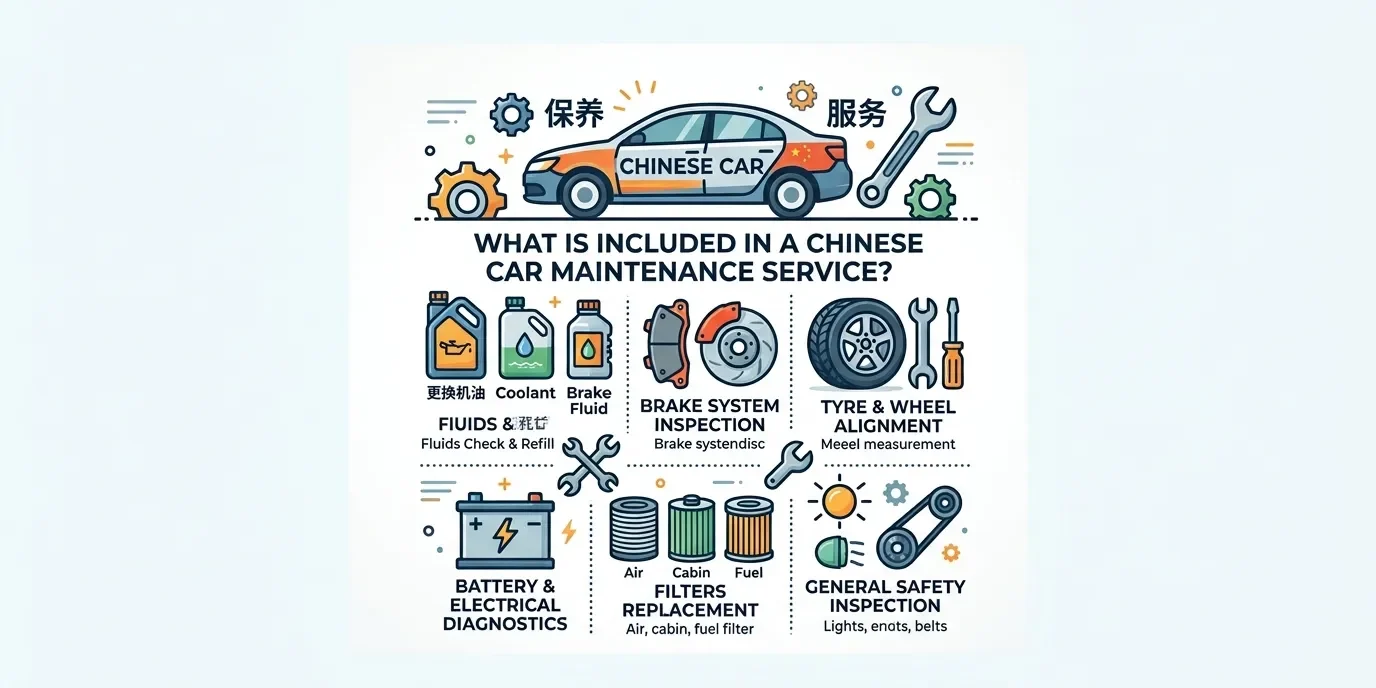
What Is Included in a Complete Chinese Car Maintenance Service?
A complete service involves inspecting several systems, replacing scheduled maintenance items, and checking for developing faults. However, not every component needs replacement during every visit.
Here is what a qualified car garage should examine.
1. Engine Oil and Oil Filter Replacement
For petrol-powered and combustion-engine hybrid Chinese cars, engine oil replacement is one of the most important maintenance tasks.
Engine oil lubricates moving components, reduces friction, and helps control engine wear. Over time, oil becomes contaminated and loses some of its protective properties.
During an oil service, a technician drains the old oil, installs a suitable oil filter, and adds new engine oil that meets the manufacturer’s required specifications.
Using the correct oil is especially important in modern turbocharged engines found in many Chinese vehicles.
Expert tip: Never choose engine oil based only on viscosity or price. Always confirm the required oil grade, performance specification, and manufacturer approval for your exact engine.
2. Air Filter and Cabin Filter Inspection
Air filters help prevent dust and dirt from entering the engine. In Dubai, airborne sand and construction dust can cause filters to become dirty faster than expected.
A restricted engine air filter may affect engine performance and fuel efficiency. During maintenance, the technician checks the filter and replaces it when necessary.
The cabin air filter is equally important. It helps capture dust and airborne particles before they enter the passenger compartment through the ventilation system.
If your AC airflow has become weak or a dusty smell comes from the vents, the cabin filter should be inspected.
3. Engine Cooling System Inspection
A healthy cooling system is essential for driving in Dubai, especially during the hottest months.
During a Chinese car maintenance service, technicians check the radiator, cooling fans, coolant reservoir, hoses, connections, and visible signs of leakage.
They also check the coolant level and condition. If a coolant replacement is due, the correct manufacturer-approved coolant must be used.
An engine that frequently overheats may have a faulty thermostat, cooling fan, water pump, radiator, or coolant leak.
Important: Never open a hot radiator or pressurised coolant reservoir. If the temperature warning light appears, stop safely, switch off the engine, and arrange professional assistance.
4. Brake System Inspection and Maintenance
Your car’s braking system is one of its most important safety features.
A standard service should include checking the brake pads, brake discs, calipers, brake hoses, and brake fluid condition.
Technicians look for uneven pad wear, damaged discs, fluid leaks, and signs that the brakes are not operating correctly.
Common warning signs include squeaking, grinding, vibration while braking, or a brake pedal that feels unusually soft.
Brake pads and discs do not require replacement at every service. They should be replaced when their measured condition falls outside safe or manufacturer-specified limits.
5. Tyre Inspection, Pressure and Wheel Alignment
Tyres experience significant stress during Dubai’s summer months.
During a maintenance visit, the garage checks tyre pressure, tread depth, sidewall damage, uneven wear, and overall tyre condition.
Tyre pressure should be checked when the tyres are cold and adjusted according to the vehicle’s recommended pressure label.
Uneven tread wear or a steering wheel that pulls to one side may indicate an alignment or suspension problem.
Wheel balancing and alignment are separate services that may be recommended when inspection results or driving symptoms justify them.
6. Transmission and Gearbox Inspection
Many Chinese vehicles use automatic transmissions, continuously variable transmissions (CVTs), or dual-clutch transmissions (DCTs).
These systems have different fluid specifications and service requirements.
A technician checks for transmission leaks, unusual noises, harsh gear changes, delayed engagement, and relevant diagnostic fault codes.
Transmission fluid replacement may be required at specific mileage or time intervals, depending on the model.
Using the wrong transmission fluid can damage internal components. For this reason, a professional garage should confirm the gearbox type and manufacturer specifications before carrying out a fluid change.
7. Suspension and Steering System Check
Dubai’s speed bumps, uneven road surfaces, and daily driving can contribute to suspension wear.
During servicing, technicians inspect shock absorbers, suspension bushings, ball joints, control arms, steering joints, and other accessible components.
Damaged suspension parts may cause knocking sounds, uneven tyre wear, poor handling, or excessive movement over bumps.
A proper inspection helps identify whether the issue comes from suspension wear, wheel alignment, or another component.
Replacing the correct faulty part is more effective than changing several suspension components without a confirmed diagnosis.
8. Battery and Electrical System Inspection
Modern Chinese vehicles depend heavily on electronic systems, sensors, and control modules.
A routine maintenance visit may include testing the 12V battery, checking charging performance on applicable petrol vehicles, and inspecting accessible electrical connections.
Technicians should also investigate battery warning lights, starting problems, and intermittent electronic faults.
Depending on the model, additional checks may cover parking sensors, cameras, lighting systems, electronic parking brakes, and safety-related electronics.
A weak 12V battery can cause unexpected electrical issues, even when the engine and other mechanical components are functioning correctly.
9. Air Conditioning System Inspection
Air conditioning is essential for comfortable driving in Dubai.
A Chinese car AC inspection should include checking cabin cooling performance, airflow, compressor operation, and accessible components for signs of damage or refrigerant leakage.
If the AC blows warm air, the problem may involve low refrigerant caused by a leak, a faulty compressor, poor condenser airflow, or an electrical fault.
Simply adding refrigerant is not always the correct repair.
A qualified technician should identify the cause before recommending an AC recharge or component replacement.
10. Computer Diagnostics and Software Checks
Modern Chinese cars contain electronic control units that manage engine performance, transmission operation, braking, and other vehicle functions.
During a diagnostic inspection, technicians connect a compatible scanning tool to the vehicle and check for stored fault codes.
These codes can help identify problems involving sensors, ignition systems, emissions controls, or electronic components.
However, a fault code does not automatically mean that a particular part must be replaced. Proper diagnosis may require live-data checks, electrical testing, and physical inspection.
Software updates should only be performed when appropriate, using compatible equipment and approved procedures.
11. Spark Plugs, Belts and Fuel System Checks
Petrol-powered Chinese vehicles may also require spark plug replacement, drive belt inspection, and fuel system checks.
Worn spark plugs can contribute to rough idling, misfires, and poor engine performance.
Technicians also inspect accessible belts and hoses for cracks, damage, or other signs of deterioration.
Fuel injector cleaning should not automatically be included in every service. It is most useful when inspection or diagnostic results indicate a genuine fuel delivery problem.
Timing belts, where fitted, should be replaced according to the manufacturer’s schedule rather than simply because the vehicle is receiving a major service.
What Is the Difference Between Minor and Major Chinese Car Service?
Chinese car service packages are commonly divided into minor and major maintenance.
| Minor Car Service | Major Car Service |
|---|---|
| Engine oil and filter change, where applicable | Minor service items plus additional scheduled maintenance |
| Fluid level and condition checks | More detailed fluid inspection and scheduled replacements |
| Basic brake and tyre inspection | Comprehensive brake, tyre, and suspension checks |
| Air and cabin filter inspection | Filter replacements when due |
| Battery and lighting checks | Additional electrical and diagnostic checks |
| Basic safety inspection | Spark plugs, transmission fluid, coolant, or other items when scheduled |
A minor Chinese car service focuses on routine maintenance and essential safety checks.
A major Chinese car service is more comprehensive and can include replacement of additional fluids, filters, or components according to the manufacturer’s maintenance schedule.
However, a major service does not automatically mean an engine overhaul, gearbox repair, or replacement of every fluid. These jobs should only be performed when they are scheduled or genuinely necessary.
Before approving a package, ask the garage for a detailed list of included services.
How Is Hybrid and Electric Chinese Car Maintenance Different?
Chinese electric and hybrid vehicles need a different approach from conventional petrol cars.
Fully electric models, including many BYD vehicles and the MG4 EV, do not require engine oil changes or spark plug replacement.
Instead, electric vehicle maintenance focuses on battery-related diagnostics, thermal management, braking systems, tyres, cabin filters, and other scheduled checks.
Hybrid vehicles require maintenance for both their combustion engine and electrical systems. Some also have separate cooling circuits and specialised transmission components.
High-voltage battery systems must only be inspected or repaired by technicians with the necessary EV training, equipment, and safety procedures.
Owners should never attempt to disconnect or repair orange high-voltage cables.
How Often Should You Service a Chinese Car in Dubai?
The correct Chinese car service interval depends on the manufacturer, model, model year, drivetrain, and operating conditions.
For example, MG UAE lists general service intervals of 10,000 km or six months for petrol, conventional hybrid, and plug-in hybrid vehicles. Its fully electric vehicles have a general interval of 25,000 km or 12 months.
BYD UAE provides different recommendations, including an initial service for its electric vehicles at around one year or 20,000 km and more frequent maintenance for plug-in hybrids.
These are manufacturer examples, not universal rules for every Chinese car.
Always follow the maintenance schedule for your specific vehicle, using whichever limit comes first: mileage or time.
Heavy traffic, dusty environments, repeated short journeys, and other severe operating conditions may require additional inspections or shorter maintenance intervals when the manufacturer recommends them.
How Much Does Chinese Car Maintenance Cost in Dubai?
The cost of Chinese car servicing in Dubai depends on the work required rather than the country where the vehicle was manufactured.
A routine oil and filter service generally costs less than maintenance involving spark plugs, transmission fluid, coolant replacement, or additional repairs.
The final price depends on the vehicle model, labour requirements, fluid specifications, spare parts, and diagnostic work.
A transparent garage should provide an itemised estimate showing the cost of labour, replacement parts, fluids, and any recommended additional work.
Before accepting a service package, confirm whether diagnostics, filters, fluids, and VAT are included in the quoted price.
Signs Your Chinese Car Needs Immediate Inspection
You should not always wait for the next scheduled service, especially when your vehicle starts behaving differently.
Important warning signs include unusual engine noises, overheating, weak air conditioning, rough idling, fluid leaks, brake vibration, difficulty starting, and sudden changes in transmission performance.
A dashboard warning light may also indicate a problem that requires diagnosis.
If the vehicle shows a red oil pressure warning, serious overheating warning, or a critical braking fault, stop in a safe location and seek professional assistance instead of continuing to drive.
Early inspection often prevents a small problem from developing into a more expensive repair.
How to Choose the Right Chinese Car Garage in Dubai
Not every garage has the equipment or technical information needed for every Chinese vehicle.
Before booking, check whether the workshop can identify the correct maintenance schedule, obtain compatible parts, and perform the diagnostic work required for your particular model.
A reliable workshop should explain which repairs are necessary, provide an itemised quotation, and obtain your approval before completing additional work.
It should also document replaced parts and provide a service record after the job is finished.
For vehicles under warranty, check the manufacturer’s service requirements and warranty conditions. Some repairs, software procedures, and high-voltage system work may need to be handled by an authorised service centre.
Chinese Car Maintenance in Dubai at Car Repair Auto Services
Routine maintenance should help you understand your car’s condition, not leave you confused about unnecessary repairs.
If your Chinese vehicle is due for servicing, Car Repair Auto Services in Dubai is a name to consider when arranging a maintenance inspection or discussing your vehicle’s service requirements.
Whether you own an MG, Geely, Chery, Haval, Changan, Jetour, or BYD, the important first step is identifying the correct service requirements for your exact model.
When requesting a quotation, share your vehicle’s make, model, year, mileage, engine type, and any warning lights or symptoms.
This information helps determine which inspections, maintenance procedures, and replacement parts may be needed.
Frequently Asked Questions About Chinese Car Maintenance Service
1. What is included in a Chinese Car Maintenance Service?
A Chinese Car Maintenance Service typically includes oil and filter replacement where applicable, brake inspection, tyre checks, fluid inspections, battery testing, air conditioning checks, suspension inspection, and computer diagnostics. Additional maintenance depends on the vehicle’s mileage, drivetrain, condition, and manufacturer service schedule.
2. How often should Chinese cars be serviced in Dubai?
Chinese car service intervals vary by model and manufacturer. Some petrol and hybrid vehicles require maintenance every 10,000 km or six months, while certain electric models have longer intervals. Always follow your owner’s manual and arrange additional inspections when severe driving conditions or warning symptoms justify them.
3. Is Chinese car maintenance expensive in Dubai?
Chinese car maintenance costs depend on the vehicle, service type, required parts, and labour. Routine servicing is usually less expensive than major scheduled maintenance or repairs. Request a written quotation from a qualified garage to understand the full cost before approving the work.
4. Do Chinese electric cars need regular maintenance?
Yes. Chinese electric cars need periodic inspections of brakes, tyres, cooling systems, electrical components, and battery-related systems. They generally do not require engine oil changes, but they still need model-specific scheduled servicing to maintain safety and reliability.
5. Can an independent garage service a Chinese car under warranty?
An independent garage may perform some routine maintenance, but warranty requirements differ by manufacturer and market. Before booking, check the vehicle’s warranty terms, required service documentation, approved parts specifications, and whether particular repairs must be performed at an authorised service centre.
Conclusion
A professional Chinese Car Maintenance Service is essential for keeping your vehicle safe, dependable, and comfortable on Dubai’s roads.
From engine oil and filters to brakes, cooling systems, air conditioning, and advanced diagnostics, every inspection plays a role in preventing unexpected problems.
The most important point is that maintenance should match your vehicle’s actual requirements. Petrol, hybrid, and electric Chinese cars do not all need the same service procedures.
Looking for Chinese car maintenance in Dubai? Contact Car Repair Auto Services to discuss your vehicle’s condition, ask about a suitable inspection, and request a clear maintenance quotation before booking.