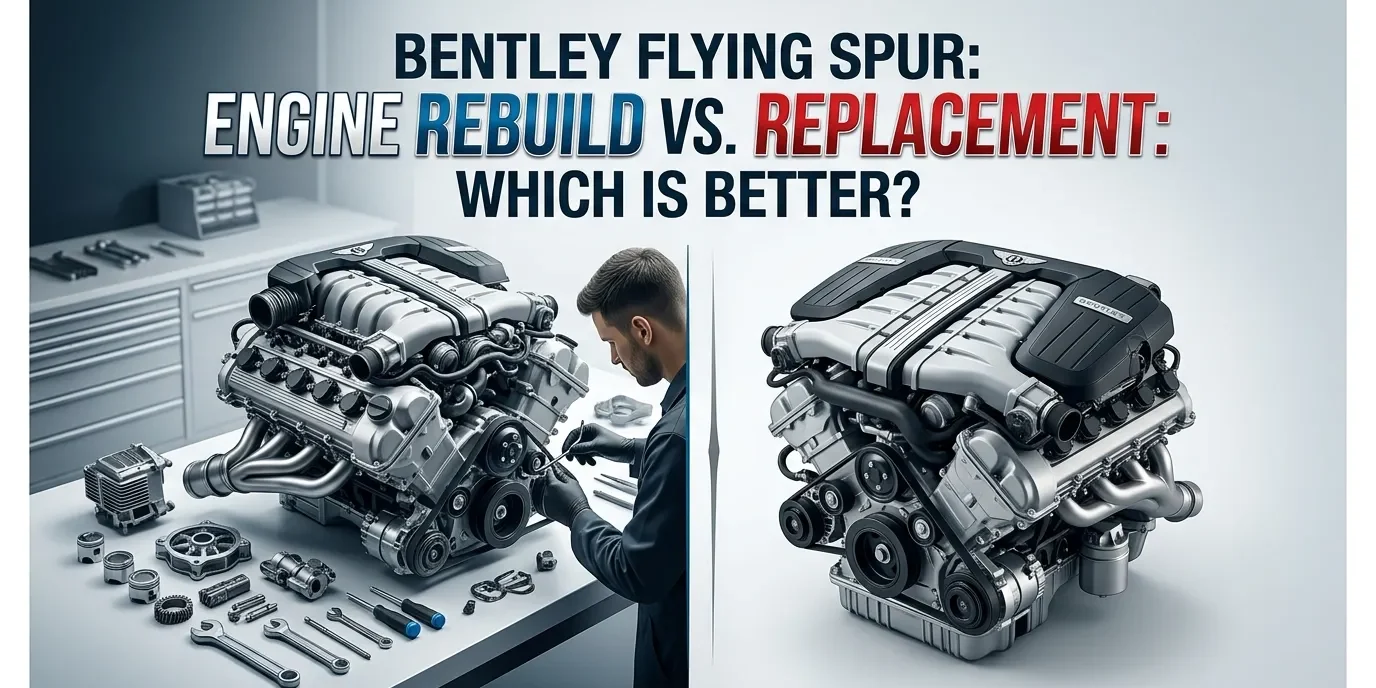
A Bentley Flying Spur is built for exceptional performance, but even a luxury engine can develop serious mechanical problems. When your car starts knocking, overheating, losing power, or consuming too much oil, you may face an expensive decision. Should you rebuild the existing engine or replace it entirely?
For Bentley owners in Dubai, choosing the wrong option can lead to unnecessary expenses and recurring mechanical problems. A Bentley Flying Spur engine rebuild can restore performance when the original engine remains repairable, while replacement may be a better solution for extensive internal damage.
This guide explains both options, their costs, benefits, risks, and how to choose the right solution for your Bentley.
Bentley Flying Spur Engine Rebuild vs. Replacement: Quick Answer
Rebuilding a Bentley Flying Spur engine is generally the better choice when the engine block, crankshaft, and other major components are still serviceable. Engine replacement is usually more practical when severe damage makes rebuilding technically difficult or excessively expensive.
However, neither option should be recommended without a proper mechanical inspection. The best decision depends on the engine’s condition, repair cost, replacement availability, and how long you plan to keep the vehicle.
Understanding the Bentley Flying Spur Engine
The Bentley Flying Spur uses sophisticated powertrains designed to deliver strong acceleration, smooth operation, and excellent driving comfort.
Depending on the model year and specification, a Flying Spur may have a 6.0-litre twin-turbocharged W12, a 4.0-litre twin-turbocharged V8, or a hybrid powertrain.
Earlier Flying Spur Hybrid models combined a 2.9-litre V6 petrol engine with an electric motor. Newer versions use advanced 4.0-litre V8 hybrid technology.
Bentley officially ended W12 engine production in July 2024, making engine condition, component availability, and correct parts identification especially important for owners of W12-powered vehicles.
These engines differ in construction, components, electronic controls, and repair requirements. A rebuild suitable for an older V8 may not be practical for a heavily damaged W12 or a newer hybrid powertrain.
That is why a Bentley engine specialist should identify the exact engine code and vehicle specification before recommending major mechanical work.
What Is a Bentley Flying Spur Engine Rebuild?
A Bentley Flying Spur engine rebuild involves dismantling the existing engine, inspecting its internal components, replacing damaged or worn parts, and assembling it according to the correct technical specifications.
Unlike a minor engine repair, a complete rebuild addresses internal mechanical wear and restores the engine using reusable major components.
Depending on the damage, the rebuild may involve piston rings, pistons, crankshaft bearings, cylinder head components, gaskets, seals, and timing components.
Cylinder bores, crankshaft journals, and other precision surfaces must be measured before deciding whether machining or replacement is possible.
How Does the Engine Rebuilding Process Work?
A professional engine rebuilding process begins with identifying the original fault. Simply installing new parts without finding the reason for engine failure can result in the same problem returning.
The engine is then dismantled and inspected for wear, overheating damage, cracks, and internal contamination.
During reassembly, technicians must follow the correct tightening procedures, component clearances, timing settings, and manufacturer specifications.
The completed engine also requires oil pressure verification, leak checks, electronic diagnostics, and controlled performance testing.
A properly planned rebuild should address the cause of failure, not just the damaged components.
What Is a Bentley Flying Spur Engine Replacement?
Engine replacement means removing the damaged engine and installing another compatible engine assembly.
Unlike rebuilding, this approach does not depend on repairing every damaged internal component of the original engine.
There are three main replacement options.
Used Engine
A used Bentley Flying Spur engine comes from another vehicle. It can be an economical choice if the unit has a verifiable history, suitable mileage, and documented condition.
However, low mileage alone does not guarantee reliability. An engine may have hidden wear, overheating damage, or poor maintenance history.
Reconditioned or Remanufactured Engine
A reconditioned engine has undergone some level of repair or refurbishment. A properly remanufactured engine is generally rebuilt through a more extensive process involving component inspection, replacement, and testing to defined standards.
Because suppliers use these terms differently, always request written details of the work completed.
New Engine
A new engine may offer the clearest component history, but availability and cost can make it impractical for some Flying Spur models.
The exact part number, powertrain configuration, and manufacturer support must be confirmed before placing an order.
Bentley Flying Spur Engine Rebuild vs. Replacement: Key Differences
| Comparison | Engine Rebuild | Engine Replacement |
|---|---|---|
| Original engine | Retained | Replaced |
| Best suited for | Repairable internal damage | Severe or uneconomical damage |
| Initial cost | Often lower if major parts are reusable | Depends heavily on engine source |
| Repair time | Can be longer due to machining | May be quicker if a compatible unit is available |
| Reliability | Depends on rebuilding quality | Depends on replacement condition and quality |
| Hidden risks | Additional damage found during dismantling | Unknown history of a used engine |
| Parts availability | Internal parts and machining required | Complete compatible engine required |
| Warranty | Depends on workshop terms | Depends on engine supplier and installer |
Neither solution automatically guarantees better reliability. A carefully rebuilt original engine may outperform a poorly maintained used replacement.
Similarly, a verified remanufactured engine may be a better investment than rebuilding an engine with extensive internal damage.
Signs Your Bentley Flying Spur May Need Major Engine Work
Not every engine warning means you need a complete rebuild. However, certain symptoms should never be ignored.
Excessive engine oil consumption: Frequent oil top-ups may indicate worn piston rings, internal wear, or problems with the crankcase ventilation or turbocharging system.
Engine knocking or metallic sounds: Deep knocking noises can indicate bearing damage or other serious mechanical problems. Continuing to drive may cause additional damage.
Blue or white exhaust smoke: Persistent blue smoke may indicate oil burning. White exhaust vapour that continues after warm-up can indicate coolant entering the combustion chambers, although further testing is necessary.
Repeated engine overheating: Overheating can damage cylinder heads, gaskets, and internal engine components. Severe overheating may also distort precision surfaces.
Loss of power and rough idling: Poor acceleration, vibration, and misfiring may result from compression loss. However, faulty ignition coils, injectors, sensors, or turbocharger components can produce similar symptoms.
Low engine oil pressure: Persistently low oil pressure is particularly serious because it can damage bearings and other lubricated components.
If your Bentley displays a red oil pressure warning, severe overheating warning, or heavy knocking, stop driving when it is safe and arrange vehicle recovery.
Why Engine Diagnostics Must Come Before Rebuilding or Replacement
One of the most expensive mistakes a Bentley owner can make is approving a complete engine rebuild based only on a dashboard warning light.
Fault codes provide useful information, but they do not always identify the underlying mechanical failure.
Before recommending major engine work, a qualified garage should perform the relevant diagnostic checks.
- Computer diagnostics: Read fault codes, freeze-frame data, and live engine parameters using suitable Bentley-compatible equipment.
- Compression testing: Check cylinder sealing performance and identify uneven compression readings.
- Cylinder leak-down testing: Determine whether compression is escaping through valves, piston rings, or the cooling system.
- Borescope inspection: Examine accessible internal cylinder surfaces for scoring, damage, or unusual deposits.
- Oil pressure and contamination checks: Investigate lubrication problems, metallic particles, and possible bearing wear.
- Cooling system inspection: Test for leaks, coolant pressure loss, and evidence of overheating.
Not every vehicle needs all these tests. The diagnostic process should follow the symptoms and the manufacturer’s procedures.
When the results indicate internal damage, a partial dismantling inspection may be necessary to confirm the full repair scope.
Bentley Flying Spur Engine Rebuild Cost in Dubai
The cost of rebuilding a Bentley Flying Spur engine in Dubai depends on its engine type, the severity of damage, and the availability of replacement components.
Published Dubai workshop pricing guides provide broad planning figures for Bentley engine work.
| Engine service | Indicative cost in Dubai |
|---|---|
| Bentley engine rebuild | AED 23,100 to AED 57,750 |
| Bentley engine replacement | AED 36,750 to AED 94,500+ |
These figures are illustrative published Bentley workshop estimates, not verified market averages or quotations from Car Repair Auto Services. A Flying Spur W12, V8, or hybrid repair may cost less or significantly more depending on the work required.
Several factors can change the final bill.
Engine configuration: A W12 rebuild generally requires more extensive component handling and specialised work than many conventional engines.
Extent of damage: Replacing worn bearings is different from repairing damaged cylinder walls, distorted heads, and a severely worn crankshaft.
Parts availability: Genuine Bentley parts, suitable original-equipment components, and replacement engine assemblies can vary significantly in price and delivery time.
Machine work: Cylinder measurement, precision machining, and cylinder head inspection add to rebuilding costs.
Labour and installation: Engine removal, dismantling, assembly, electronic setup, and final testing all affect the total.
Before approving a rebuild, request an itemised quotation covering parts, labour, machining, installation, fluids, testing, and applicable VAT.
Also ask which additional findings could increase the cost after dismantling.
When Is Rebuilding a Bentley Flying Spur Engine the Better Choice?
An engine rebuild is worth considering when the main structure of the original engine remains in good condition.
For example, imagine a Flying Spur V8 with verified internal wear and excessive oil consumption. If inspection shows that the cylinder block and crankshaft can be reused within specification, rebuilding may restore reliable operation without purchasing a complete replacement engine.
Rebuilding can also be attractive when the car has a documented service history and the owner wants to retain the original engine.
This may be especially relevant for a well-maintained W12 model, provided the necessary internal components and specialist machining services are available.
However, retaining the original engine is only beneficial when the repair can be completed to the required mechanical standards.
Rebuilding a severely damaged engine simply to keep its original components can become more expensive than replacing it.
When Is Engine Replacement the Better Option?
Engine replacement becomes more attractive when repairing the original engine is technically impractical or financially unreasonable.
Consider a Flying Spur that has suffered severe overheating followed by extensive internal damage. If the engine block, cylinder heads, crankshaft, and several additional components require replacement, the rebuilding cost may approach or exceed the price of a suitable engine assembly.
In this situation, a compatible remanufactured or properly inspected replacement engine may offer better value.
Replacement can also make sense when rebuilding parts are unavailable or the required specialist machining would cause a lengthy delay.
The most important factor is compatibility.
A replacement engine must match the vehicle’s mechanical configuration, engine management requirements, emissions equipment, and relevant drivetrain components.
Installing an engine from a different Flying Spur generation is not necessarily a straightforward swap, even if both units have the same cylinder configuration.
How Dubai’s Climate Affects Bentley Engine Reliability
Dubai’s high temperatures, heavy traffic, and dusty conditions can increase the demands placed on a vehicle’s cooling, lubrication, and filtration systems.
The climate does not automatically cause engine failure. However, existing cooling or lubrication problems may become more serious when a car operates under sustained heat.
For example, a partially blocked radiator or weak cooling fan may cause temperature problems during slow traffic, even if the vehicle appears to operate normally during shorter journeys.
Likewise, a neglected air filter can allow dust-related intake problems to develop if filtration performance deteriorates.
Before completing any Bentley Flying Spur engine rebuild or replacement in Dubai, the workshop should inspect related systems, particularly the cooling system, radiator, coolant hoses, water pump, engine oil circuit, and applicable turbocharger oil supply components.
Otherwise, the original fault may damage the rebuilt or replacement engine again.
Special Considerations for Bentley Flying Spur W12 and Hybrid Engines
Rebuilding a Bentley W12 Engine
The Bentley W12 is a compact, complex 12-cylinder engine requiring precise mechanical work.
Since Bentley ended W12 production in 2024, sourcing particular engine assemblies and internal parts may require additional planning.
A specialist should confirm parts availability, cylinder condition, crankshaft measurements, and the full repair procedure before committing to a rebuild.
For owners who value retaining their original W12 powertrain, a high-quality rebuild may be attractive when the engine remains structurally repairable.
Replacing an Engine in a Hybrid Flying Spur
Hybrid Flying Spur models require additional safety and compatibility checks.
The petrol engine operates as part of a powertrain that also includes high-voltage electrical components and sophisticated control systems.
Mechanical engine replacement must therefore be coordinated with the appropriate hybrid safety procedures, electronic configuration, and diagnostic checks.
High-voltage systems should only be handled by appropriately trained and equipped personnel.
A replacement petrol engine alone will not resolve a fault originating in the hybrid battery, electric drive components, or related control systems.
Common Mistakes to Avoid During Bentley Engine Repair
The first mistake is replacing major components without identifying the cause of failure.
A second mistake is choosing a replacement engine based only on price. A cheap used engine with no verifiable history can become expensive once installation, hidden damage, and additional repairs are considered.
Another common oversight is ignoring components connected to the original failure. For instance, after a serious bearing failure, contaminated oil passages, oil coolers, and related lubrication components may require inspection or replacement.
The same principle applies to cooling systems following overheating.
Finally, never assume that a rebuilt or replacement engine comes with a comprehensive warranty. Some warranties cover only the engine assembly, while others may include certain labour costs.
Always read the coverage, exclusions, claim conditions, and maintenance requirements before approving the work.
Does an Engine Rebuild or Replacement Affect Bentley Resale Value?
Both repairs can affect a vehicle’s resale value, but their impact depends heavily on the quality of the work and the available documentation.
A properly documented rebuild may reassure a future buyer that an identified mechanical fault was repaired.
A replacement engine can also be acceptable when its origin, compatibility, condition, and installation are clearly recorded.
For a premium vehicle such as the Flying Spur, buyers may want evidence of the engine’s history, inspection results, invoices, and warranty coverage.
Where an engine change affects registered vehicle details, confirm the relevant documentation and technical inspection requirements with Dubai’s Roads and Transport Authority.
Keeping complete records helps avoid unnecessary questions during resale.
How to Choose the Right Bentley Engine Repair Garage in Dubai
The garage you choose is just as important as the engine repair option itself.
A workshop should be able to explain the fault, provide supporting diagnostic evidence, and compare rebuilding with replacement based on the actual condition of your vehicle.
Ask how the team will verify internal measurements, source compatible components, test the completed engine, and prevent the original failure from recurring.
You should also receive clear information about expected turnaround time, additional repair approvals, and warranty terms.
At Car Repair Auto Services, Bentley Flying Spur owners can enquire about engine diagnosis and discuss the most suitable repair approach for their vehicle.
The goal should be to identify a technically sound solution before committing to major engine work.
Final Verdict: Is It Better to Rebuild or Replace a Bentley Flying Spur Engine?
There is no single answer that applies to every Bentley Flying Spur.
Rebuilding is generally preferable when major engine components remain serviceable and the work can be completed reliably at a reasonable cost. Replacement becomes a stronger option when structural damage is severe, repair parts are unavailable, or rebuilding is no longer economical.
For Dubai owners, the smartest decision starts with accurate diagnostics, a clear comparison of the total costs, and an experienced workshop that understands Bentley’s complex powertrains.
If your Flying Spur is showing signs of engine trouble, contact Car Repair Auto Services to discuss a professional inspection and compare your repair options before making an expensive decision.
Frequently Asked Questions
1. Is it worth rebuilding a Bentley Flying Spur engine?
Yes, rebuilding can be worthwhile when the original engine block, crankshaft, and other major components are in repairable condition. A quality rebuild can restore reliable operation while retaining the original engine. However, the final decision should depend on mechanical inspection results, total repair cost, parts availability, and vehicle value.
2. How much does a Bentley Flying Spur engine rebuild cost in Dubai?
Published Dubai workshop estimates for Bentley engine rebuilding can range from approximately AED 23,100 to AED 57,750, but this is not a fixed Flying Spur price. The actual cost depends on whether the vehicle has a W12, V8, or hybrid powertrain, the extent of internal damage, and the parts required.
3. How long does a Bentley engine rebuild take?
A complete Bentley engine rebuild may take several days to multiple weeks, depending on dismantling requirements, machining, replacement parts, and final testing. Engine replacement may take less workshop time when a fully compatible unit is already available, although sourcing delays can make the overall process longer.
4. Is a rebuilt Bentley engine as reliable as a replacement engine?
A properly rebuilt engine can provide dependable performance when its components meet the required specifications and the original failure has been corrected. A replacement engine is not automatically more reliable, especially if it is used and has an uncertain history. Workmanship, component quality, testing, and maintenance are essential for both options.
5. Can I drive my Bentley Flying Spur with engine knocking or overheating?
Driving with severe engine knocking, low oil pressure, or repeated overheating can cause additional damage. Stop the vehicle safely, switch off the engine when appropriate, and arrange professional assistance. Continuing to drive can turn a repairable problem into a much more expensive engine failure.