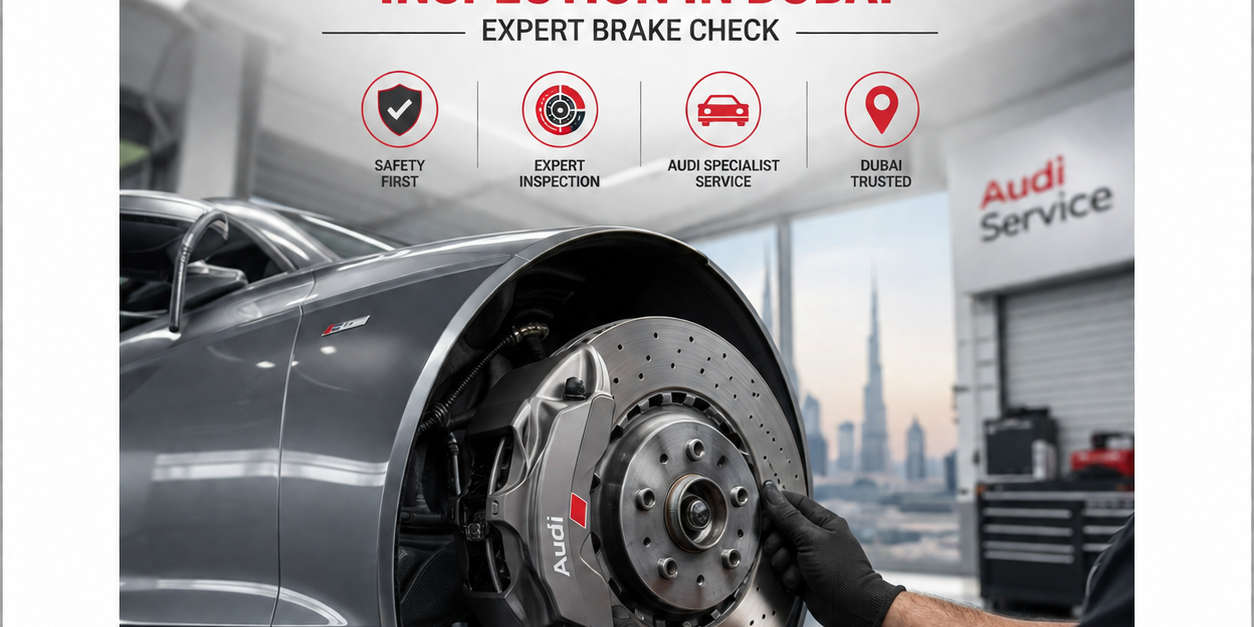
An Audi brake inspection in Dubai should happen every 10,000 to 15,000 km, or every six months, whichever comes first. Dubai’s heat, stop-start traffic, and sandy roads wear down brake pads and fluid faster than in cooler climates. A certified garage checks pad thickness, rotor condition, brake fluid quality, and the ABS system to confirm your Audi stops safely.
If you drive an Audi in Dubai, you already know this city is tough on cars. Between the heat radiating off Sheikh Zayed Road and the constant stop-start crawl through Al Quoz and Business Bay, your brakes work harder here than almost anywhere else in the world. Most owners don’t think about their brakes until they hear a squeal or feel a shudder through the pedal, and by then, the problem has usually been building for weeks.
In this guide, we’ll walk you through everything you need to know about Audi car brakes inspection in Dubai, based on what we actually see on the lift every week. You’ll learn how often to check your brakes, what a proper inspection covers, the warning signs to watch for, and roughly what a brake job costs here. No jargon, no upselling, just the facts a good mechanic would tell a friend.
Why Audi Brakes Wear Out Faster in Dubai
Audis are built for German autobahns and cool European winters, not 45 degree summer afternoons on the E11. That mismatch matters more than most owners realise.
Brake pads generate friction, and friction generates heat. In Dubai, your brake components are already starting from a hotter baseline because the ambient temperature is high and the tarmac itself radiates heat back up into the wheel wells. Add heavy traffic on roads like Al Khail Road or near Mall of the Emirates, and your pads are constantly heating and cooling in short cycles. That thermal stress breaks down pad material and brake fluid much quicker than manufacturer estimates, which are usually based on European or American driving conditions.
Sand and dust are the other factor. Fine desert sand works its way into brake calipers and rotors, acting almost like sandpaper every time you brake. Over months, this speeds up rotor wear and can cause uneven pad contact, which shows up as vibration or pulling to one side.
We’ve serviced enough Audi A4, A6, Q5, and Q7 models in Al Quoz to say this with confidence: a brake system that would last 25,000 km in Germany often needs attention closer to 15,000 km here.
How Often Should You Get Your Audi Brakes Inspected in Dubai?
Direct answer: Get your Audi brakes inspected every 10,000 to 15,000 km, or at least twice a year, even if there are no obvious warning signs. If you regularly drive in heavy traffic, tow, or use Sport mode often, inspect closer to the 10,000 km mark.
Audi’s onboard system uses electronic wear sensors on many models, and the dashboard will eventually flag a warning. The problem is that this warning often appears only when pads are already close to the metal backing plate. Waiting for the dashboard light is like waiting for a headache to check your blood pressure. It works, but it’s not proactive.
A visual and physical inspection catches problems the sensor can’t. Rotor scoring, brake fluid contamination, and caliper sticking rarely trigger a dashboard alert until they’ve caused real damage.
Signs Your Audi Needs a Brake Inspection
Some symptoms are obvious, others are subtle. Here’s what our technicians tell customers to watch for:
- Squealing or grinding noise when braking, especially at low speed
- Vibration or pulsing through the brake pedal or steering wheel
- Longer stopping distance than you remember, even on dry roads
- Brake pedal feels soft or spongy, sinking further than usual before engaging
- Car pulls to one side under braking
- Dashboard brake warning light illuminated
- Burning smell after driving, particularly downhill or in heavy traffic
If you notice even one of these, it’s worth booking an inspection within the week rather than waiting for your next scheduled service. Brakes are not a part you want to gamble on, especially on fast-moving roads like Sheikh Zayed Road.
What Happens During a Professional Audi Brake Inspection
A proper inspection is more than a quick glance at the pads. Here’s the process our technicians follow on every Audi that comes through the workshop:
- Visual check of pad thickness on all four wheels, comparing front and rear wear patterns
- Rotor inspection for scoring, cracking, warping, or uneven surface wear
- Caliper function test to confirm pistons move freely and aren’t sticking
- Brake fluid test using a moisture meter, since fluid absorbs water over time and lowers its boiling point
- Brake line and hose check for leaks, cracks, or corrosion
- ABS and electronic parking brake diagnostic scan using Audi-specific software
- Road test to confirm pedal feel, stopping performance, and absence of vibration or pulling
This full check usually takes 30 to 45 minutes. If everything is within spec, you get a written report showing remaining pad and rotor life. If something needs attention, we explain it clearly, with photos, before doing any work.
Common Audi Brake Problems We See in Dubai Garages
After years of working on Audis across the emirate, a few patterns come up again and again.
Rear brake wear on Quattro models. Because Audi’s all-wheel-drive system distributes braking force differently than front-wheel-drive cars, rear pads on Q5 and Q7 models sometimes wear faster than owners expect. Many drivers assume the front brakes take all the load, so rear inspections get skipped.
Brake fluid degradation from heat. We regularly test fluid that’s absorbed enough moisture to lower its boiling point well below Audi’s spec, even in cars under two years old. In extreme heat, degraded fluid can lead to a spongy pedal or, in rare cases, brake fade during hard braking.
Rotor warping from stop-start traffic. Sitting in traffic on Al Ittihad Road with brakes lightly applied, then suddenly braking hard, creates uneven heat spread across the rotor. Over time this causes warping, which owners feel as pulsing through the pedal.
Squeaking that isn’t a real problem. Not every noise means danger. Sometimes it’s just brake dust or a wear indicator doing its job. This is exactly why a trained eye matters more than guessing based on sound alone.
Audi Brake Pad Replacement Cost in Dubai
Direct answer: Audi brake pad replacement in Dubai typically costs between AED 400 and AED 1,200 per axle, depending on the model, whether you choose OEM or quality aftermarket pads, and whether rotors also need replacement. A full front and rear brake job with rotors can range from AED 1,500 to AED 3,500.
Dealership pricing for the same work often runs 30 to 50 percent higher, mainly due to overhead costs rather than better parts or labour quality. A specialist garage that focuses on German and luxury vehicles can use the same grade of components at a fairer price, without cutting corners on the actual mechanical work.
OEM vs Aftermarket Brake Pads for Audi: Which Is Better?
This is one of the most common questions we get, and the honest answer is that it depends on how you drive.
OEM (Original Equipment Manufacturer) pads match exactly what Audi installed at the factory. They offer predictable performance and are the safer default choice if you want zero guesswork.
Quality aftermarket pads from established brands like Brembo, ATE, or Textar often match or exceed OEM performance, sometimes with better heat resistance for hot climates like Dubai’s. The key word is quality. Cheap, unbranded pads are where problems start, with inconsistent friction, more brake dust, and shorter lifespan.
Our general recommendation: for daily driving in Dubai traffic, a reputable aftermarket pad rated for high temperatures often performs better than standard OEM pads, at a lower cost. For track use or if you simply want factory-exact parts, OEM remains the safer choice.
Mistakes Audi Owners Make With Brake Maintenance
We see the same avoidable mistakes repeated across almost every make, but they’re worth calling out specifically for Audi owners.
- Ignoring the rear brakes because the front ones “feel fine”
- Skipping brake fluid flushes, since fluid doesn’t show visible wear like pads do
- Waiting for the dashboard warning light instead of scheduling inspections proactively
- Assuming a squeak always means urgent danger, or the opposite, assuming it never does
- Choosing the cheapest aftermarket pads without checking the brand’s heat rating
None of these mistakes are about negligence. They come from not knowing what to look for, which is exactly the gap a good inspection habit closes.
Why Choose Car Repair Auto Service for Your Audi Brake Inspection
We’re based in Al Quoz, and Audi is one of the brands we work on most often, alongside Mercedes-Benz, BMW, Land Rover, and other premium marques. Our technicians use Audi-specific diagnostic software rather than generic scan tools, which matters when checking ABS and electronic parking brake systems that are common on newer A6 and Q7 models.
Every inspection comes with a clear, honest report. If your brakes are fine, we tell you that and send you on your way. If something needs work, you’ll see exactly what and why before we touch the car. Alongside brake service, we also handle engine repair and diagnostics, suspension and steering repair, and car electrical repair, since brake performance is often connected to how well these other systems are working.
If you’re searching for a reliable garage near you in Dubai, our workshop is open 24/7, and most brake inspections can be completed the same day. You can also browse our blog and news section for more practical car care guides written by our own technicians.
Frequently Asked Questions
How long do Audi brake pads last in Dubai? Audi brake pads typically last between 20,000 and 40,000 km in Dubai, shorter than the manufacturer’s global estimate due to heat and traffic conditions. Driving style and whether you use Sport mode often also affect lifespan.
Is it safe to drive with a brake warning light on? It’s not recommended. A brake warning light usually means pad thickness has dropped below the safe threshold, and continuing to drive risks rotor damage and longer stopping distances. Book an inspection within a few days.
Can I inspect my Audi brakes myself? You can do a basic visual check by looking through the wheel spokes at pad thickness, but a full inspection requires removing the wheel and testing brake fluid, calipers, and the ABS system, which is best left to a trained technician.
Does Audi brake fluid need to be changed even if the pads are fine? Yes. Brake fluid absorbs moisture over time regardless of pad wear, and Audi recommends flushing it roughly every two years to maintain proper braking performance and prevent internal corrosion.
What’s the difference between brake inspection and brake service? An inspection checks the condition of pads, rotors, fluid, and calipers without necessarily replacing anything. A brake service includes replacing worn components, such as pads or fluid, based on what the inspection finds.
Final Thoughts
Your Audi’s brakes are not a part to leave to chance, especially in a city where heat and traffic push them harder than they were designed for. A regular inspection every 10,000 to 15,000 km catches problems early, keeps repair costs lower, and most importantly, keeps you and everyone on the road around you safe.
If it’s been a while since your last brake check, or you’ve noticed any of the warning signs above, don’t wait for the dashboard to tell you. Book an Audi brake inspection with our team at Car Repair Auto Service in Al Quoz, Dubai. Call us at +971 54 369 7087 or message us on WhatsApp to schedule a same-day check.